
North America's Oldest Fossil Cave Is A Midwest Gem Hidden In The Ozarks
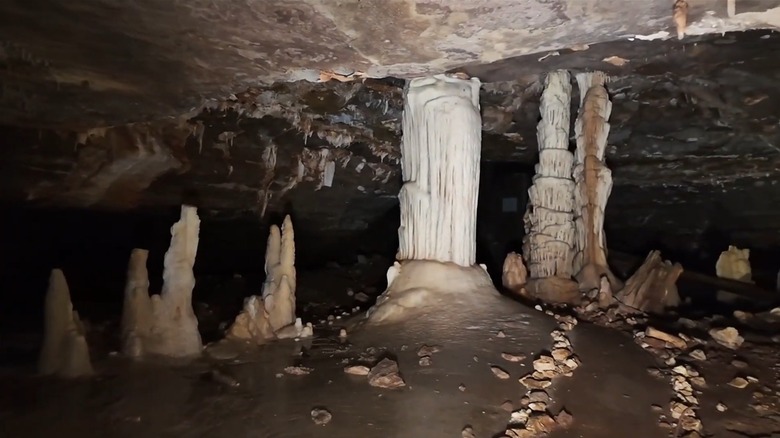
Missouri is one of America's five states with the most caves, with around 7,500. While it may not have as many caves and caverns as Tennessee, the "Cave State" does have something no other state has: the oldest fossil cave in North America. The story of the accidental discovery of Riverbluff Cave is almost as surprising as the fossils themselves.
On September 11, 2001, a crew was blasting out a new road near Springfield when they got the call to stop all detonations immediately, due to the attacks on the World Trade Center. Some of the explosives around a limestone outcrop had already been laid down and couldn't be removed, so they were allowed to be set off. The explosion revealed the top of a cave that had been hidden below the roadbed. The cave, soon named Riverbluff Cave, had never before been seen by humans.
Formed about 1.3 million years ago during the Pleistocene epoch, this cave hidden in the Ozarks was possibly a shelter for a variety of animals. The claw marks of 1,400-pound ancient short-faced bears are on its walls, as are the shells of extinct foot-long tortoises, both atypical in a cave environment. The same can be said for peccaries, a pig-like animal whose tracks were found in Riverbluff Cave. In fact, at the time of discovery, Riverbluff Cave was the only one in the world with known peccary tracks. The bones of a 300-to-400-pound baby mammoth were found in the cave, too, buried under a thick layer of ash from the Yellowstone eruption that it was trying to escape, making Riverbluff Cave a true menagerie of extinct animals.
What to visit around Riverbluff Cave in Missouri
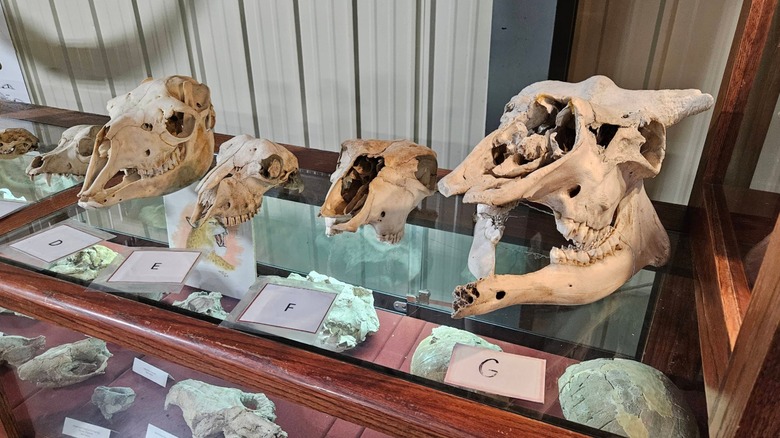
The Riverbluff Cave is located just 20 minutes outside the big flavors and quirky vibes of Springfield, but the cave is closed to the public. It was vandalized after its discovery, as people desecrated a calcite column and destroyed fossils. It's now open only to researchers and scientists; only a few hundred people have seen it at this time.
If you're interested in understanding the cave's history and seeing some of its artifacts, head to the Missouri Institute of Natural Science, which is right next to it. This is Missouri's first natural history museum, which opened in 2009 as a way to support the research of the cave. One of its most impressive displays is Henry the triceratops, whose skeleton was discovered in Wyoming. The museum is free, although donations are welcome, and it's open every day except for Sunday.
For those interested in fossils and geology, the area outside the museum is open for exploration. There are trails around the grounds and a fossil-hunting area near the museum, which provides baggies for your finds. A trail leads to an outcrop of limestone and chert that's known as the Burlington Formation. Formed 325-360 million years ago during the Mississippian Period, this area was once under the warm and shallow Kaskaskia Sea. Corals, brachiopods, and crinoids (or sea lilies) lived here, and their fossils settled on the ocean floor. So, grab a bag and see if you can find any crinoids, the state fossil of Missouri.