
Why The Grand Canyon Has Striped Rocks (And Where You Can Find Them)
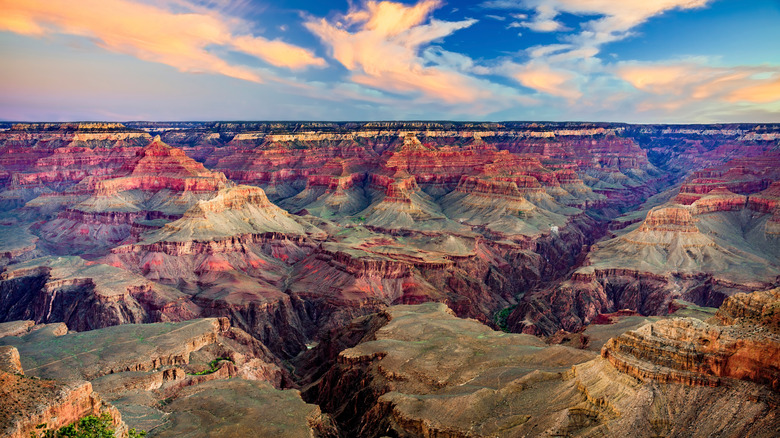
The bizarre but beautiful Grand Canyon is a place of impressions. Who can fail to be struck by the awe of its sheer scale, drama, and array of color? Arguably, among its most striking features are the striped horizontal layers that create an almost rainbow-like effect across the canyon walls. For many visitors, these stripes are one of the canyon's most memorable sights — especially once you understand how they formed within this span of the earth carved by the Colorado River over millions of years.
The rocks of the Grand Canyon are much older than the canyon itself. Composed largely of sedimentary layers, the oldest rocks at the bottom are nearly 2 billion years old, while the youngest layers near the rim are about 270 million years old. By contrast, the Colorado River began carving the canyon roughly 5 to 6 million years ago. That timing is fortunate, since erosion exposed all the colorful layers that show a chronology of our planet spanning hundreds of millions of years.
So how did these layers form? This region was once near the edge of an ancient continent and, at times, covered by shallow seas filled with organisms. Over time, shells and remains of marine animals like crustaceans, mollusks, and worms were compacted together to form horizontal layers of limestone, sandstone, and shale. As sea levels rose and fell, the layers reveal the different levels of the seabed. And while the canyon walls display these bands clearly, you can also find striped rocks deeper within the canyon by hiking or rafting — though collecting them is prohibited under National Park Service regulations.
The Grand Canyon's ancient striped rocks
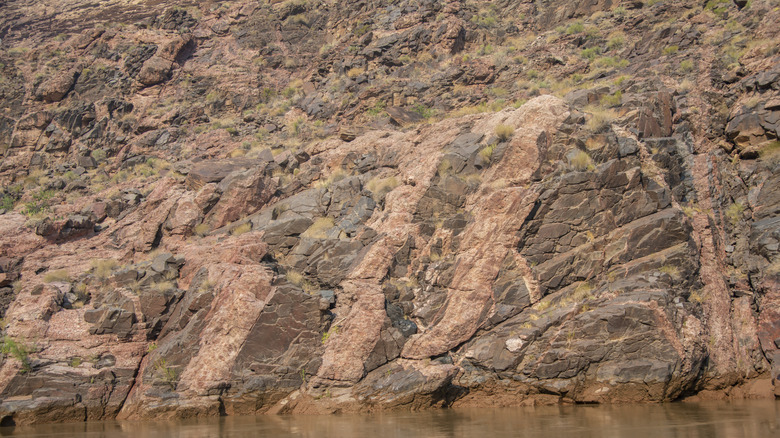
Many visitors experience the canyon from the rim, but that vantage point misses one of its most fascinating features: the Vishnu Schist at the bottom of the inner gorge. These are among the oldest rocks in the canyon, and from above, their intricate patterns are easy to miss. Up close, however, they reveal crystallized pink-and-white stripes lining the Granite Gorges.
Unlike the other layers, these basement rocks are metamorphic and igneous in origin. Around 1.7 billion years ago, tectonic activity pushed volcanic island arcs into the edge of the North American continent. This process helped form the early foundations of what is now Arizona. Over hundreds of millions of years, these ancient mountains were eroded down to their roots, which are visible today at the bottom of the Grand Canyon. What's wild is that this "root" was once 10 to 15 miles beneath the Earth's surface, before being exposed through uplift and erosion. Today, parts of this gray layer of schist, gneiss, and granite have crystal-filled fracture lines and taffy pink folds.
The iconic but dangerous multi-day Bright Angel Trail takes you down to the canyon floor, where you can find these ancient, trippy rocks. You can also see them via the Clear Creek Trail, which starts at the bottom of the canyon. For a more family-friendly approach, walk the Trail of Time. This 2.83-mile paved interpretive path showcases different canyon specimens and includes one of these striped rock examples.
The zebra stripes of the Grand Canyon's red rocks
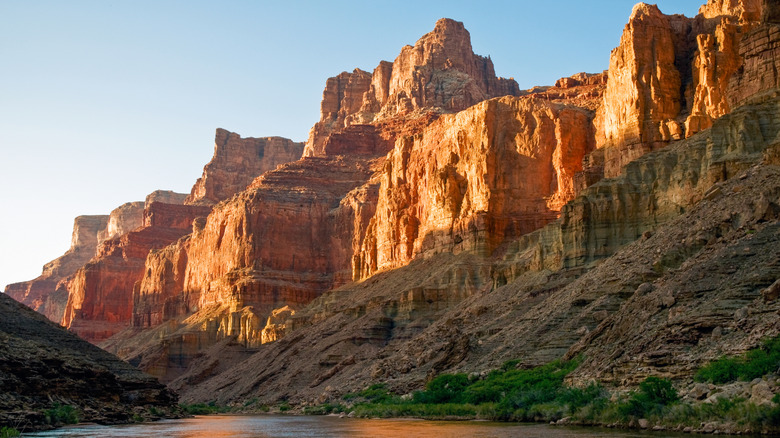
One of the Grand Canyon's lesser-known features is the zebra-striped rocks found deeper within the canyon. Located in areas like Saddle Canyon, these gray rocks with dark stripes can look almost surreal against the surrounding landscape — almost as if they're candy dropped by a mythical god lording over the canyon. For better or worse, their origin is less dramatic: they're derived from Redwall Limestone, the layer found about halfway down the canyon.
Despite its name and appearance, Redwall Limestone was originally gray. It's almost surprising, considering this red color has become synonymous with the Grand Canyon. But that redness actually comes from iron-rich layers above, whose iron oxide seeped down and stained the limestone over time. This roughly 500-foot-thick layer of limestone was formed about 340 million years ago, when this area was covered by an inland sea. The shells and fossils of marine organisms mixed with sediment, eventually hardening into the limestone seen today.
The levels and position of the inland sea changed over time, leaving its subtle variations on the Redwall Limestone. In some fallen rocks, these variations appear as banding. You can find examples around River Mile 47 in Saddle Canyon. Access is typically only by rafting, so be sure to research how to choose a Grand Canyon rafting trip that suits your needs. There's a steep 1.6-mile out-and-back hike that's a popular side hike with river rafters, but you can also camp here and try to beat any crowds that way.