
Canada's Once-Thriving Limestone Quarry Is Now A World-Famous Garden With Endless Breathtaking Flowers
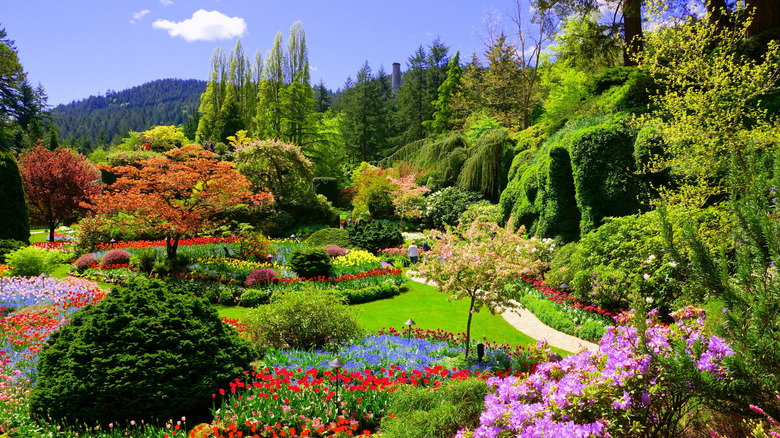
Quarries typically evoke a certain kind of imagery: roughly hewn walls, crushed rubble underfoot, and stone slabs carelessly abandoned in unsightly heaps. But, on Canada's Vancouver Island, one such abandoned quarry has a completely different aura, filled with a floral aroma, an explosion of colors, and the sound of birdsong. Just over 12 miles from Victoria, the brunch capital of Canada, lies the Butchart Gardens, a world-famous botanical garden colloquially known as The Gardens. Over a million visitors make their way to The Gardens every year.
In 1904, an industrialist named Robert Pim Butchart opened a limestone quarry near Tod Inlet for his cement company, which employed 368 workers from around the world at its height. The limestone quarry served the Butchart family faithfully for around 5 years, allowing Robert to become the first local producer of Portland cement — a limestone-based cement from England. However, once the quarry's limestone deposits ran out in 1909, what was left was an ugly, rubble-filled depression 50 feet deep. Robert's wife, Jennie Butchart, decided to turn the quarry into a garden, beginning work on what would become one of the most famous attractions in British Columbia.
By then, Jennie Butchart had already contracted Japanese landscaper Isaburo Kishida to build her a Japanese-style garden overlooking a small cove. The quarry was transformed into the now famous Sunken Garden by transporting soil from nearby farms and using the remaining rubble to construct raised flower beds. Following the completion of the Sunken Garden, the ever ambitious Jennie followed it up with an Italian Garden and a Rose Garden, all of which opened to the public by 1929, with Jennie herself playing hostess to The Garden's visitors. Today, The Gardens are easily accessible from Victoria International Airport in Sidney, 8 miles away.
An endless display of colorful flowers
The Butchart Gardens is split into five themed gardens: The Sunken Garden, the Italian Garden, the Rose Garden, the Japanese Garden, and the Mediterranean Garden. The first division you will come across is the Sunken Garden, the largest and most famous of The Gardens' divisions.
A switchback stone staircase takes you down to the old limestone quarry, now a stunning display of water features and flowering trees set amidst winding paths and grass lawns. The old quarry walls are covered with ivy, painstakingly planted there by Jennie Butchart herself, adding a Hobbit-like touch of whimsy to the garden. In the middle of the Sunken Garden lies the Mound, a tall limestone outcrop left over from mining, now transformed into a lookout point with a winding staircase to the top. On the southern end is the Ross Fountain, named after Ian Ross, Robert and Jennie Butchart's grandson, who inherited The Gardens from his grandparents and added concerts and light displays to the visitor experience.
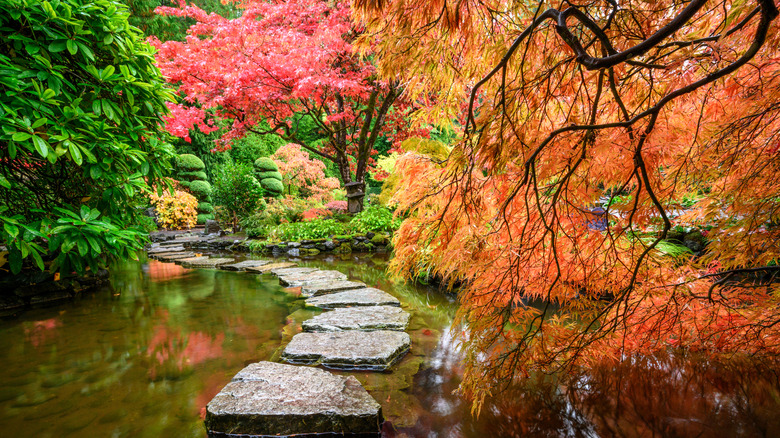
The Rose Garden features 2,500 plants, manicured lawns bordered by wild roses, rose beds, and a tunnel made of 30 rose-covered arches (pro tip: this arch is a fantastic photo spot). After that, visitors have the option to continue straight past the Sturgeon Fountain to the Italian Garden or turn left for the Japanese Garden. The Japanese Garden's entrance is through a traditional Torii gate and features maple and beech trees, the famous Himalayan Blue Poppy, rhododendrons, and azaleas placed around bubbling streams with small bridges crossing over. The Italian Garden is more lively, set right next to the eateries, with flower beds arranged around a cross-shaped water feature. The Mediterranean Garden features exotic and drought-resistant plants right beside the parking lot.
Year-round fun and beauty at the Butchart Gardens
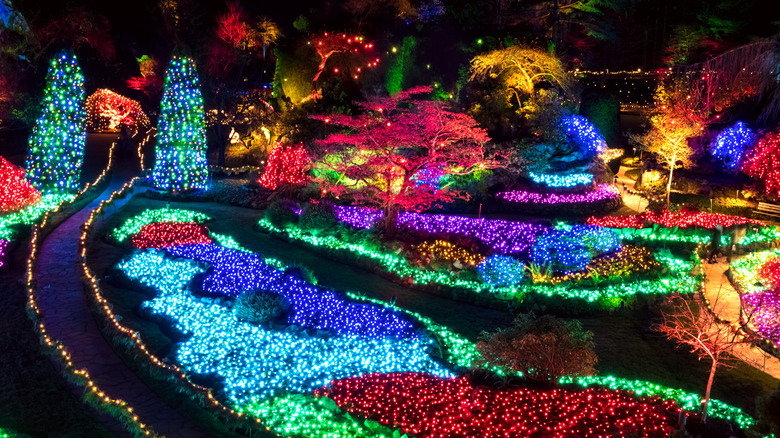
While The Butchart Gardens aren't nearly as large as the massive 2,007-acre Royal Botanical Gardens in Burlington or even the more modest 190-acre Montreal Botanical Gardens (set inside the immersive and family-friendly Montreal Biodome), there's still a lot to take in at The Gardens. In 1977, when Ian Ross's son Christopher took over The Gardens' management, he began instituting changes to attract more visitors and add new experiences, beginning with choreographed fireworks shows. When his sister (and the Butchart Gardens' current owner) Robin Lee-Clarke took over, she also added a children's pavilion and carousel. In winter, Butchart Gardens comes alive with a Christmas display, seasonal or evergreen shrubs, indoor flower displays, and historical displays chronicling the lives of the Butchart family.
The Gardens also include four eateries: The Coffee Shop, Blue Poppy Restaurant, The Dining Room, and Gelateria (a gelato shop). The Coffee Shop is the most centrally located, easily visible next to the Gift Store, while the Gelateria and Dining Room are beside the Italian Garden. The Coffee Shop and the Dining Room are open year-round, but the Blue Poppy Restaurant and Gelateria are closed during winter, with the Blue Poppy Restaurant turning into an indoor garden (or wedding venue) during winter. All restaurants serve seasonal menus with locally sourced ingredients.
Despite the Butchart Gardens being set entirely outdoors, the garden is open year-round, with seasonal displays and some evergreen trees and shrubs. However, the best time to visit is from May onwards, earlier in the day, when the park has extended open hours (up to 10 p.m.), and the majority of the crowds haven't arrived yet. After you've checked out Butchart Gardens, you can also look at this list of the best year-round destinations for mesmerizing flower displays.