
Why Don't The Great Lakes Freeze Over?
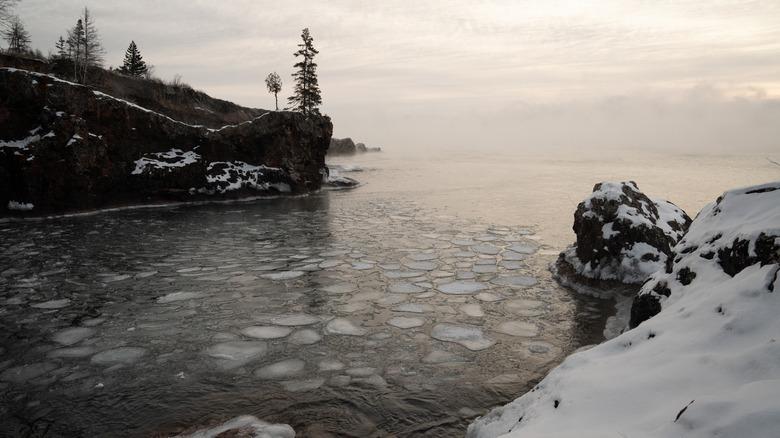
Only about 2.5% of the Earth's water is freshwater, and about a fifth of that is contained in one area: North America's Great Lakes, the world's largest freshwater system. Between them, Lakes Michigan, Superior, Huron, Erie, and Ontario have more than 10,000 miles of shoreline and cover a surface area of over 94,000 square miles. That massive size gives them attributes you'd expect more from a sea than a lake, like the fact that they produce ocean-like waves that people can actually surf, or that they contain over 35,000 islands, many of which are popular destinations for secluded getaways. You'll notice another unique quality of the Great Lakes if you visit them in the winter: that their surfaces very rarely freeze, even during the coldest months of the year.
Now, seas and oceans also stay liquid during the winter, but they have a secret weapon. The salt in seawater drops its freezing point to 28.4 degrees Fahrenheit, as opposed to the 32 degrees Fahrenheit freezing point of fresh water. And even the ocean isn't immune to freezing, with roughly 15% of its surface turning to sea ice for at least part of the year. This begs the question — why don't the Great Lakes freeze over? While their immense size is part of the answer, that's not the only factor at play.
The reason the Great Lakes don't completely freeze
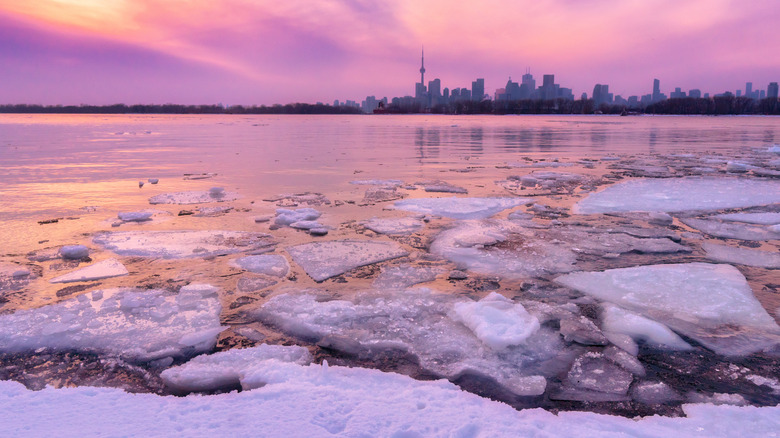
First and foremost, ice does form on the Great Lakes, usually starting in late November and peaking in February. How much depends on the lake. On average, Lake Ontario has the lowest ice coverage (10-25%), while Lake Erie has the highest (85-95%). Extreme cold increases this, like during the 2014 polar vortex, when over 92% of the Great Lakes' surface froze, though even in the coldest winters, the lakes rarely freeze entirely.
One reason for this strange behavior is that the depth of the Great Lakes varies significantly, and deeper lakes retain more heat. Lake Erie is the shallowest, with an average depth of 62 feet, and usually freezes first. Yet this clearly isn't the only factor, considering that Lake Superior is by far the deepest Great Lake, with an average depth of 483 feet, but Lake Ontario — with an average depth of 283 feet — tends to have the least ice. This holds true even in extreme winters. For instance, in 1996, both Lake Erie and Lake Superior froze over completely (and Lake Huron was nearly there, with 98.2% coverage), but less than half of the surface (45.1%) of Lake Ontario formed ice.
This is where climate and topography enter the equation. Lake Ontario is farther south than Lake Superior, so the temperature around it doesn't usually drop as low. Lake Erie is the farthest south, but since it's shallower, ice still forms despite the warmer climate. Wind patterns play a role here, too. Lake Ontario's largest dimension is from west to east, the same direction that wind often flows over the Great Lakes. This means more surface movement and larger waves pulling warmer water from the depths. The combination of depth, climate, and water movement is what ultimately keeps Lake Ontario from completely freezing over.