
It Felt Like Everyone Had One In The '80s — Here's Why This Retro Item Belongs On Your Next Vacation
We may receive a commission on purchases made from links.
Ahh, the '80s: the decade that popularized the Walkman, Jazzercize, Cabbage Patch Kids, the Rubik's Cube, and those shoulder-pad-heavy power suits. But it was also the era of the Polaroid — the world's first instant camera. Producing high-quality (for its time) imagery with a dreamy aesthetic in just minutes, it soon became a household staple. And, like many of the best trends from this decade, it's making a well-deserved comeback, particularly among travelers.
Polaroid's first camera, Model 95, was launched in 1948 by American innovator Edwin Land. The product revolutionized modern photography, as it removed the development process, which could be costly and time-consuming. Retailing for $89.75 ($1,100 if adjusted for inflation), that first model wasn't too out of reach for average middle-class families. And during the '80s, the company expanded its line-up of models, meaning that there were options at different price points for both hobbyists and budding professionals. This made the Polaroid an excellent and versatile tool for documenting everyday moments, special occasions, and holidays abroad. Users were obsessed with how the camera immediately spat out an image, quickly capturing a specific moment in time that couldn't be reproduced — they could physically hold a family portrait taken in front of the Eiffel Tower shortly after the shutter clicked. However, by the nineties, as digital tech took off, instant cameras became antiquated. And in 2001, the company filed for bankruptcy.
Interestingly, in 2017, Polaroid experienced a revival — there was a certain nostalgia for analog photography in an increasingly digital world of over-sharing curated content on social media. Indeed, film photography is one of the things people miss about traveling before the Internet existed. Now, Polaroids are the thrift-store find travelers want to take with them on vacation.
Why you should travel with a Polaroid camera
Although there's no need to pack a DSLR for vacation anymore, there's still value in bringing some kind of camera. And if you're not convinced of the appeal of an old film camera that takes a limited number of pictures, consider this: it's a chance for you to be more intentional while on the road.
As LA-based visual artist Thalía Gochez stated in an interview with Bricks Magazine, "Each shot teaches you to wait, to not waste the shot on something you don't truly feel is worth shooting. It teaches me to create with intention while always keeping in mind to highlight the story in the most authentic way." With a Polaroid, you can't snap dozens of photos of one street, for example, so you'll consider more carefully what you're trying to capture. You might take two imperfect, messy (but real) images of that street — and then spend the rest of your time actually enjoying your getaway.
Additionally, the photos Polaroid produces have a unique, retro aesthetic that can't be duplicated. Another California-based photographer, Matthew O'Brien, shared on PetaPixel, "I love the distinctive color palette and the softness. The impressionistic quality puts more emphasis on the emotional and less on the descriptive content." And once your photo is printed, you have a tangible piece of art in your hands. Put a series of images from the same city together to document a special place, or glue your favorites into your travel journal to commemorate a transformative trip.
Finally, you can use this camera to capture and share spontaneous connections with people you meet. These photos make for excellent souvenirs — give that cafe owner you chatted with in Medellín one of these snaps, and watch his face light up with joy.
What to expect with Polaroid cameras and where to find them
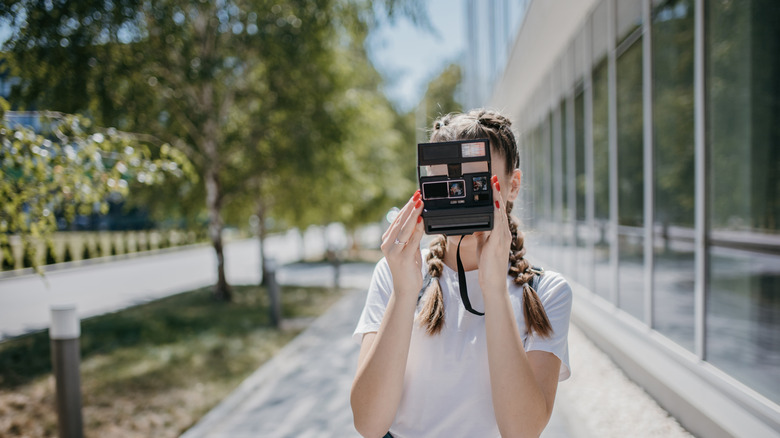
It's important to keep in mind that this isn't the tool for the professional travel photographer (unless you're working on a specific art project). If you're hoping to come away with crisp, close-up images of penguins in the wild or exquisite forest landscapes, then leave the Polaroid at home (and read our guide on how to take better vacation photos like the pros). You're not going to accomplish these goals with a piece of equipment that costs less than $150 and offers few manual settings (although this is changing with newer iterations, like the Polaroid I-2). Instead, this camera is for travelers who want to embrace spontaneity and a more tactile photographic experience.
To find a vintage Polaroid, you can try your luck browsing through your local antique or second-hand store (for Goodwill, it's best to check their online store for cameras). Be aware that, if you pick up an older model, you may have difficulty finding the correct film, as some are no longer supported by the company.
If you're less inclined to go on a city-wide scavenger hunt, you can find all available models (plus bundles that come with film and other accessories) on Polaroid's website. The Polaroid Now Generation 3 Travel Set includes the camera body, a bag, and one pack of film (eight photos). It's available in several colors, such as black, Arctic blue, and coral, and it retails for $169.99 ($153 for new Polaroid Members) as of this writing, with an overall rating of 4.9 (from over 30 reviews). Amazon sells a similar bundle for $159.99. While it doesn't come with a bag, it includes two packs of film and has a 4.1 rating from more than 1,000 reviews.