
Air Canada Is Cutting Some Of Its Most Important Flights — Here's Why
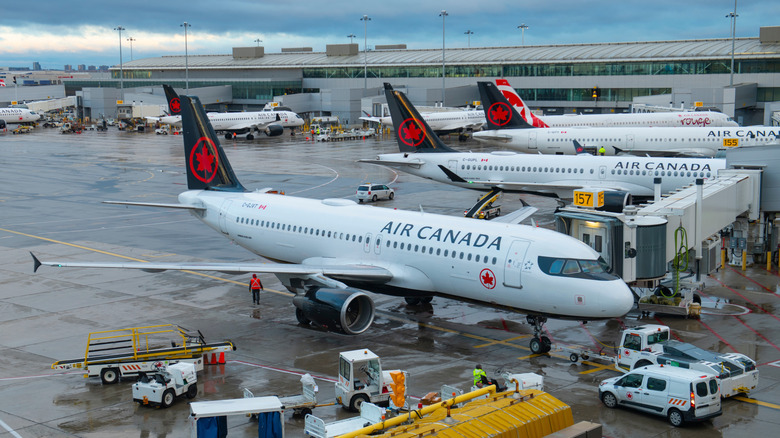
Air travel is facing its biggest fuel cost surges in years. Jet fuel prices have more than doubled since late February, when tensions in the Middle East escalated, causing supply concerns and pushing global energy prices higher. Air Canada is suspending six direct routes, including some important cross-border flights in North America. The most high-profile are from Toronto and Montreal to New York's John F. Kennedy International Airport, both halted from June through October 2026.
That amounts to four daily flights: three from Toronto and one from Montreal. Passengers can still fly between Canada and New York City with Air Canada, which will continue operating 34 daily flights into LaGuardia Airport and Newark Liberty International Airport — two of the busiest routes between the U.S. and Canada. Additionally, the service between Salt Lake City and Toronto will be suspended starting in July 2026, with plans to resume in 2027. Domestically, Air Canada is also suspending direct flights from Fort McMurray to Vancouver and from Yellowknife to Toronto.
Jet fuel is typically an airline's biggest operating expense, accounting for just under 30% of total costs, according to a World Air Transport Statistics (WATS) report (via the International Air Transport Association). Prices had stabilized around $100 per barrel through much of 2024 and early 2025 after recovering a significant drop during the pandemic. In March 2026, however, prices skyrocketed, exceeding $200 per barrel. "Jet fuel prices have doubled since the start of the Iran conflict, affecting some lower profitability routes and flights which now are no longer economically feasible," Air Canada said in a statement on April 17. The airline spent over $5 billion on fuel in 2024, so when prices spike, some routes quickly become unprofitable. Before long, onboard amenities could be affected, too. Air Canada is one of the few in North America that still offers free alcohol – a perk that could come under pressure if costs continue to climb.
What these Air Canada cuts mean for passengers

The immediate impact in North America will be felt most by travelers flying between Canada and New York City this summer, as well as those traveling on the affected domestic corridors. But the broader implications are harder to ignore. Higher fuel costs are often passed on to consumers through increased fares, and with continued uncertainty around the Strait of Hormuz — a major route for global oil shipments – there's little certainty about whether prices will ease ahead of the U.S. and Canada's peak travel season.
Air Canada isn't alone. Major airlines are permanently closing routes to Las Vegas, and capacity reductions are rippling across the industry globally. Other Canadian carriers like WestJet, Porter Airlines, and Flair Airlines have also made changes. WestJet forecasts nearly 6% in capacity cuts in June and introduced temporary fuel surcharges on select bookings. Porter Airlines and Flair Airlines have also implemented fuel-related fees.
Higher ticket prices, reduced flight frequencies, and fewer route options could define summer 2026 air travel across Canada and beyond. Air Canada says it will offer affected customers alternate travel options, so if your route is on the list, check your inbox. And if you're still in the planning stages, you may want to save one of these five Canadian summer getaways with Caribbean-blue water for next year.