
Florida's Busiest Highway To Navigate (And Why Drivers Dread It)
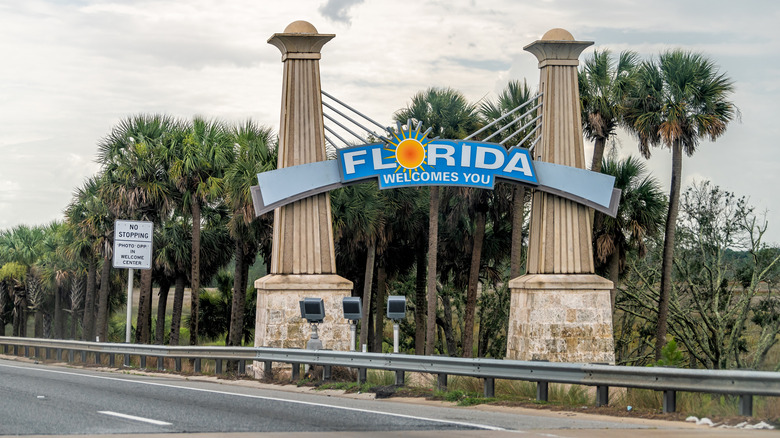
The United States relies heavily on its interstate highway system — arteries of transit and commerce that connect the country. One of the most significant corridors is Interstate 95, a north-south highway that crosses 15 states, stretching from Miami to Houlton, Maine, near the Canadian border. Intersecting highways and auxiliary roads branch off as it passes through major hubs like New York City and Boston. I-95 construction began shortly after President Dwight D. Eisenhower signed the Federal-Aid Highway Act of 1956. Its final segment wasn't completed until 2018 in New Jersey. Florida contains its longest continuous segment at 382 miles.
Within Florida, I-95 serves as a critical commercial route, running parallel to the Atlantic coastline from Jacksonville through Daytona Beach, Melbourne, and West Palm Beach before reaching Miami. For years, the highway has been associated with heavy traffic, contributing to Miami's well-documented congestion and high rate of serious car crashes, per Florida Today. According to the Federal Highway Administration, up to 339,000 vehicles travel along parts of I-95 in South Florida daily, making it one of the most-used routes in the U.S. "I-95 at all hours of the day has become unbearable," wrote a Reddit poster in r/Florida, a sentiment echoed by many. "Every single day ... Some kind of bottlenecking accident, roadwork, or mass confusion," added another. "My normal trip takes less than 20 minutes, but it's always double that now."
Miami isn't the only place where I-95 causes headaches. Southbound near Jacksonville, a sprawling "new" I-295 interchange has been under construction for years, creating persistent bottlenecks and merging complexities. If you find yourself in the wrong lane, you'll be forced to double back — and GPS doesn't always help, as the ever-evolving road layout causes lag. "I avoid 95 at all costs," wrote a Redditor.
Why is I-95 so bad in Florida?
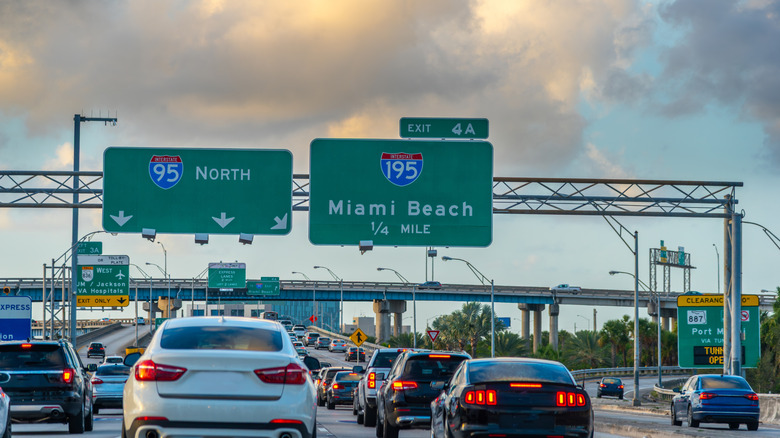
Even among the country's most heavily traveled roadways, I-95 has earned a reputation as one of the most frustrating stretches in the U.S., especially across Florida. Drivers regularly compare it unfavorably to notoriously contested regions like California, and in online discussions, some have even joked about a "misery per mile" metric. By that standard, I-95 is often a top contender for worst highway. "[T]op 10 most deadly stretches of road in the nation," wrote one user in a Reddit thread. "I-95 you're more likely to die or see someone else die." Another agreed: "I feel like my life is on the line every time."
Much of the congestion stems from a combination of factors: heavy tourism, a constant flow of out-of-state drivers unfamiliar with local roads, and significantly limited public transportation options, leaving most residents and visitors alike dependent on cars. These issues have intensified in recent years. During the COVID-19 pandemic, Florida saw a surge in new residents as people relocated, drawn by open beaches, fewer restrictions, lower taxes, and job opportunities. Cities like Tampa and Jacksonville experienced rapid growth, placing additional strain on already overburdened roadways like I-95. Tampa was even named one of 2025's best, fastest-growing places to live in America – though it is not located along I-95.
Although migration has slowed somewhat, Florida's population is expected to keep growing, which will continue to strain infrastructure, including I-95, according to the Federal Highway Administration. "Yep, the great COVID migration really exposed the poor road designs," wrote a Florida resident on Reddit. "There isn't a break, not even on secondary roads anymore," wrote another. "All [roads] are flooded with vehicles. I always avoid I-95 when possible because I know there will be traffic and I will get stuck."
Is there a solution to Florida's I-95 problem?
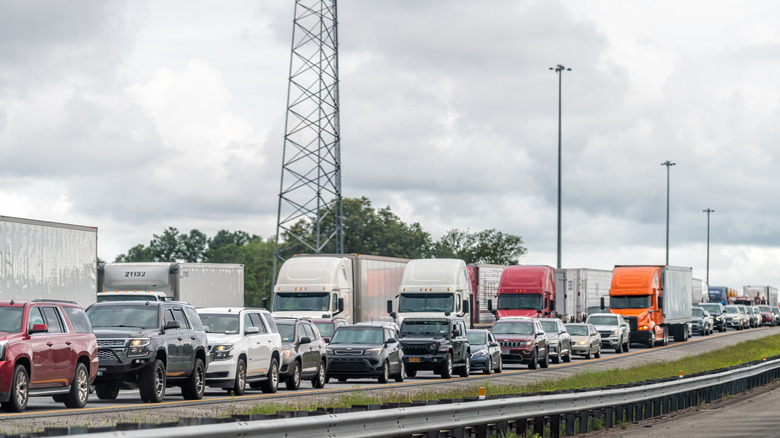
Florida's I-95 congestion problem is easy to describe — and complain about — but difficult to solve. State efforts, such as adding express lanes in South Florida, have provided some relief for drivers willing to pay, but they haven't significantly reduced overall traffic volume. Critics argue the lanes simply charge a premium without fixing the underlying issue. As Florida's population continues to grow and tourism remains strong, the number of cars on the road keeps rising faster than capacity. The state's limited public transit options only add to the strain, even though studies show Americans consider rail the best form of transportation.
In 2025, Governor Ron DeSantis announced a $15-billion investment to address transportation congestion, targeting projects such as highway maintenance, bridge repair, and new lane construction on Florida's roadways, along with some support for local transit systems. Whether it effectively manages congestion in the long term remains to be seen. As one Reddit user put it: "Maybe if they invested in scalable public infrastructure we wouldn't need our already limited budget to add more roads. These are not scalable solutions to problems of scale."
Meanwhile, the Florida Department of Transportation is advancing the I-95 Managed Lanes Master Plan in Palm Beach County to expand I-95 capacity along a 38-mile stretch. Additional upgrades in other regions, along with new traffic management infrastructure, aim to reduce bottlenecks. However, these projects can take years to complete, and much of the funding goes toward maintenance rather than expansion. "I've been driving in Jacksonville since around 1999. In 26 years I can not recall a time when either I-10 or I-95 was not under construction," one Redditor wrote. "How much longer are these road projects going to take?"