
Your Plane's Overhead Luggage Storage Once Had A Much Comfier Use In The '50s
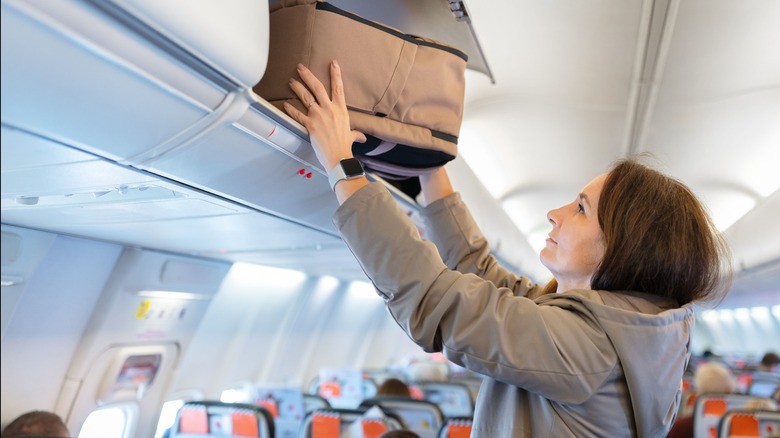
Modern-day commercial flights aren't known for comfort. An overseas trip will have many travelers frantically researching how to survive a long-haul flight, with limited leg room and difficult sleeping arrangements unless you're willing to shell out for business class. But only a few decades ago, a comfortable overnight wasn't the rarity it is today: An ingenious use of cabin space gave passengers a place to sleep in what is now the overhead luggage compartment.
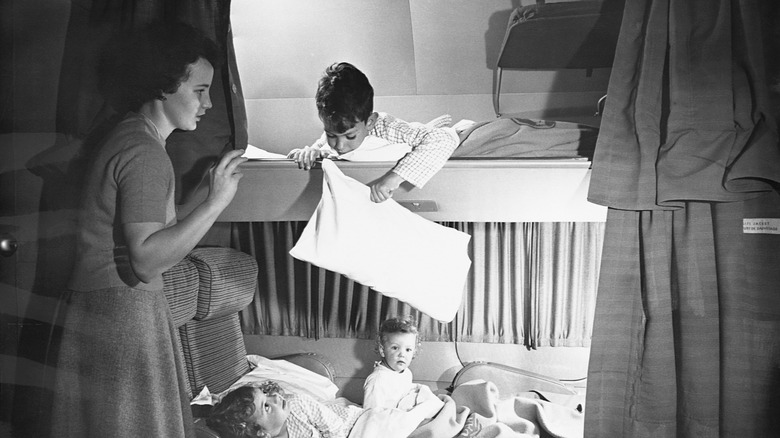
Several midcentury airlines used the compartment above some seats as a sleeping space. It was a feature on ultra-luxury planes, like the Boeing 377 Stratocruiser used by Pan Am and other airlines of the era. Though the exact layout of these bed-style seats depended upon the plane, seat type, or airline, these typically double-decker sleeping berths ensured passengers on long flights would have privacy, room to relax, and the luxurious meals that were once typical airline fare.
Granted, not all seats on 1950s planes came with this luxury option, and comfortable in-flight sleeping arrangements never came cheap. Typical fares for these bed-style seats, adjusted for inflation, would cost thousands of dollars today, comparable to business and first-class on modern airlines. But during the 1950s Golden Age of Travel, there weren't any affordable airfare options — even a short flight might cost the equivalent of over a thousand dollars today. So it might have made a little more sense to shell out on a blissful night in a private overhead bunk if you were already ponying up 5% of your salary to get on a plane at all.
Modern carriers take cues from the airline beds of the past
If you've ever walked enviously through a business-class compartment on the way to your economy seat on a long flight, you are no doubt aware that the idea of lie-flat airplane seats is alive and well. And though you won't be nodding off in the overhead compartment anymore, some modern airlines offer bed-style seating options even in economy class.
In terms of creative use of cabin space, Air New Zealand has re-embraced the midcentury bunk bed tradition. The airline's soon-to-be-unveiled Economy Skynest is a sleeping pod that passengers can book in four-hour windows to get some shut-eye on flights between New York and Auckland. While it lacks the luster of 1950s luxury travel, it just might make surviving 20-plus-hour flights a bit easier.
The airline has also introduced an option to purchase whole rows of economy seats that convert to bed-like Economy Skycouches, using an existing cabin feature to create sleeping space. It isn't the only airline to experiment with this concept. United Airlines plans to roll out a similar three-seat option called the Relax Row in 2027, and Lufthansa and All Nippon also give economy-class customers the same choice. But these seats don't quite match the privacy of the Golden Age bunks — you'll have to pay for business class if you want that. At least for now, a comfortable and private night of in-flight sleep remains a luxury purchase. It's just one more way that air travel is different today than in decades past.