
The Largest Singular Collection Of Frank Lloyd Wright Architecture Is On A Vibrant Florida College Campus
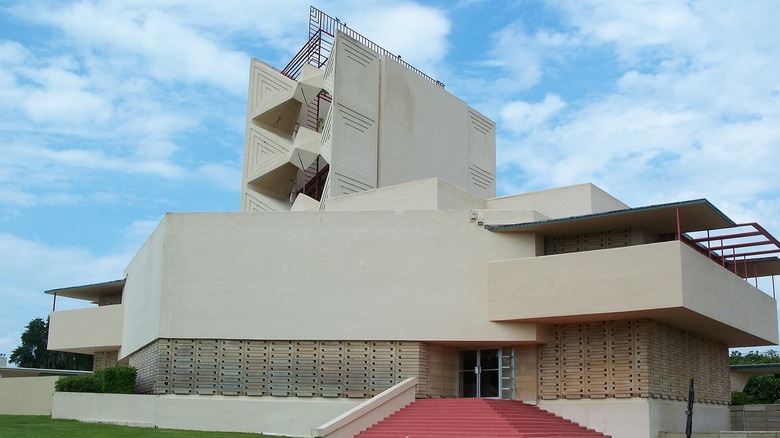
Frank Lloyd Wright remains one of America's most influential architects, with landmark designs still drawing visitors across the U.S. Famous for his Prairie School homes and flat, ranch-style "Usonian" designs, architecture aficianados are likely familiar with his most lauded works: Taliesin in Spring Green, Wisconsin or Taliesin West in Scottsdale, Arizona; the Solomon R. Guggenheim Museum in New York City; Fallingwater in Mill Run, Pennsylvania; and the Frederick C. Robie House in Chicago, the very city where Wright began his career. However, the biggest single-site collection of Wright-designed structures in the world is sometimes overlooked, in many ways a "hidden treasure" located on a private college campus in central Florida. Florida Southern College in Lakeland features 13 Wright-designed buildings — including the Annie Pfeiffer Chapel and the Polk Science Building Planetarium – and is part of a National Historic Landmark district while still operating as a fully functioning university campus.
Set across approximately 113 acres of moss-draped live oaks and citrus groves landscaped around Lake Hollingsworth, the collection — "Child of the Sun," as it is known — includes signature Wright aesthetics alongside unique design elements. Wright got involved in 1938, when it was just a small Methodist school run by Dr. Ludd Spivey on the site of a disused citrus grove. Spivey's goal was for the school to become a futuristic, globally renowned center, and, inspired by a feature in Time Magazine, Spivey contacted the architect to see if he could help. Until Wright's death in 1959, the project — a planned 18-structure community — remained ongoing; 13 buildings were ultimately completed.
Today, Florida Southern College is considered the oldest private comprehensive university in the state, with approximately 3,000 students enrolled. Not only do students study, work, and worship in the storied buildings Wright designed, but the public is also welcome to reserve campus tours.
Highlights include two chapels, a covered esplanade, and Frank Lloyd Wright's only planetarium
Miller Planetarium, located in the Polk County Science Building, is Frank Lloyd Wright's only planetarium and one of the last buildings he completed on campus. Not to be confused with an observatory — a domed structure equipped with telescopes — a planetarium simulates the skies within a domed theater. The planetarium was carefully renovated in 2024 under the oversight of architect and Wright conservator Jeff Baker.
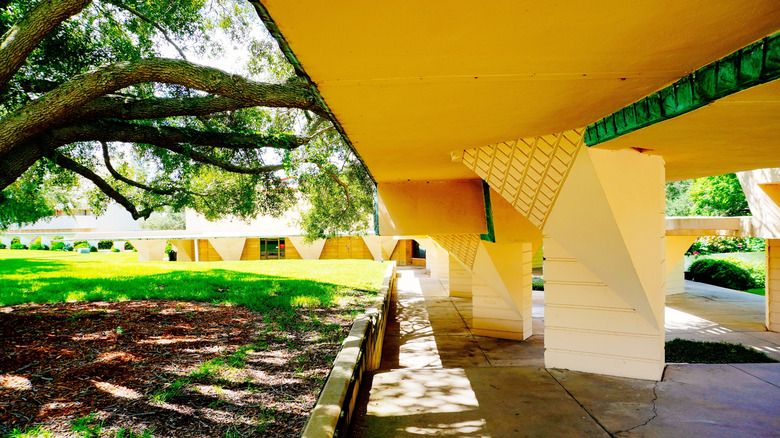
Wright's personal favorite was the Lucius Pond Ordway Industrial Arts Building, where the social sciences department is now quartered. Its centerpiece is the only theater-in-the-round he ever designed. Another campus highlight is the Wright-designed esplanade. This covered, mile-long sidewalk resembling a portico allows easy, shaded transit between buildings, even during Florida's tropical rains or intense sun.
Arguably, the pièce de résistance is Wright's first campus undertaking: the Annie Pfeiffer Chapel. Although he designed it, the chapel was constructed almost entirely by students — primarily women — due to World War II labor shortages, in exchange for board and tuition. Coquina, concrete, and multicolored stained glass comprise this geometric structure, including thousands of interlocking "tapestry" bricks made of concrete and native soil. A 65-foot bell tower, skylights, soaring acoustics, and "God's Bicycle Rack," a decorative rooftop element, round out the features. Soon after its completion in 1941, the chapel was damaged by a hurricane and rebuilt. It's undergone restorations since then, including one in 2025 following water damage. Next door, the William H. Danforth Chapel features large stained-glass windows and the original furnishings designed by Wright and built by the college students. "It's hard in central Florida to find such history in architecture," wrote one Google reviewer. "Overall it was very amazing to see this historic property still being maintained and properly preserved to this day."
The collection includes one posthumously constructed structure based on a Frank Lloyd Wright design
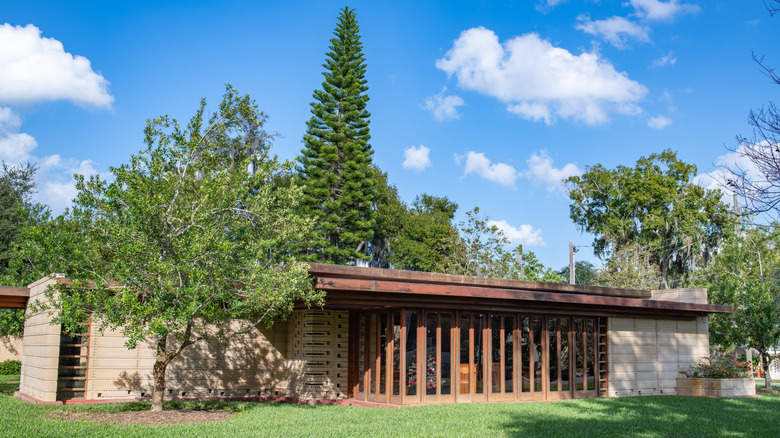
Of Frank Lloyd Wright's 13 "Child of the Sun" structures, just 12 were finished during his lifetime, as he was simultaneously working on other commissions like RiverRock, a surreal Ohio villa that became his final project. His last for Florida Southern College was not built until 2013, a Usonian-style house originally intended for faculty housing. Today, it serves as the Sharp Family Tourism and Education Center, where guests can browse the gift shop. The Water Dome is yet another unique campus feature that received some posthumous modifications. When first constructed in 1948, it was the largest water feature Wright had ever designed. In 2007, it was enhanced with modern technology, including 75 water jets capable of shooting 45-foot streams.
While visitors can explore the campus on their own, guided tours are widely recommended, and reservations are strongly encouraged. The 90-minute tour offers a comprehensive overview of the grounds, including the original E.T. Roux Library. The in-depth tour builds on this experience with additional interior access. An even more immersive experience, the behind-the-scenes tour, is also available. One Tripadvisor reviewer called it "a truly unique FLW tour that's worth seeking out," while another complimented its vibrant grounds: "Florida Southern College campus is beautiful with all the Frank Lloyd Wright buildings. Very worthwhile tour!"
Lakeland isn't far from fellow Polk County city Winter Haven, a charming destination that enjoys its proximity to Lake Hollingsworth and several theme parks. The easiest way to get to Florida Southern College is to fly into Tampa, about 35 miles west, or Orlando, about 55 miles northeast, and drive via Interstate 4 — luckily avoiding I-95, Florida's busiest highway. There is free parking across the street from the visitor center.