
Viral Plane Seat Drama Proves A Simple Truth: Boundaries Don't Disappear At 30,000 Feet
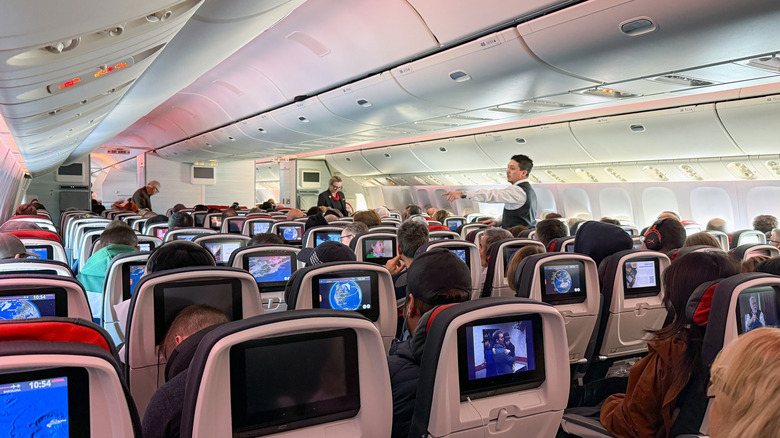
There's no denying that traveling can be transformative, though it can arguably also bring out the worst in people, including on flights. Indeed, having a less than pleasant flight is a universal experience. However, it can become even more distressing when someone wants your airplane seat, and you don't want to give it up. Unfortunately, this can lead individuals to disregard and unnecessarily overstep boundaries. According to the Daily Mail, a woman named Jeniffer Castro found herself in this situation on a flight in Brazil. She declined to vacate her assigned window seat for a crying child, which led to a fellow passenger — who is not the child's mother — filming Castro. (For those curious, the mother was on board and was reportedly not involved in this situation.)
The passenger declared on camera (via news.com.au) that Castro lacked empathy, among other things. You can probably guess what happened next: the video was posted online and subsequently went viral. Although the incident transpired in late 2024, it continues to resurface on social media, including on Facebook, where users overwhelmingly side with Castro. "She did the right thing. If your child wants a window seat, then book a window seat for them," reads one comment.
Another wrote, "Everyone has the option to pre-book seats [...] you're not entitled to have someone give up their seat for your child because you didn't plan accordingly." I also agree with Castro's decision to stay put, but I believe that there is a bigger issue here. It's not that she was asked to swap seats in the first place; it's that she said no and was shamed for doing so.
Refusing to give up your seat shouldn't make you a villain
On Facebook, several users explained why they pay for specific seats on a plane, with some citing anxiety or added comfort. But the fact of the matter is that if the seat is assigned to you, it's yours. Nevertheless, some individuals may be emboldened to push boundaries and act inconsiderate towards people they believe they'll likely never see again — particularly when they do not get what they want, or if they disagree with someone's actions. Put simply, they flip the script and villainize the person who has the right to decline.
In the now infamous viral video, Jeniffer Castro is seen at her seat, eyes closed, ignoring the camera. The passenger filming her zooms in and out on her face as she goes off on Castro for refusing to give up her seat for a child. In an interview with the Daily Mail, Castro revealed that she had to leave her job due to the fallout from the video. She stated, "I was the target of judgments, attacks and speculation from people who don't even know the full story."
Castro is far from the only individual who has been in a similar situation. In a TikTok, user @kalrobbins said that they experienced "30 minutes of intimidation" after they refused to give up their paid seat to a fellow passenger. Likewise, user @tinamichellee said that they turned down a couple who asked if they could swap. When @tinamichellee said no, the pair made a fuss. The reactions to these specific incidents suggest there's often an expectation for strangers, especially if they are women, to be accommodating in uncomfortable situations — and saying no can lead to intense backlash.
Seat swapping or seat disputes can be a lose-lose situation
Asking to swap seats is a question that will drive most flight attendants up the wall. Still, it happens for a variety of reasons. This could be based on personal preference or families failing to purchase seats together (though, consider that there is a way to handle families being split up on a flight). The bottom line is that if someone says no, their decision should be respected. If not, I believe that it can create turmoil for all involved. The person remaining in their seat has been punished for not providing what was asked of them, with the aggressor gaining nothing in the end.
Now, both must endure a tense situation in an enclosed space for minutes or hours. In the same vein, passengers need to be cognizant that boundaries, as well as consequences, still exist on flights. If the conflict escalates, it can end up with individuals being removed from a flight. However, if you don't want to move from your assigned seat but oblige because you feel like you can't say no, the outcome may still be negative. Travel blogger Somewherelands found themselves in this situation, writing, "By saying yes, I'd turned myself into the one thing I hate the most when it comes to bad behavior: an Enabler."
A few months after the incident, Jeniffer Castro ended up suing the airline and the passenger who filmed her. Castro told the Daily Mail that she was doing so because of her belief that her life should not have been upended for declining to move seats. She hopes that this will prevent it from happening to someone else. As of this writing, it's unclear if this lawsuit has been settled or not.