
The 'Sistine Chapel Of Crystals' Is A Unique Cave In Mexico With Some Of The Largest Natural Crystals Worldwide
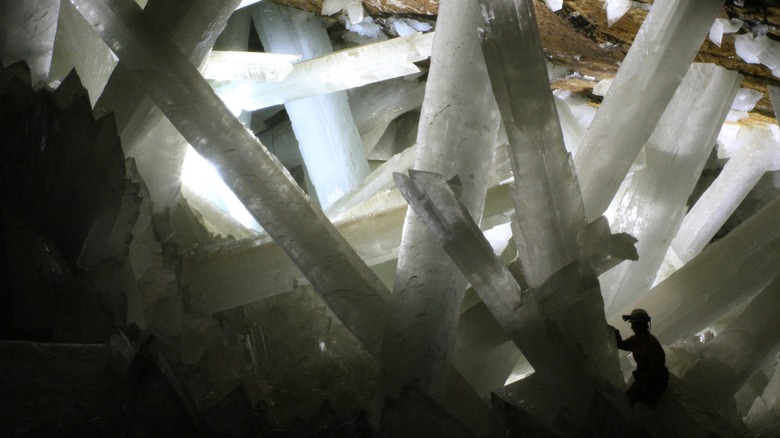
The Sistine Chapel is often compared to ancient and awe-inspiring natural or archaeological sites because of its immense scale and artistic complexity. Mexico has its own natural wonder worthy of a similar comparison, aptly called the "Sistine Chapel of Crystals." The subterranean Cave of Crystals is a unique attraction in the Sierra de Naica Mountain, located in the state of Chihuahua. Holding some of the world's largest known natural selenite gypsum crystals, the cave is one of the most mysterious sites that only a select few have witnessed. The colossal natural wonder is situated almost a thousand feet underground, with crystal beams as long as 36 feet.
There's a reason why the crystal cave remains closed to the public — with temperatures up to 136 degrees Fahrenheit, it is extremely hot and dangerous for daily visitors. On top of that, humidity levels are almost at 100%, making survival without specialized gear limited to minutes. Moreover, even the lowest recorded temperature (113 degrees Fahrenheit) is barely manageable.
The Cave of Crystals is a relatively recent discovery. It was found by accident in 2000 when miners broke into a chamber. What they saw inside was giant white crystals covering the entire space from floor to ceiling. These were a variety of selenite gypsum, created due to salts dissolving in groundwater and evaporating in the sedimentary environment. The cave was only accessible because the mining company pumped water out. Once they stopped the pumping in 2015, the cave reflooded, remaining a well-kept secret from the world. Geologist Juan Manuel García-Ruiz is the one who coined the term "Sistine Chapel of Crystals" in an interview with National Geographic. Today, the cave maintains its intrigue as an unseen marvel, sealed away from the rest of us.
Why Mexico's Cave of Crystals is so extraordinary
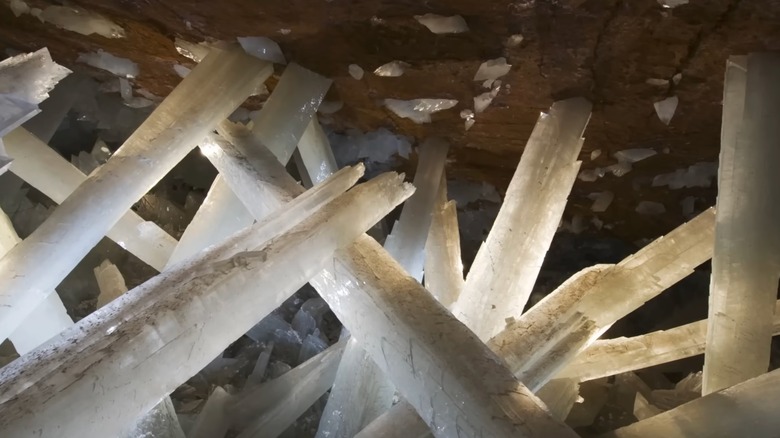
Estimated to be 26 million years old, the Cave of Crystals was formed as a result of volcanic activity. Magma-driven circulation drove mineral-rich solutions through fractures — as it gradually cooled over millennia, the hot water hollowed out the limestone, which left behind intricate deposits that solidified into crystals. The heat in the cave eventually steadied at a constant 136 degrees Fahrenheit. This established an environment for gypsum crystals to precipitate from anhydrite.
Thanks to the stable temperature, the crystals were able to achieve massive dimensions — the biggest one in the cave is 39 feet high with a diameter of 13 feet. Featuring a U-shaped form, the Cave of Crystals is a 30-foot-wide and 90-foot-long chamber, with crystals sprouting from the cave walls and floor. A major factor in the cave having the perfect growth conditions for crystals was that it was filled with water, and reflooding kept the crystals in their element. Since it lies directly over a subsurface magma reservoir, both heat and humidity make it challenging to visit. The actual Sistine Chapel may prohibit photography, but the Cave of the Crystals is closed off entirely. It's neither open to the public nor active for mining, so the crystals can be preserved for many years to come
While the Cave of Crystals remains flooded, you can explore other natural wonders in Chihuahua, like the Cascada de Basaseachi National Park, with stunning forests and iconic waterfalls. There's also the sensational Copper Canyon that's actually four times larger than the Grand Canyon in Arizona. Or, to stay on theme, you fly to Europe and visit the "Sistine Chapel of Prehistoric Art," a stunning set of cave paintings hidden on Spain's Green Coast.