
This Once-Thriving Caribbean Island Capital Now Sits As Abandoned Ruins And Rubble
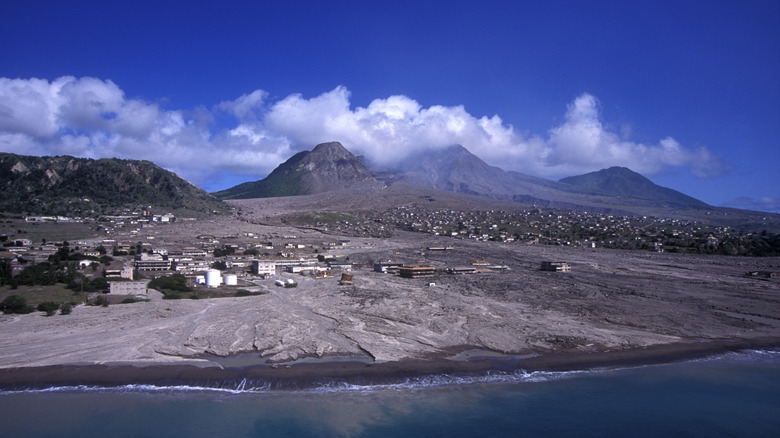
If you've ever karaoke-crooned "I Guess That's Why They Call It the Blues" by Elton John or danced to "Every Little Thing She Does is Magic" by The Police, you're connected to a fascinating bit of music history rooted in a half-abandoned island tucked deep in the Caribbean. Montserrat is part of the Lesser Antilles, situated between St. Kitts and Nevis, Guadeloupe, and Antigua and Barbuda. Referred to as the "Emerald Island of the Caribbean," the former British colony attracted Irish immigrants, creating a unique Afro-Irish culture. Yet today, a series of natural disasters has left much of the island, including its former capital, Plymouth, a deserted wasteland that's restricted to visitors, as it's considered one of the Caribbean's most active volcanic spots.
Montserrat was once a celebrity hotspot and glamorous vacation destination, hosting stars like Eric Clapton, Sir Paul McCartney, and Michael Jackson. Plymouth, its capital city and only port, was the island's heartbeat; legendary Beatles producer Sir George Martin even founded a Caribbean outpost of the iconic London-based Air Studios nearby. Uncommon Caribbean described it as one of the 1970s' "most desired Caribbean playgrounds," and the Beach Boys referenced "that Montserrat mystique" in their 1988 song, "Kokomo." And yes, Elton John and The Police laid down tracks here, too — scenes from the island even appear in one of The Police's music videos.
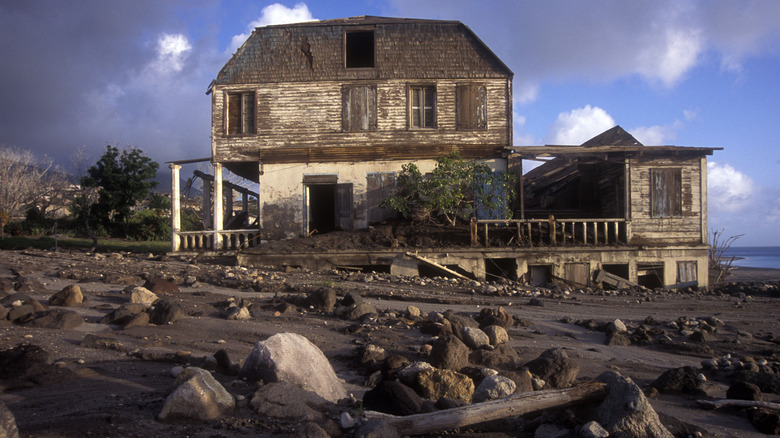
In 1989, Hurricane Hugo hit, damaging 90% of the island's structures, including Air Studios. The deadliest, costliest storm ever to hit the island displaced thousands of residents. The community was still in the years-long recovery process when, in 1995, Montserrat's volcanoes sprang to life. Catastrophic eruptions over the next few years turned what was once a thriving post-colonial capital into a Caribbean Pompeii, with ruins and rubble. Today, Plymouth is a rare example of a capital city turned into a ghost town — abandoned and uninhabitable, but visitable.
Multiple natural disasters decimated the small island
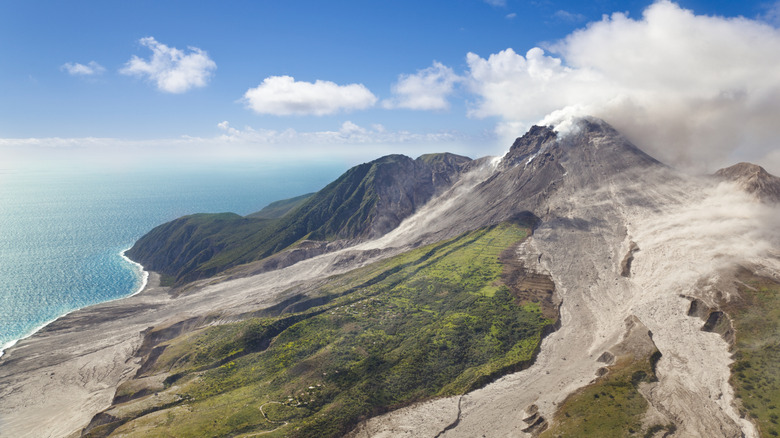
The Leeward Islands are known for their volcanoes: Montserrat's neighbor, Dominica, has geothermal activity so strong it warms the sea around it, and St. Vincent and the Grenadines experienced a massive eruption in 2021. But Montserrat might be the most volatile of them all. Although it experienced seismic activity throughout the 20th century — including earthquakes — its volcanoes had lain dormant for nearly 400 years. Soufrière Hills, the crown jewel volcano, loomed serenely above lush tropical foliage. According to music lore, island visitor Jimmy Buffett loved Soufrière Hills' geothermal hot springs and even recorded "Volcano" at Air Montserrat in 1979.
In 1995, Chances Peak began regularly exploding white gas into the air, raining debris, sending hot ash into the boiling sea, and prompting massive, long-term evacuations. In 1996, another eruption from Soufrière Hills buried villages in layers of mud, rocks, and ash. In 1997, the biggest eruption yet occurred, burying Plymouth, killing 19 people in a single day, and destroying the island's airport. Further eruptions occurred in 2003, but the last notable Soufrière Hills eruption occurred in 2010. Island authorities permanently vacated the capital and zoned it as exclusionary, forbidding unauthorized entry and leaving Plymouth, a once-thriving travel destination, abandoned.
Visit Montserrat and catch a glimpse of the ghost capital
In recent years, development has slowly revitalized parts of Montserrat. A new capital, Little Bay, is under construction, and tourism has started making a comeback. Still overlooked by vacationers heading to its more developed Caribbean neighbors, it's an off-the-beaten-path destination, rich in culture and natural landscapes. Most flights connect through Antigua or St. Maarten, and visitors can also arrive via select small cruise lines.
Plymouth is still restricted, but some companies now offer tours, welcoming visitors to experience the ghost capital with specially licensed guides. Some of Plymouth's post-apocalyptic sites include a former bakery, a gas station, a police station, an old church and steeple, and the Coconut Hill Hotel, the oldest hotel on the island. Visitors can also glimpse Soufrière Hills and the ghost of Plymouth from Garibaldi Hill and Jack Boy Hill. From the Montserrat Volcano Observatory, the leftovers of Air Studios are visible, too.
Meanwhile, the northern half of Montserrat remains a stunning, wildly underrated tropical paradise, pulling out all the Caribbean stops: bars, beaches, jungles, birdwatching, boat tours, and water sports. There's even a botanical garden. There are no major hotel chains, but guest houses and villa rentals are available. Despite its turbulent past, the island welcomes visitors and is the perfect destination not only for travelers who love the thrill of visiting an active volcano but also for low-key vacationers looking for fewer crowds and a laid-back vibe.