
Vietnam's Largest Lake Is An Ancient National Park Beauty Surrounded By Mountains And Forests
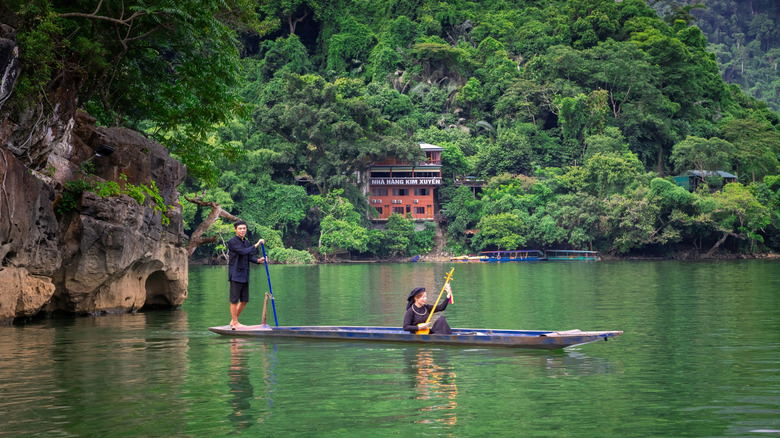
Mention Vietnam, and certain images pop into mind: bustling cities, scooter-clogged streets, bustling food markets, idyllic palm tree-backed white-sand beaches. But those searching for a bit of stillness amidst nature need only head to the Ba Be National Park in the Bac Kan province of northeast Vietnam, where Ba Be Lake — the country's largest freshwater lake, and a pretty darn picturesque one at that — sits surrounded by a landscape of towering karst mountains and lush forests.
Ba Be literally translates to "three lakes" in the local Tày language, a nod to the convergence of the Pé Lam, Pé Lu, and Pé Lèng lakes. Together, the linked waters stretch 5 miles and span widths reaching 1,300 feet. In its green waters live over a hundred species of fish, an important source of livelihood for the local community who call the national park home. The lake is a gateway to the park's most famous attractions on and along its waters — an island that houses the simple yet solemn Am Ma Pagoda, the Dau Dang Waterfall, the Puong Cave, and the Tien Pond — and you'll need a boat or kayak to access them.
The Ba Be Lake holds a remarkable set of distinctions: Aside from being Vietnam's largest — its surface totals more than 1,000 acres — it's also the highest, sitting roughly 476 feet above sea level. It is also one of the world's most important wetland ecosystems, with a Ramsar designation to prove it. The lake plays a significant role beyond its beauty, serving as a water source for irrigation in the dry season and a flood mitigator during the rainy months. Formed 10,000 years ago, the lake anchors the national park with the gravitas of ancient beauty.
Mountains and forests surround the ancient lake
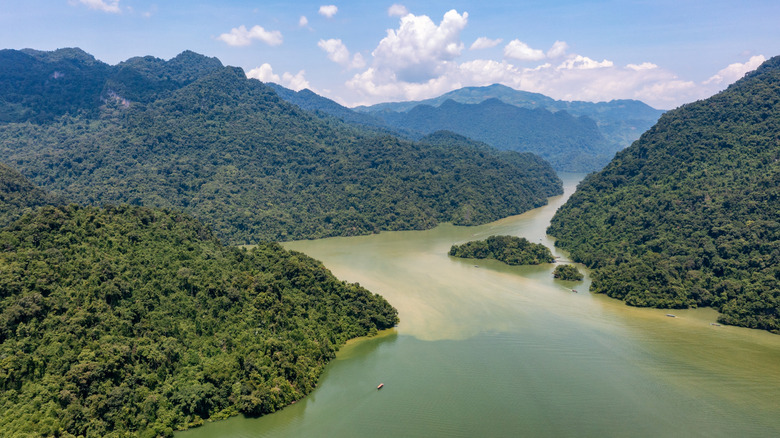
If the lake is Ba Be National Park's heart, the forests and mountains that surround it are its stage. Ba Be's national park designation was awarded in 1992, and it is also a recognized ASEAN Heritage Park — credentials that speak to a natural patchwork of soaring limestone peaks and evergreen tropical forests that blanket the undulating slopes and valleys across the park. The rainforests form a natural habitat for a sanctuary of wildlife, including some of Vietnam's rare and endangered species, among them the white-eared night heron and the Tonkin snub-nosed monkey.
Karst peaks rim the lake, time and water having slowly carved their way through the rock to sculpt out waterfalls, islets, and intricate cave systems. Tunneling into Lung Nham Mountain is the Puong Cave, a 98-foot-high cave studded with stalactite and stalagmite formations — and home to a thriving bat colony spanning over a dozen species.
Hikes through the forests and mountains — some more challenging than others — reward visitors with spectacular natural payoffs. The Dau Dang Waterfall is a crowd-pleaser, its cascades fed by the Nang River tumbling over boulders. The lesser-known but equally riveting Tat Ma Waterfall demands a two-hour trek to reach, but it's well worth the effort to arrive at the mist-covered cascade whose water is believed by locals to have healing properties.
Visiting Ba Be Lake and its national park
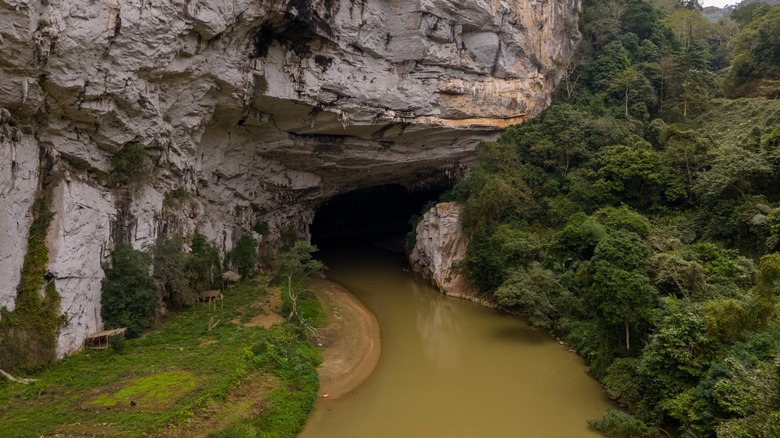
Boat and kayak tours glide along Ba Be Lake's scenic routes, making stops at its greatest hits: the An Ma Pagoda, the rock chambers of Puong Cave, and the thundering Dau Dang Waterfall. Once ashore, the lake passes the baton to the national park's forests and mountains, which teem with inland trails, indigenous villages, and caves. Vietnam may be one of Asia's most underrated destinations for traveling solo, but you'll likely want to have a tour guide when visiting Ba Be National Park — a splurge even seasoned traveler Rick Steves says is worth it on any trip.
Routes can be steep and tricky, and guides always have the inside knowledge of off-the-radar spots. Treks to Pac Ngoi Village, a stone's throw away from Ba Be Lake, reveal stilted houses against lush greenery, occupied by the Tày people who've called the landscape home for generations. More ambitious multi-day treks trace through steep hills, jungle routes, and waterfalls. Of course, multi-day trekking naturally raises the question of where to sleep — and the answer is a unique experience in itself. Budget guesthouses, lodges, and homestays are available inside the park, making them one of the best ways to experience authentic Vietnam.
Ba Be National Park sits some 130 miles north of Hanoi, roughly a five-hour car journey that makes for a good weekend jaunt, yet far enough to still feel removed from the city. Buses depart from Hanoi to the closest village of Ba Be Lake; shuttles or taxis also get you there directly. However you get there, prepare for a scenic journey through rolling farmlands, tea plantations, and karst mountains.