
France's Cosmopolitan 'City Of A Thousand Fountains' Teems With Artsy Vibes And Bustling Open-Air Markets
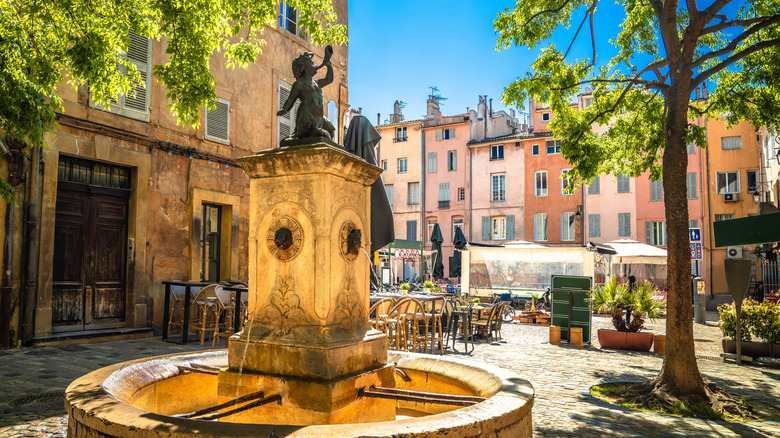
Southern France consistently ranks among Europe's most bustling destinations for millions of travelers from all around the globe. Yet, beyond the idyllic beaches and lavender fields beaming under the summer sun, you might find many places that carry less of the hype but have just as much to offer. One of them is Aix-en-Provence — or more simply, Aix. This mid-sized town of just over 150,000 inhabitants (per World Population Review) is strategically located in the Provence-Alpes-Côte d'Azur region, around 30 minutes north of Marseille and 2.5 hours east of Montpellier.
The town's history stretches back to the second century B.C., when the Romans established the thermal settlement of Aquae Sextiae. Since then, water has always played a pivotal role in Aix's identity, to the point that it is also known as the "City of a Thousand Fountains," or Ville aux Mille Fontaines. Today, it still counts more than 250 public and private fountains, including the majestic Fontaine de la Rotonde, built in 1860 at the western end of the Cours Mirabeau and crowned by three statues representing justice, agriculture, and fine arts. Further along the boulevard stands the moss-covered Fontaine Moussue, while the mid-17th-century Fontaine des Quatre Dauphins (featuring, as the name suggests, four dolphins) is just a few blocks away.
The historic center (the Vieil Aix) is largely pedestrianized and features a remarkable collection of 17th- and 18th-century golden limestone buildings, which seem to glow in the sunlight. Notably, it is organized around a lively urban "spine," the Cours Mirabeau, a sort of Provençal Champs-Élysées, lined with mansions, shopping boutiques, and charming cafès — once the epicenter of local cultural life.
Aix-en-Provence's artistic heritage and cosmopolitan spirit
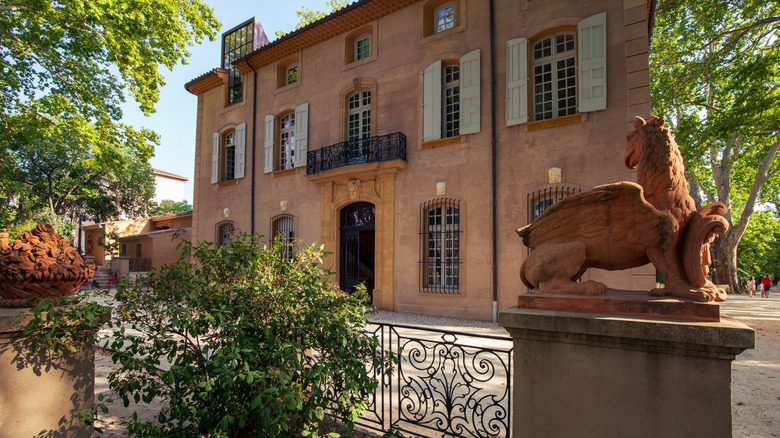
Long before becoming a popular tourist destination, Aix served as the political and judicial capital of Provence (a colorful region boasting intoxicating culinary traditions and a rich past) from the 12th century until the French Revolution. Its dynamic, cosmopolitan nature was reinforced by the foundation of one of France's oldest universities (the present-day Aix-Marseille University). By the 19th century, Aix had begun to attract notable painters and scholars, who often gathered at the iconic café Les Deux Garçons to discuss and exchange ideas, such as Paul Cézanne, Pablo Picasso, and Émile Zola. However, the building had a devastating fire in 2019 (per Franceinfo) and is still under construction. In Aix, post-impressionist Cézanne laid the foundations of an avant-garde visual language that would later redefine 20th-century art — cubism.
Several other sites continue to preserve the painter's legacy. Cézanne's Les Lauves Studio and the Bastide du Jas de Bouffan country estate are open from July through October. Some of his seminal works are currently exposed all over the world, including at The Baltimore Museum of Art in Maryland, one of the best free museums in the United States.
An eclectic mix of contemporary art studios, independent galleries, and small museums contributes to the city's present-day fame as the artistic capital of the region. Fondation Vasarely is home to some of the most emblematic works of Hungarian optical art pioneer Victor Vasarely, while Studio Gaïa is a bright ceramics atelier offering workshops and residencies. The city is even home to two exhibition spaces from the world-renowned Bel-Air Fine Art group. The cultural calendar is equally interesting: the annual Festival d'Aix-en-Provence during the month of July is an eagerly awaited event for opera and classical music lovers.
Exploring Aix-en-Provence lively open-air markets
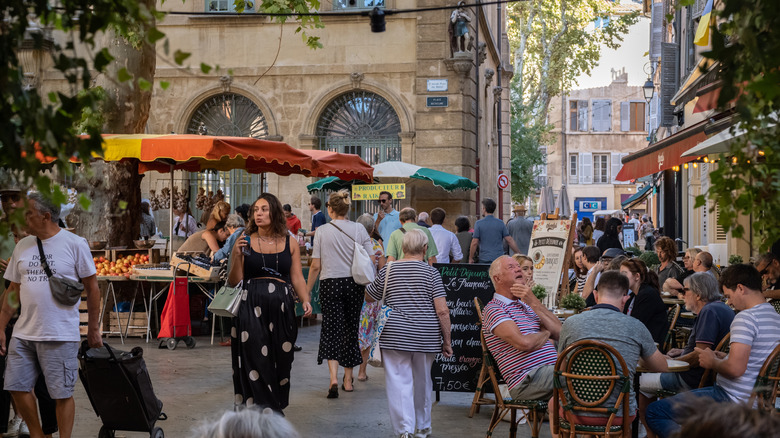
Aix-en-Provence has had lively, colorful open-air markets since the Middle Ages, and today, there are still around a dozen locations across the city. The most central is Place Richelme, a picturesque, small square originally called Place aux Herbes, home to the daily food market. It runs every morning from around 8 a.m. until noon, when the first stalls begin to close. It mainly focuses on fresh, locally-grown produce, from seasonal fruits and vegetables to olive oil, local cheeses, and honey.
On Tuesdays, Thursdays, and Saturdays, the Place Verdun and Place des Prêcheurs markets come to life. Many vendors are small producers from surrounding villages in Provence, selling local delicacies. The calissons de Provence (diamond-shaped sweets made from candied melon or orange peel and ground almonds, finished with a thin layer of royal icing) are a popular local treat and can often be found throughout the markets' stalls.
However, the most colorful and photogenic location is the Marché aux Fleurs (Flower Market) in Place de l'Hôtel de Ville (Town Hall Square). The flower market takes place Monday to Sunday — except on the first Sunday of each month, when it is replaced by an antiques market. The blooms fill the square with fresh-cut fragrances, potted plants, and aromatic herbs. European expert Rick Steves says that visiting French markets is "as important as the museums," so you definitely do not want to miss out on all Aix-en-Provence has to offer.