
This Is Spain's Largest City By Population (And It Has Twice As Many People As Barcelona)
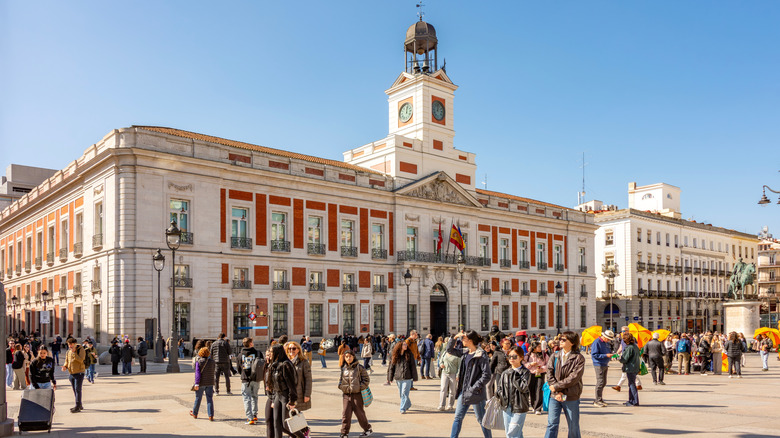
When going abroad, some travelers seek out the high energy and abundance of options offered by the biggest cities. Conversely, others avoid these exact places for the very same reason, viewing them as sensory overload. If you define the world's biggest cities as those with at least a million people, then Spain has only two. One is Barcelona, while the other is the country's capital and most populous city: Madrid. According to the World Population Review, Madrid has just over 3.5 million residents, which puts its population at just around twice that of Barcelona.
To put that in perspective with other European metropolises, Madrid is bigger than Rome by close to a million people, but it doesn't come close to London, which has over 9 million. Despite its ranking, Madrid is considered one of Europe's best-kept secrets and one of its most walkable cities. Its city center is very dense, full of tightly woven, crisscrossing streets lined with shops, restaurants, and museums. It can feel crowded in places, especially in peak tourist season, but its ratio of tourists to locals is less lopsided than in Barcelona — Madrid saw about 11.2 million visitors in 2025, while Barcelona had around 16 million.
Don't expect much solitude in Madrid, but given that visitor distribution, you're more likely to run into locals than in its Catalonian counterpart. Plus, for those travelers who love to get lost in big cities, Madrid's size means there's a ton to explore, with landmark museums and so many tapas bars that Rick Steves recommended tourists "go mobile" for dinner.
How to navigate Madrid, Spain's largest city
One way you might make visiting Madrid's sprawling footprint more manageable is by splitting up your days in the city by neighborhood. Madrid is a mosaic of different enclaves that each have a distinct flair. Three of its most iconic museums — the Thyssen-Bornemisza, Reina Sofía, and Prado museums — are close to each other around Cortes, in an area called the Golden Triangle of Art. Here, you can see how Madrid rivals New York City when it comes to art museums. If you're drawn to Madrid's royal history, you'll naturally want to spend a day in Palacio, the neighborhood home to the Royal Palace of Madrid (plus the spectacular gardens that lie behind it). To experience the edgier, more youthful side of Madrid, spend some time in Lavapiés or Malasaña — the latter's Plaza del Dos de Mayo is a great spot to sit around at night for a lively atmosphere.
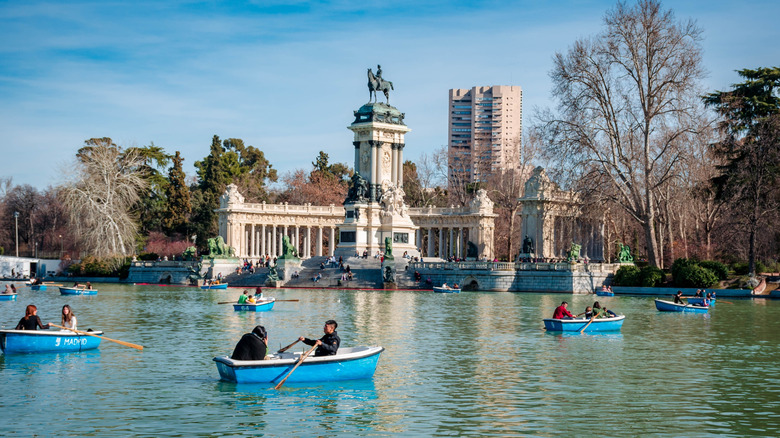
Though it's a dense, busy city, Madrid has excellent options when it comes to green spaces to get away from the traffic and noise. El Retiro Park is the best oasis you'll find without venturing far from the city center. It's part of a UNESCO World Heritage Site, with beautifully landscaped gardens, sculptures, and a wide lake. Madrid's biggest public park is Casa de Campo. It's a bit outside the city center — roughly an hour by metro — but it really can't be topped if you're looking for some nature-focused respite. It has an oak forest, dozens of walking trails, and tennis courts.
Madrid's busiest season is in summer, when flocks of tourists add to the already hefty population. Shoulder seasons — in spring and fall — are a good time to visit for less crowding with mild weather.