
Texas' Once-Thriving Quarry Is Now An Incredible Japanese Botanical Garden With A Picturesque Waterfall
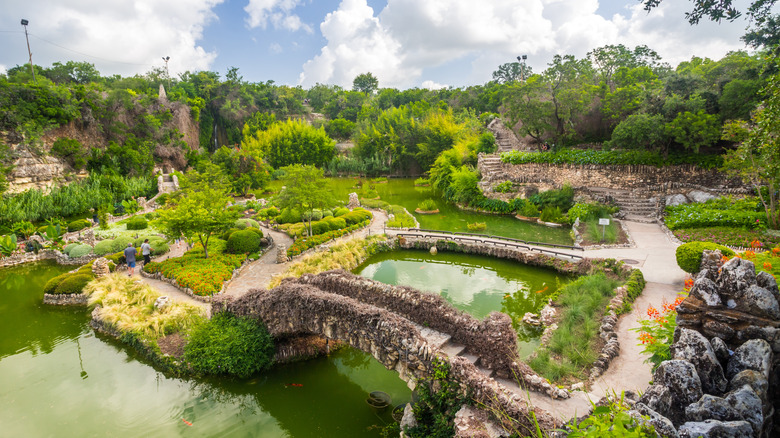
The Lone Star State is probably the last place you would expect to find a tranquil, Japanese-inspired oasis. Yet, that's exactly what you get at San Antonio's Japanese Tea Garden. This garden represents the good, the bad, and the ugly of San Antonio's 20th century efforts to beautify its abandoned industrial areas.
The garden's history begins in the mid 1800s, when German masons operated a limestone quarry here. In 1880, the Alamo Portland and Roman Cement Company (now known as the Alamo Cement Company) acquired the quarry and operated it until 1908, when they abandoned it and moved to a new location near Alamo Heights. In 1916, newly-appointed Park Commissioner Ray Lambert looked at the leftover ugly, rubble-filled depression and saw an opportunity to turn the eyesore into one of the city's most beautiful spots, inspired by Japanese art and fashion. Design work began in 1917 to transform the quarry into a new 1,200-square-foot Japanese-themed sunken garden — complete with a koi pond, waterfall, and stone bridges. Lambert roped everyone into the construction — residents donated flower bulbs for the garden, city engineers built bridges, and the park's construction was largely done by prison inmates.
The garden officially opened in 1919, although construction continued even after. Artist Eizo "Kimi" Jingu and his family were invited in 1919 to live in the garden and become its full-time caretakers and opened the Bamboo Room, a Japanese restaurant serving light fare and tea. The family continued to live in the garden until they were evicted in 1941 because of anti-Japanese xenophobia during World War 2. The garden was subsequently renamed the Chinese Tea Gardens (and moved in new Chinese caretakers) until its original name was restored in 1984.
The Japanese Tea Garden today
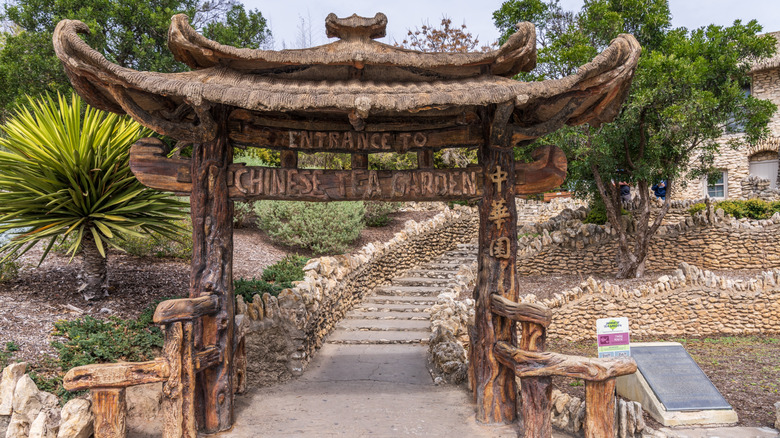
Despite its somewhat controversial history, the Japanese Tea Garden remains one of Texas' hidden gems, nestled inside the urban oasis that is Brackenridge Park. It features lush greenspaces, stone arch bridges over clean ponds with koi swimming merrily beneath, and a pagoda-shaped pavilion in the upper garden. Visitors enter through a Chinese Torii Gate constructed in 1942 by Mexican artist Dionicio Rodriguez, a master of the "Faux Bois" technique of creating structures using materials that mimic wood, in this case using cement. The Torii Gate was constructed after the Jingu family's eviction, and still features the park's rebranded "Chinese Tea Garden" name. "We acknowledge the complex histories of all public parks. This is no different," Mary Jane Verette, President and CEO of San Antonio Parks Foundation, told The Texas Bucket List. "And you move forward into the future by recognizing the past."
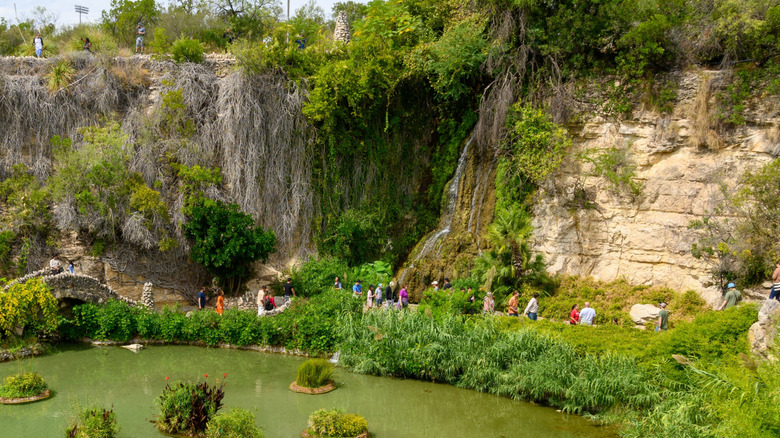
The crown jewel of the Japanese Tea Garden is its 60-foot waterfall, which empties into the garden's pools. Despite its height, it isn't a large, gushing waterfall, but a lacy addition that fits in well with the serene vibe of the garden. Thin ribbons of water cascade down the old quarry's moss-covered stone walls into the pond below, adding a pleasant layer of running-water white noise to the garden's ambiance. It's a good spot for a photo op, shaded from the sun by shrubs along the walls and above.
This element is just one aspect of the peaceful and serene atmosphere of the gardens, which visitors often compliment. "Spent over an hour at the Japanese Tea Garden, San Antonio, and every minute felt peaceful," reports one Tripadvisor reviewer. "Just the two of us, some juice, a deck of cards, and the calm of nature all around. Simple moments like these turn into the best memories."
Planning a trip to the Japanese Tea Garden
The Japanese Tea Garden is open every day from 7 a.m. to 5 p.m. In keeping with San Antonio's reputation as the city with the highest number of free attractions, it's also free to enter. The upper garden and pavilion are wheelchair-accessible and can hold up to 300 people, making it a good place for events like weddings, engagement parties, and more. The park is also dog-friendly, although pets must be kept on a leash.
Visitors can dine on an eclectic fusion of Japanese and San Antonio's Mexican cuisine at the restored Jingu House, the former Bamboo Room restaurant that was renamed after the family that meticulously took care of the garden in its early years. According to the Japanese Tea Garden San Antonio website, the Jingu House's former iteration opened in 1926, making 2026 its 100th anniversary!
The garden is accessible from the Museum Reach section of the San Antonio Riverwalk, which runs along Brackenridge Park. Within the park, you'll find the Japanese Tea Garden near the San Antonio Zoo. Try to plan a trip either early in the morning or during the weekdays, as the "tight walkways make the Japanese Tea Garden a nightmare when it's crowded, and it's always crowded on the weekends," per one local Redditor.