
The East Coast's Only-Known Geyser Is A Pennsylvania Phenomenon Emerging From An Abandoned Coal Mine
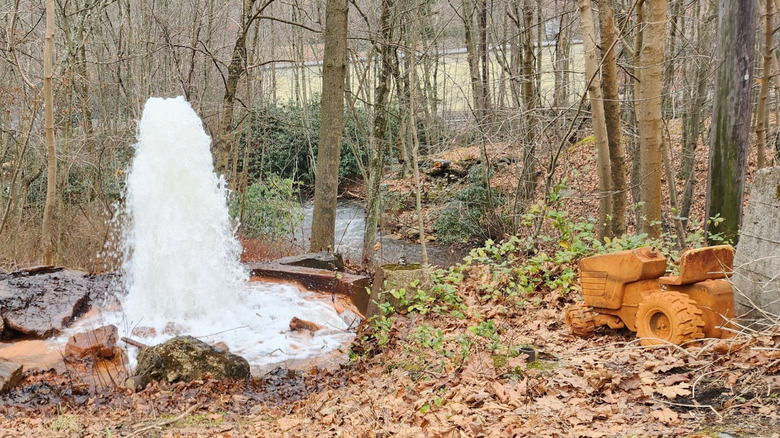
Geysers are an extremely rare natural phenomenon. According to data from the U.S. Geological Survey, there are fewer than 1,000 worldwide, and about half are in Yellowstone National Park. The chance to see geysers in action is a big reason the park drew upwards of 4.7 million visitors in 2025. But Yellowstone doesn't have the United States' only geysers. There is one known to exist in America's East Coast region, and it's located in Pennsylvania's Schuylkill County: the Big Mine Run Geyser.
Technically speaking, from a geological standpoint, calling this bizarre roadside attraction a "geyser" isn't completely accurate. A true geyser is formed by a hot spring, and the water that erupts from it is usually close to boiling temperature. That is not the case for Big Mine Run Geyser. Its water doesn't come from a natural aquifer, but from water that's accumulated in an abandoned mine about 300 feet below ground. Instead of being steaming hot, the gushing water is at a normal groundwater temperature (50 to 55 degrees Fahrenheit) and smells strongly of sulfur, both clues that the geyser isn't naturally occurring.
Knowing this doesn't make it less fascinating to watch, though, especially since Big Mine Run Geyser is easy to check out. You can see it from the side of Big Mine Run Road between Ashland and Girardville. To put that in a broader context, it's about 60 miles west of Allentown, about the same distance north of Harrisburg, and roughly 110 miles north of Philadelphia. While there are no signs or historic markers on-site, it's hard to miss, especially since it can shoot up to 15 feet high when it's in peak form.
How Big Mine Run Geyser formed (and what you'll see when you visit)
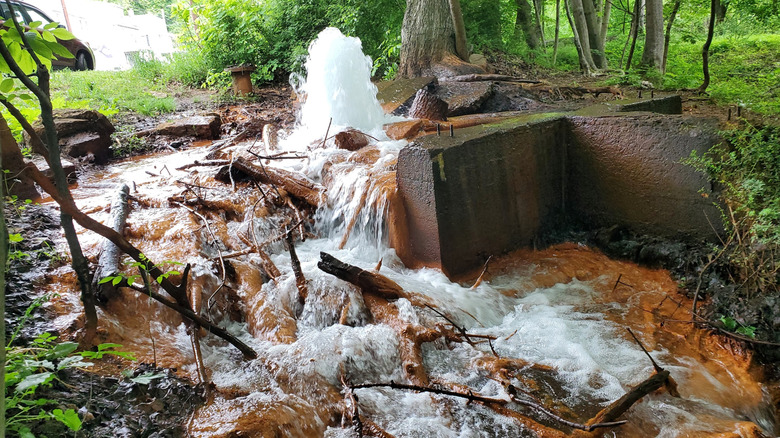
Similar to the world's only captive geyser in Soda Springs, Idaho, the Big Mine Run Geyser was created by accident, although the specifics of its origin vary. In the case of Big Mine Run, it's the direct result of the region's mining history. The area around Ashland was among the most productive anthracite coal mining sites in Schuylkill County during the 19th century. It first opened in 1854 and produced almost 10 million tons of coal by the time it closed in 1934. When the mine was active, a pump system was used to remove water and prevent flooding. Once the mine closed, the pumps stopped running, allowing water to fill the tunnels. As pressure built within the mine, the water needed another way to escape. It started to shoot out of the ventilation shaft next to Big Mine Run Road, and the geyser was born.
The height and flow of Big Mine Run Geyser vary depending on the mine's level and the pressure of water. After heavy rains, the geyser can be as tall as 12-15 feet. During droughts, it can stop flowing entirely. When it is flowing, the geyser is about 32 inches across and is a full sensory experience. You'll hear the roar of the water from the road and smell the rotten-egg reek of sulfur as you approach. The same minerals that cause the odor are responsible for the unique, bright orange ground around the geyser and down the hill where the water flows. Minerals like iron dissolve into the water in the mine and accumulate on the ground as the water flows over it. Once there, the iron oxidizes, creating the bright orange stains on the surrounding landscape.
Planning a trip to Big Mine Run Geyser
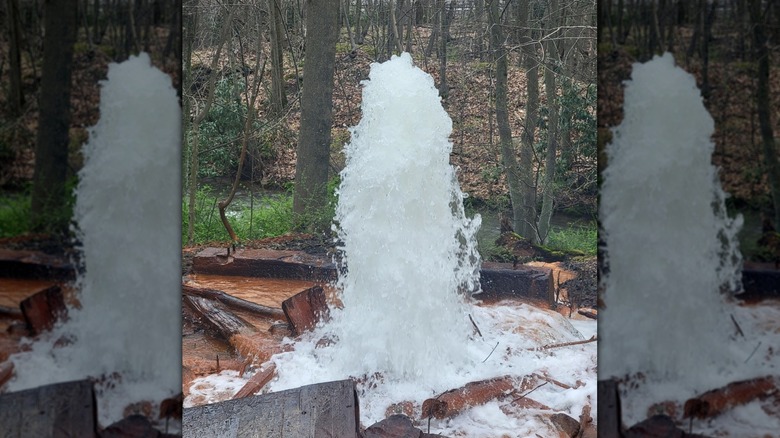
If you want to see Big Mine Run Geyser at its best, you'll need to visit at the right time. It's most likely to have a strong flow after heavy rainfall and in the spring, when snowmelt creates more groundwater to fill the mine. Visitors who have come in the fall report it being smaller, around 3-4 feet tall.
Whenever you come, Big Mine Run Geyser is free to visit and accessible 24 hours a day. Keep in mind that it is located on private property, so you shouldn't explore too far from the geyser site. You should also respect the property by not leaving trash behind, although not everyone has followed that advice, and you'll often see litter or debris around the geyser. Because of this, it's smart to wear closed-toed shoes and watch where you step.
Visiting Big Mine Run Geyser only takes a few minutes and probably isn't worth a dedicated trip on its own. There are some nearby attractions that you can add to your itinerary to make a day of it, though. The burning ghost town of Centralia is just a few minutes' drive up Big Mine Run Road, so you can stop to see spots like the Odd Fellows Cemetery and the smoking vents from the ongoing fire. To learn more about the region's mining history, you can drive about two miles down PA-54 into Ashland to visit the Museum of Anthracite Mining and Pioneer Tunnel Coal Mine, where you can tour a once-active coal mine Tuesday through Sunday from June 3 through Labor Day, or Saturday and Sunday in September, October, and May. Additional tour times are to be determined. There are other coal history sites across the region, too, like Eckley Miners' Village, America's best-preserved anthracite coal mining town, which is about an hour's drive from Big Mine Run.