
What Nobody Believes About The Eiffel Tower Surprises Even Seasoned Travelers
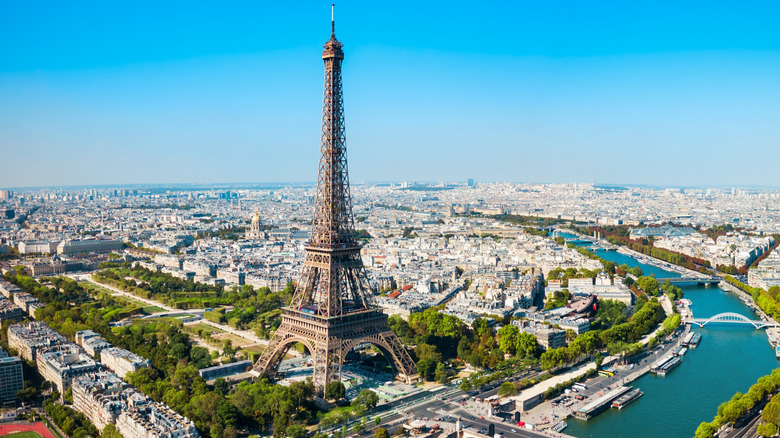
When it comes to global landmarks, few capture the imagination like the Eiffel Tower. Soaring 1,083 feet into the heavens above Paris, the Eiffel Tower was built by civil engineering genius Gustave Eiffel to be the monumental entryway and primary attraction for the 1889 World Exhibition, as well as to commemorate the 100th anniversary of the French Revolution. Eiffel's creation was originally supposed to be demolished after 20 years, yet more than a century later, it endures as one of humanity's greatest building achievements.
Thanks to the Eiffel Tower's starring role in everything from major Hollywood movies to the Paris 2024 Olympics, the hulking structure that presides over the bank of Paris' Seine River has left a lasting image in most people's minds before they set foot anywhere near it. But while many of the 7 million visitors who flock to this Paris icon every year have a pretty good idea of what to expect, there are plenty of fascinating things about the tower that visitors need to see to believe. For example, the Eiffel Tower's structure itself isn't actually fixed. Even though the tower is constructed of thousands of tons of impermeable wrought iron (its nickname is "The Iron Lady"), this seemingly static behemoth is capable of motion, and you just might be able to see it move depending on the weather, season, and time of day you visit. Along with this, the tower also has some fun, secret nooks and crannies you can view up close.
Weather causes the Eiffel Tower to change size and position
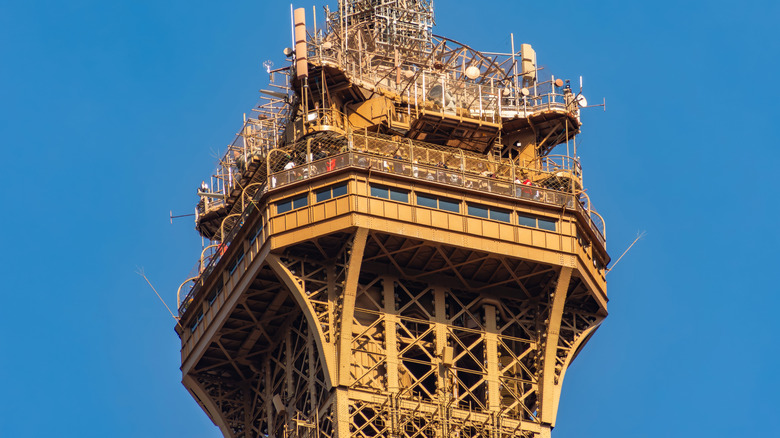
The Eiffel Tower boasts several unique structural characteristics that visitors might find surprising for an edifice weighing 10,100 tons. Despite being constructed of 18,038 pieces of iron along with 13,000 bolts and 2.5 million rivets, the Eiffel Tower is actually flexible and mobile thanks to the principle of thermal expansion. Simply put, the tower expands, shrinks and even moves in sync with seasonal weather conditions. On warm summer days or during a brisk winter, the Eiffel Tower can grow or shrink vertically anywhere between 4.5 and 6 inches.
Heat from the sun has the most dramatic impact on Gustave Eiffel's creation, causing the tower not only to expand, but also to change position. Throughout the day, the sun heats one side of the tower at a time, causing that side to stretch and actually lean away from the direction of the sun while the other three unheated sides remain fixed. As the sun moves around the tower, heating each side one-by-one, each side expands and leans individually. Over the course of the day, this phenomenon causes the top of the tower to rotate in a roughly 6-inch circle, moving west, south, and east before settling back into its original position in the evening.
Harsh winds also impact the tower, making it visibly sway up to 2.5-inches. Interestingly, this world famous landmark harnesses the wind, too. A pair of wind turbines on the second floor powers restaurants and shops on the first floor below. The turbines are camouflaged in the tower's very own "Eiffel Tower Brown" paint, so you'll need to work hard to spot them.
Discover the secret places where the Eiffel Tower pays homage to science
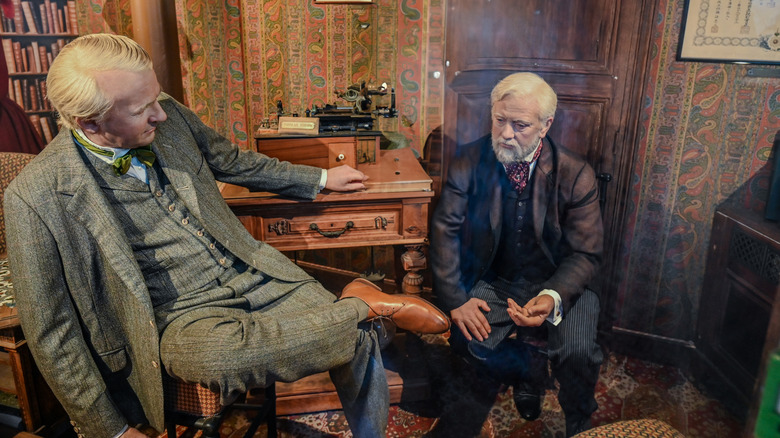
While Rick Steves says the best views from the Eiffel Tower aren't at the top, the travel guru does recommend checking out the secret spot at the tower's summit: Gustave Eiffel's 1,076-square-foot personal apartment. Eiffel conducted experiments and entertained luminaries here, including Thomas Edison, who visited during the World Exhibition. Edison gifted Eiffel his revolutionary phonograph — the world's first device to record and emit sound. The apartment isn't open to the public, but you can scale all the way up and take a peek inside. You'll discover a reconstruction of Eiffel's apartment that recaptures the famous meeting with wax figures of Eiffel, his daughter Claire, and Thomas Edison.
Many photographs of the tower online and in guide books are large-scale shots striving to capture its grandeur, but if you want to see the names of the 72 scientists engraved along the border above the tower's first floor, it's best done in person. Eiffel handpicked each scientist himself, inscribing their names in gold lettering to celebrate science, a field he believed the tower could advance as a site for conducting meteorology, astronomy, and physics experiments. An overly thorough paint job covered the names for a while, but they were revived in the late 1980s.
Soon, 72 more names will appear on the tower thanks to a 2025 initiative to add the names of female scientists. "It is time for this highly symbolic landmark to embrace the cause of equality between women and men, and to restore women to their rightful place on this monument dedicated to the glory of science and scientists," declared Paris Mayor Anne Hidalgo (via Cern Courrier). For more incredible Paris sites to explore on vacation, check out these 11 must-see attractions that beat the tourist crowds.