
Forget Lake Tahoe, This Mountainous Lake Oasis Is An Asian Escape With Emerald Waters, Cruises, And Hiking
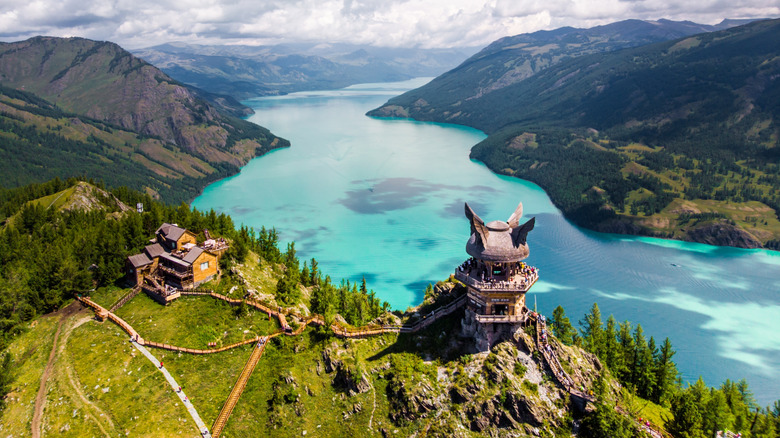
Dreams of visiting alpine lakes may invoke thoughts of mountain ranges in Europe or the high elevations of North America, but at the tip-top of China is a large pool of fresh water that rivals Lake Tahoe in its beguiling beauty. With Mongolia to its east, Kazakhstan to its west, and Russia just north, Kanas Lake in the Xinjiang region of northwestern China is a relatively unknown yet dazzling oasis high in the Altay Mountains. Glacially formed long ago and one of the deepest lakes in China, Kanas Lake is actually a particularly wide section of the Kanas River with depths up to 190 meters, or 623 feet. Often referred to as "Color Changing Lake," its captivating colors are renowned for their fluctuation, at times a vibrant emerald, other times more of a turquoise blue, with many variations in between due to seasons, weather, surrounding foliage, and rivers entering from upstream.
The prismatic waters lap the lakeshore at an elevation of 1,374 meters, or 4,508 feet, and is part of the Xinjiang Kanas National Geopark, a region of unusual geological features and enormous historical significance. In Mongolian, Kanas translates to "beautiful and mysterious lake," the region possessing a rich cross-section of culture given its geographic location. Genghis Khan's remains are purported to be at the bottom of the lake, which keeps the Tuva people, who consider themselves direct descendants of Khan, on a generational mission to protect the sacred spot.
How to explore ancient Kanas Lake
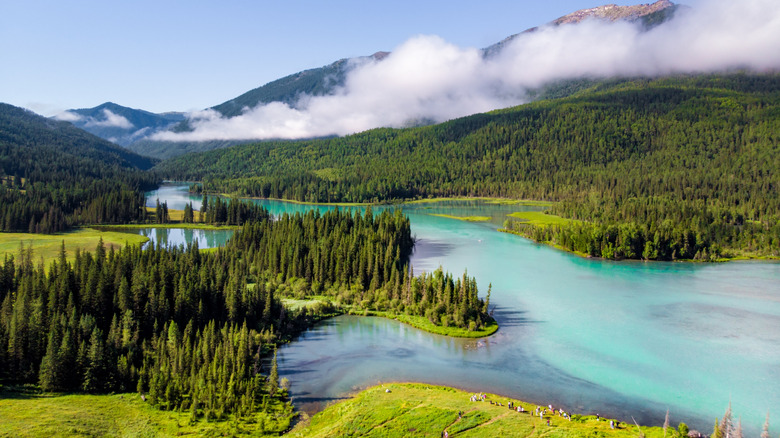
Kanas Lake can be hypnotizing to behold, and its shores teem with fir and pine trees comprising China's largest taiga forest, a type of subarctic forest found in areas such as nearby Siberia. Snow from the lofty mountains, including Youyi and Khuiten Peaks, surrounding Kanas Lake have fed its freshwaters for 200,000 years and serve as a picturesque backdrop. In fact, there's evidence the region may be the birthplace of skiing some 10,000 years ago based on petroglyphs found in the Altay Mountains.
Three bays are in the vast 10,030-square-kilometer (3,872-square-mile) geopark surrounding Kanas Lake: Moon Bay, Shenxian Bay (also called Fairy Bay), and Wolong Bay (also called Dragon Crouching Bay). Their ethereal names are befitting of the mystical scenery. Moon Bay's vividly hued crescent shape cutting through the forest is considered a must-see spot, with Tripadvisor reviewers describing it as a dreamy fairyland. You can hike between the bays, beginning at Fairy Bay and ending at Wolong Bay, which is about a 2.8-mile journey one way. If you want a birds-eye view of Kanas Lake, you can climb 1,068 stairs to the Guanyu Pavilion 1,969 feet above the water.
Taking a boat tour is another way to see Kanas Lake. Cruised take about 45 minutes and cost 120 RMB, roughly $18. The boat takes you around the water by the three bays, with a photography stop in the lake's center. Boats depart from Shuanghu Wharf throughout the day, although cruising between 3 p.m. and 5 p.m. has been recommended for the lighting.
How to get to Kanas Lake and where to stay
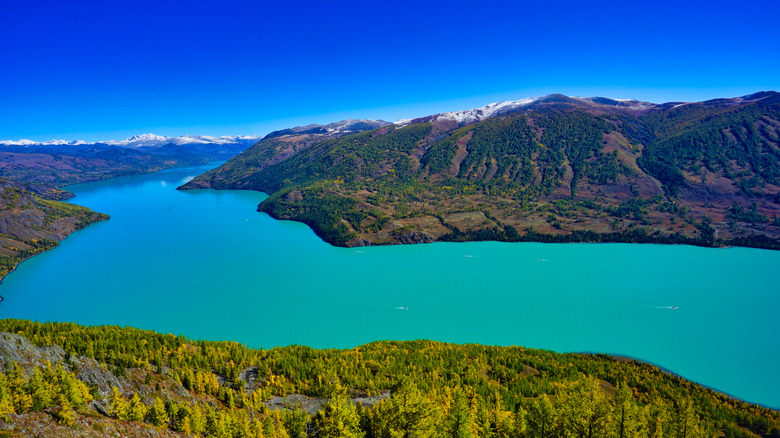
Just like Mongolia, one of Asia's most underrated pristine wonders, Kanas Lake has miles of nature, which is often enveloped in an otherworldly mist beginning in late summer through autumn, especially in early morning. The best time to visit the area is between May and September when the generally chilly temperatures around Kanas Lake are at their highest, still reaching only between 30 and 52 degrees Fahrenheit. There are plenty of common clothing mistakes to avoid on a trip to Asia, so pack appropriately and bring warm clothing and solid footwear, even in summertime. But avoid these mistakes at all costs while packing your luggage, like using the wrong type of bag.
Getting to Kanas Lake by air, flying into Burqin Kanas Airport and then driving 2.5 hours, is perhaps the simplest way. Flights from Urumqi are about 5 hours –while driving from Urumqi is picturesque, it involves a multi-day adventure to travel the nearly 1,920 kilometers, or 1,193 miles, between destinations. If choosing to drive, note there are no private cars allowed into Kanas, so booking a tour may be the best option. Thankfully, accommodations are nearby. Stay in any of several hotels in Jiadengyu at the entrance of Kanas Lake, or in a rustic wooden cabin near the lake in a Tuva Village.