
What Nobody Believes About San Francisco's Weather Until They See It For Themselves
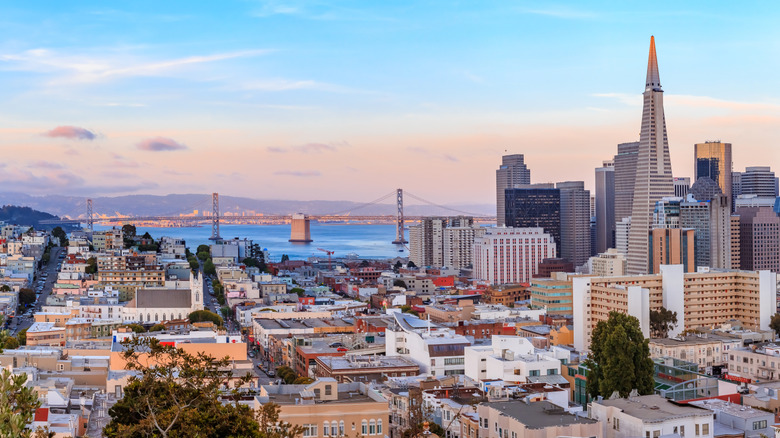
Perhaps if there's one word to sum up San Francisco, it's "unpredictable." One moment, you might be walking on a foggy beach, and the next you're zig-zagging up the "crookedest street in the world" lined with luxe homes. Similar to its undulating terrain, San Francisco's weather is extremely variable. The city is quite well known for its many microclimates — small pockets within the city that have their own distinct temperatures, fogginess, and precipitation. The differences that can arise just within the span of a few blocks are hard to believe until you cross between the microclimates yourself. According to San Francisco Public Works, the city might have more than 26 microclimates. That means you can feel cold and enveloped in fog in one neighborhood, while residents in another part of the city are hot and shading their brows from the sun.
The plethora of San Francisco's microclimates is largely because of its unique geography. On one side, it's bordered by the Pacific Ocean, and on the other, by the San Francisco Bay, both of which affect the weather, as SFBayWeather explains. The Pacific makes the city's westernmost neighbors colder and foggier. Neighborhoods on the Bay get milder bay breezes that make them cooler at night. In between these two bodies of water, the city is delineated by steep hills that redirect fog and wind.
Then, there's the iconic San Francisco skyline with its cluster of skyscrapers. The buildings add another layer to how the weather changes across the city. "You have wind blowing through these man-made canyons and tunnels, and then that causes the air near the surface to mix a lot with the air from above," climate scientist Daniel Swain said in KQED.
San Francisco's main microclimates and how to prepare for them
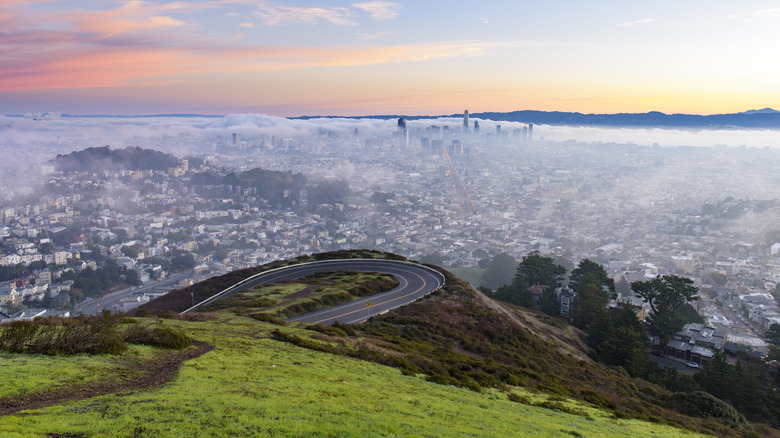
The San Francisco Chronicle breaks down the city into roughly six main climate types. On the western coast of the city, Outer Sunset has a laid-back beach-town vibe, shaped by the Pacific Ocean, which also makes it generally the chilliest area of San Francisco. You can expect wind and foggy days here, too. A sweater or light jacket is worth packing. Unfortunately, one of the foggiest neighborhoods of the city is Twin Peaks since it is the second-highest point in the city and offers some of the best San Francisco Bay Views you can reach without hiking when the sky is clear. Try visiting during a hot spell if you want to get clear views, as the San Francisco Chronicle points out. Meanwhile, northern neighborhoods — namely Marina and Cow Hollow — are flatter and some of the windiest, per SFBayWeather.
Haight-Ashbury and the Mission District might be good bets if you're looking for a neighborhood to spend the day in the sun. Haight-Ashbury is typically sunny during the day but cooler in temperature, while the Mission District is San Francisco's hottest enclave, where summer days draw park-goers in beachwear and sunglasses, per the San Francisco Chronicle. South of Market, or SoMa, is also quite sunny, but it gets strong winds from the Bay that funnel through its tall buildings.
For all its unpredictability, it might be worth downloading the app Mr. Chilly, which has 4.9 stars on the Apple App Store and maps the weather for each microclimate. Otherwise, a general rule of thumb is to have an extra layer with you for the day to take on or off as needed.