
The Newest Discovery At Stonehenge Sheds Light On One Of The World's Most Iconic And Mysterious Landmarks
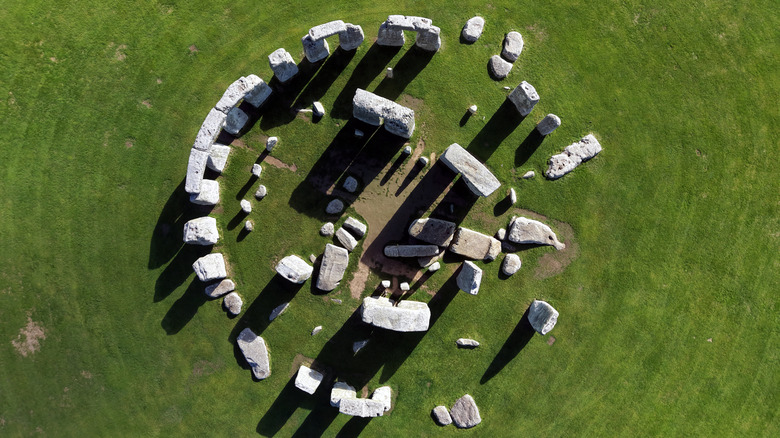
England's Stonehenge has long been recognized for its historical and archaeological importance, and researchers are still uncovering secrets about the Neolithic structure. The site's thoughtful orientation and 25-ton sarsen stones are undoubtedly impressive feats, sparking worldwide intrigue about the ancient people who lived along the Salisbury Plain. The UNESCO World Heritage site is known for its advanced architectural elements from prehistoric times, but scientists can only speculate about how it was built and why. Recently, archaeologists have deduced that Stonehenge has a wooden prototype that predates the stone structure by 500 years.
While there is evidence that activity in the Stonehenge area dates back 5,000 years, the sarsen stones are believed to have been erected about 2500 B.C. However, a wooden structure found about 3 miles from Stonehenge in Bulford has been radiocarbon-dated to around 2950 B.C., meaning that similar customs and beliefs were held by locals long before Stonehenge, per a news report by Wessex Archaeology. The wooden prototype consists of two poles spaced about 393 feet apart, aligning with the sun's placement during the summer and winter solstices. It was excavated alongside 48 pits filled with artifacts like animal bones, pots, and tools.
Although Stonehenge is one of the world's most disappointing and underwhelming attractions, its intrigue and mystique stem from the belief that it was used to mark the movements of the sun in prehistoric times, which rises and sets over the Heel Stone during each solstice. Dr. Phil Harding, who led the excavations, highlights the importance of the wooden structure's discovery and alignment in Wessex Archaeology's report, saying, "What makes it so important is just how early it is. Up till now, our knowledge of this ancient feat of astronomy was based on Stonehenge and other monuments of a similar period."
Stonehenge's astronomical importance
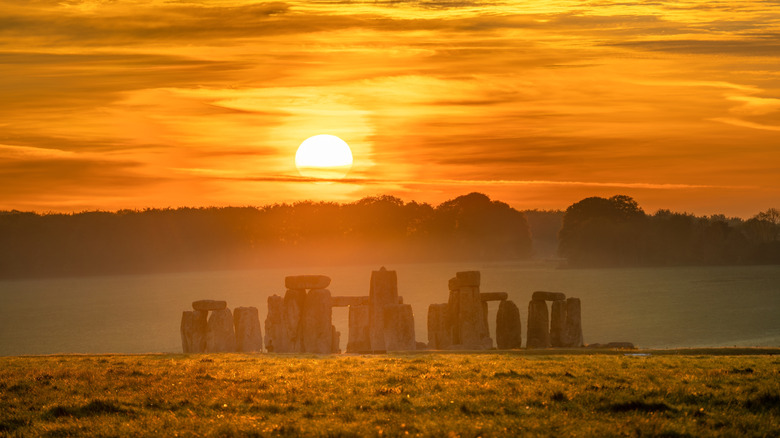
It's still a mystery how Stonehenge was made and what it meant to the Neolithic and Bronze Age people. In fact, excavation of the area where the wooden structure was found occurred between 2015 and 2017, but researchers took years to analyze the artifacts and conclude that it is connected to the solstice, per NBC News. The Bulford discovery was officially announced just before the summer event in June 2026. "It's the earliest example of people building things here that aim directly at the solstice. When we talk about the solstice, we're talking about religion. About how prehistoric peoples understood the cosmos, the world, and their place in it," says Dr. Matt Leivers from Wessex Archaeology.
Stonehenge's importance in understanding ancient customs hasn't gone unnoticed. UNESCO claims that the site is "the most architecturally sophisticated prehistoric stone circle in the world." According to the Association of Leading Visitor Attractions, the historic site received over 1.2 million visitors in 2025. For the summer 2026 solstice alone, Forbes reported over 20,000 visitors, eager to watch the sun rise over the 30-ton Heel Stone on the longest day of the year.
To join the crowds, hop on a coach tour, rent a car, or take the train to Salisbury, about three hours from London's iconic Tower Bridge (which hides a locally loved, family-run pub). There is paid parking on the premises, or you can take a bus from the train station to Stonehenge. General admission includes an exhibition featuring hundreds of artifacts, along with the chance to walk around the stones. You can also book a Stone Circle Experience for a guided tour of the inner circle. Visitors during the summer solstice will even get free entry to watch the sunset and sunrise — just make sure to reserve a parking spot in advance or plan to take the bus from Salisbury, the gateway to Stonehenge, with medieval villages and fairytale trails.