
The East Coast Is Home To All 3 UNESCO-Designated 'Symbols Of Freedom And Democracy'
From Peru's Machu Picchu to the Acropolis in Greece, UNESCO World Heritage sites are worth traveling the globe for. UNESCO, a specialized agency of the United Nations — the name stands for "United Nations Educational, Scientific and Cultural Organization" — works to preserve and highlight profoundly important global cultural sites, among its many purposes. Its prestigious World Heritage List celebrates 1,248 properties, 26 of them in the United States. Among these UNESCO-designated treasures, three are hailed as "symbols of freedom and democracy" — all of them on the U.S. East Coast.
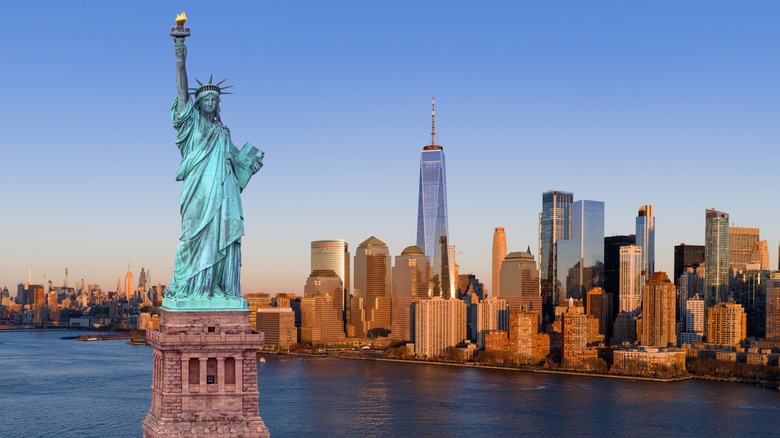
It's hardly surprising that the world-famous Statue of Liberty, the ultimate symbol of freedom, has been a UNESCO-designated World Heritage site since 1984. This colossal New York Harbor icon, a gift from France to the United States in honor of the centenary of U.S. independence, meets two of the 10 rigorously defined criteria UNESCO considers for deeming a place of "outstanding universal value." The statue satisfies UNESCO's first criterion, that it be a "masterpiece of human creative genius," and sixth criterion, which recognizes it as representing ideas of "outstanding universal significance."
An exceptional creation of the French sculptor Frederic Bartholdi and the French engineer Gustave Eiffel (of Eiffel Tower fame), the Statue of Liberty has soared above pretty Liberty Island in New York Harbor since 1886, famously welcoming generations of immigrants. Nearly every aspect of Lady Liberty's 151-foot-tall frame (the statue measures 305 feet with its base) speaks to freedom and democracy. In one hand she bears a tablet inscribed with the date of the Declaration of Independence, in the other a torch symbolizing enlightenment. At her feet are broken chains signifying freedom from the bondage of slavery. The seven rays emanating from her crown carry these enduring ideals to every continent.
Philadelphia's Independence Hall is the birthplace of American freedom and democracy
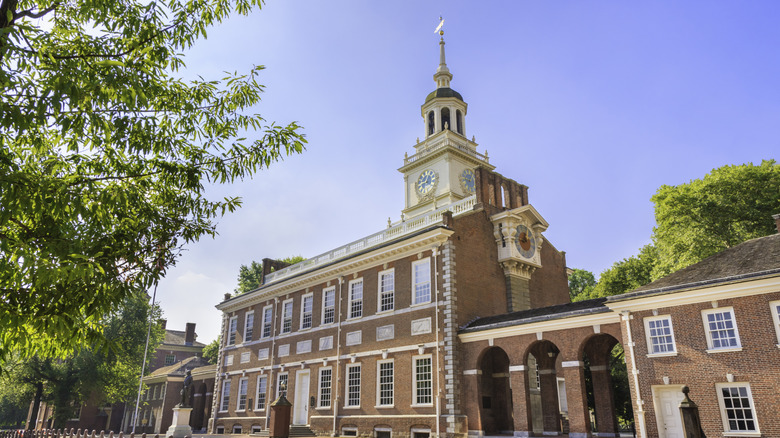
Philadelphia is often considered the "Birthplace of America" since it's where both the Declaration of Independence (1776) and the U.S. Constitution (1787) were signed. These monumental documents established the country's right to govern itself democratically, an enlightened ideal that changed the course of history and influenced governments worldwide. The signing of these documents, along with debates over the principles they define, took place inside Independence Hall, a UNESCO-designated World Heritage site since 1979. Like the Statue of Liberty, it meets UNESCO's sixth criterion, which finds that Independence Hall is connected to ideas and beliefs of outstanding universal significance.
Presiding over Independence Square, part of "America's most historic square mile," Independence Hall is also a National Historic Landmark, crowned by an ivory steeple that formerly housed the Liberty Bell. Inside the stately rooms of this 18th-century Georgian building, America's Founding Fathers — including George Washington, Benjamin Franklin, and Thomas Jefferson — worked to articulate the ideals of American democracy and freedom.
While the building's bones have been remarkably well preserved, retaining its "integrity" and "authenticity" by UNESCO standards, Independence Hall has undergone its fair share of renovations over the years. A painstaking 10-year revamp starting in the 1950s and ending in 1965 faithfully restored the Assembly Room to its glory days when the Declaration and Constitution were signed. And just outside the Assembly Room sits the West Wing, where visitors can view original copies of these documents from the 18th century, along with the Articles of Confederation, under which the nation was governed from 1781 until the Constitution took effect in 1789.
Monticello and the University of Virginia symbolize enlightened ideals
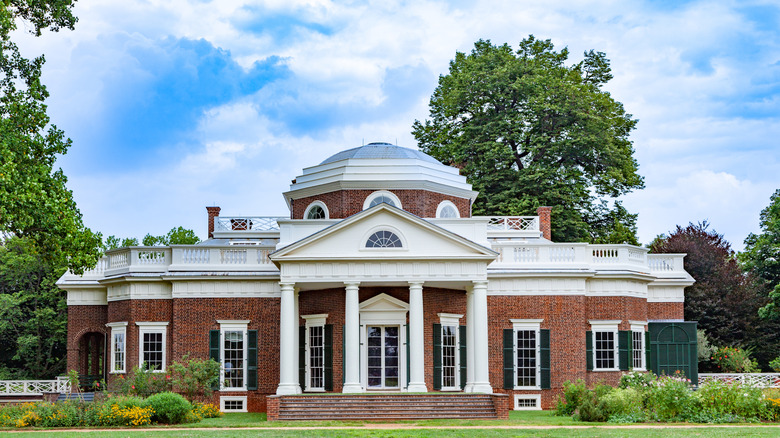
Thomas Jefferson wore a lot of hats. Third U.S. president, plantation owner, and master architect who designed the UNESCO-designated sites of Monticello and the University of Virginia in Charlottesville. Added to the UNESCO World Heritage List in 1987, these buildings meet the agency's first, fourth, and sixth criteria: their Jeffersonian architecture stands out as a masterpiece of human creative genius, they symbolize a significant historical moment, and they're connected to ideas and beliefs of outstanding universal significance. In this case, those of Jefferson, a revolutionary politician who pioneered freedom and democratic ideals by drafting and signing the Declaration of Independence.
Jefferson spent four decades constructing and tinkering with Monticello, his sprawling plantation a few miles outside Charlottesville, which he finally deemed completed in 1809. He designed the neoclassical estate after the fashionable architecture he encountered in Paris during his tenure in the 1780s as America's Minister to France. Comprising three stories, 35 rooms, and multiple gardens abloom with flowers and lined with fruit and vegetables, Monticello showcases a symphony of classical architectural elements such as porticos, cornices, and friezes, and its famous dome inspired by the Pantheon in Rome.
Jefferson's passion for the neoclassical style also influenced his design of the Academical Village at the University of Virginia in Charlottesville, a lively college town filled with wine bars that's nestled in the majestic Blue Ridge Mountains. Housing student dorms, faculty quarters, and a library, the Academical Village was built between 1817 and 1826, and remains a bustling, integral part of campus life. Like Monticello, this series of buildings graced with classical facades and pavilions is a symbolic nod to Jefferson's vision for the American republic.