
Canada's Once-Thriving Industrial Village Is Now A Well-Preserved National Historic Site And Ghost Town
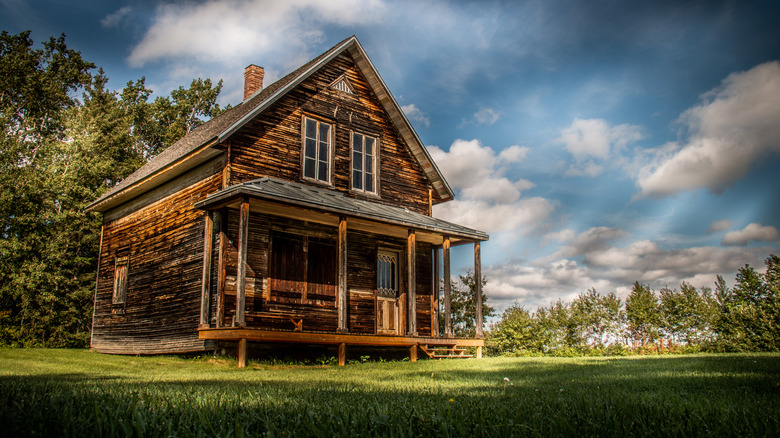
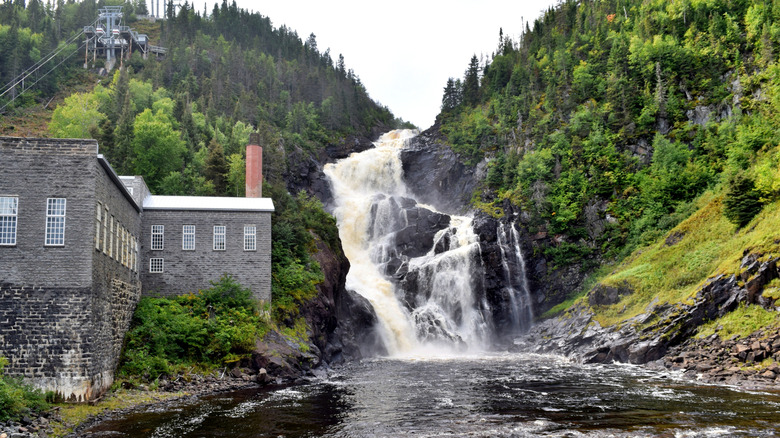
Situated in the Saguenay–Lac-Saint-Jean region in Canada's eastern province of Quebec lies an abandoned collection of buildings. This peaceful, idyllic settlement on the banks of the Ouiatchouan River is close to a picturesque waterfall (illuminated at night) and surrounded by lush greenery and woodlands. Named Val-Jalbert, it was an industrial village established around a pulp and paper mill in 1901. Unfortunately, as with many settlements that spring up around one particular industry, Val-Jalbert's fortunes were tied to those of the mill — and when it suffered its demise, so, too, did Val-Jalbert. By 1929, the last residents left, officially making it a ghost town.
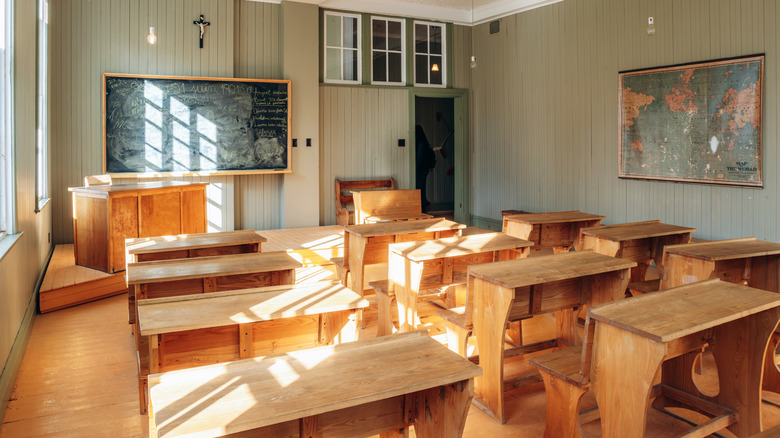
Today, this open-air museum is open to visitors, and roughly 60,000 descend upon Val-Jalbert annually. From the 90-plus original buildings, around 40 have been painstakingly restored for you to explore, including the old wooden family houses, the general store, and the Saint-Georges de Val-Jalbert convent-school, one of the better-preserved structures on the site. And in 2019, the Historic Village of Val-Jalbert became a National Historic Site for its authenticity. It's one of many once-thriving destinations turned ghost towns that are worth visiting in Canada and is supposedly one of the best-preserved in the country.
As of this writing, admission is around $35 (USD) for adults before taxes, including the cable car ride, which provides excellent views of the surrounding area and Lac Saint-Jean from above. Reduced rates are available for seniors, students, children, and families. You're also welcome to hike up the hill, and the entrance fee sans cable car is about $10.
The rise and fall of Val-Jalbert
Beginning in 1898, the Ouiatchouan Pulp Company, the brainchild of entrepreneur Damase Jalbert, was developed at the base of the eponymous waterfall. Pulp was a high-demand product at this time, as it was essential for the mass production of newspapers. The mill became operational by 1902, and around it, a planned residential area was created. Covering just 0.7 square miles, the small settlement was originally christened Saint-Georges-de-Ouiatchouan; however, in 1913, its name was changed to Val-Jalbert, after its founder, who had passed away in 1904.
The formerly bustling village housed around 1,000 inhabitants in its heyday of the mid-1920s. It boasted hydroelectric power, telephone lines, piped water, and a sewer. There were dwellings for workers, a schoolhouse, a post office, and more in this once-lively community. Unfortunately, though, it was hit by numerous hardships over the years. The Spanish flu, one of the deadliest global pandemics, struck in 1918. Although only 14 people succumbed to the disease, the population at the time was just 500 — and most of the deceased were women and children, making this incident unthinkably tragic. More misfortune ensued, as demand for pulp fell in 1924, and the mill experienced financial challenges. Workers started their exodus, seeking out more lucrative opportunities elsewhere, and the mill shuttered its doors for good in August of 1927.
Some former employees, along with the priests and nuns, stayed for another two years. The Quebec government acquired Val-Jalbert in 1949, after the company was officially declared bankrupt, and in 1960, it opened for tourism. Throughout the '60s, conservation and development work continued to transform this abandoned site into a living museum, replete with an immersive, multimedia show, costumed actors, and filmed interviews with previous residents, bringing this fascinating history to life.
Planning your visit to Val-Jalbert, Quebec
Val-Jalbert's outdoor grounds are open year-round, but the buildings are closed during the off-season (usually between mid-October and mid-May). The most pleasant time is between late June and early September, especially if you plan to swim in the nearby lake. Generally, a visit will take around three hours.
If you'd like to spend more time at the intersection of history and nature, a stay here is recommended. An on-site campground contains 188 sites, plus use of the seasonal outdoor heated pool is included. For more privacy and luxury, book an on-site guest room, which comes with access to the historic site. You'll be in a restored period house in the village, and you can dine at the gourmet restaurant inside the old mill. You can also reserve one of the 14 "minimaisons." These 500-square-foot tiny homes are located at Val-Jalbert's entrance and offer views of Lac Saint-Jean from large, glass windows. All rooms are fully furnished and come with climate controls, a kitchen, Wi-Fi, and an outdoor fire pit and picnic area.
The closest major hub to Val-Jalbert is Jean Lesage International Airport (YQB) in Quebec City, the world's first-ever UNESCO Biosphere Reserve city, about a three-hour drive away. An additional option is Montreal, the Canadian destination to visit for charming Paris vibes. You'll fly into Montreal-Trudeau International Airport (YUL), which is around five hours southwest of the village. Both offer car rental services and flights from a variety of Canadian, American, and international destinations, including Toronto, New York, San Francisco, Chicago, and Philadelphia.