
Why The East Coast Has More Barrier Islands Than The West Coast
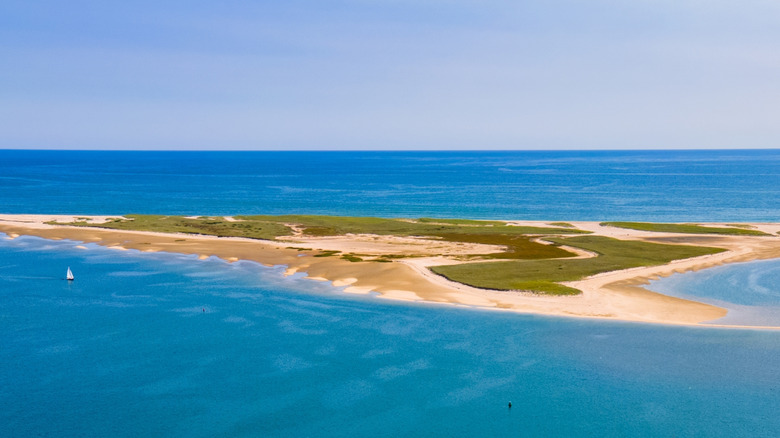
Barrier islands are among the most dynamic features of America's coastline, and they also serve a purpose in protecting portions of the mainland. Given that some of the best beach vacation destinations in the United States are located on barrier islands, they are also instrumental in our enjoyment of the coast. However, the East Coast has far more barrier islands than the West Coast. The difference between the two comes down to the geology, sediment patterns, and processes of those two coastlines.
To be clear, the term barrier islands cannot be properly affixed to just any nearshore island. True barrier islands are elongated sand-based formations that generally run parallel to the mainland. These ever-shifting islands often have dunes on the side facing the open ocean and marshes, lagoons, or tidal flats on the opposite side. Bays, lagoons, and tidal creeks often form between the barrier islands and the mainland. Islands formed from volcanic flows, tectonic activity, coral, or bedrock are classified differently — even if they have sandy beaches surrounding them.
From the dunes and forests of Maryland's Assateague Island to the irresistible beaches and luxe stays of Florida's Amelia Island, the East Coast is dotted with barrier islands. By contrast, there are no true barrier islands anywhere along the Pacific Coast of the contiguous United States comparable to those out East. This is because the West Coast has a more rugged coastline, has a high level of tectonic activity, and a narrower continental shelf with deep water much closer to the shoreline.
East Coast conditions are ideal for barrier island formation
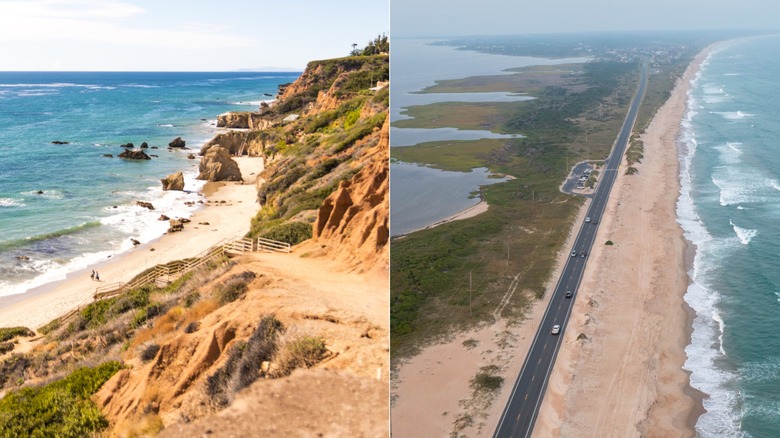
According to the Bureau of Economic Geology, the United States has over 400 barrier islands. This is more than anywhere else in the world, despite the fact that the West Coast has no true barrier islands. That is because the majority of both the East and Gulf coasts, as well as Alaska's Arctic Coast, are covered with them. In fact, the longest undeveloped barrier island in the world is Texas' Padre Island, much of which is protected as Padre Island National Seashore along the Gulf Coast.
Barrier islands form where the right combination of coastal conditions exists. Those factors are a shallow, sloping continental shelf, ample sediment, and minimal tectonic activity. Barrier islands are often found near river mouths, as the rivers serve to carry sediment which is deposited on the ocean floor. Over time, waves and currents redistribute this sediment, allowing barrier islands to form.
Unlike many other coastal islands, barrier islands are not permanent. They are constantly shifting, eroding, and rebuilding. This is true even of barrier islands that have been heavily developed, such as Absecon Island, home to Atlantic City and the longest boardwalk in the world. This is why many communities undertake barrier island restoration and beach renourishment projects to replace lost sand and protect coastal infrastructure.