
Why Many Of North America's Largest Mountains Are Close To The Same Height
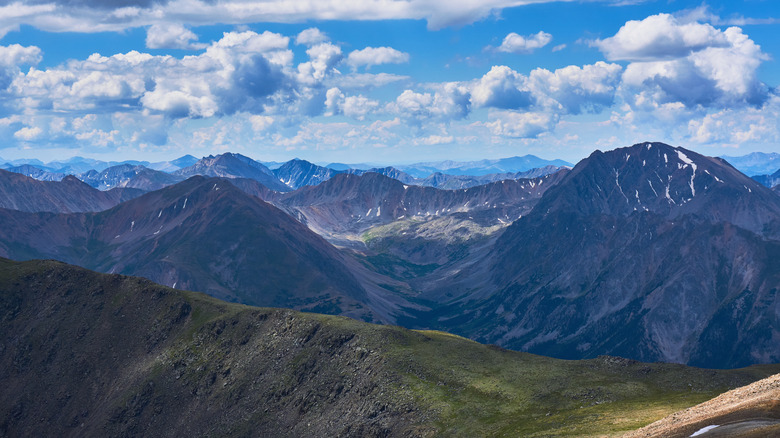
In the western reaches of the United States, mountaineers love to talk about "fourteeners." These peaks rise over 14,000 feet above sea level and are the tallest mountains in the contiguous 48 states. There are 67 fourteeners in all, all located west of the Mississippi River. The record-setter is Mt. Whitney, a summit in California's Sierra Nevada range that tops out at 14,497 feet. The next is Colorado's Mt. Elbert, at 14,433 feet, in the Sawatch Range. The fifth-tallest is 14,411-foot Mt. Rainier, in Washington's Cascades.
For those keeping track, these are three distinct summits that stand in completely different mountain ranges and states. Geologically, they have almost nothing to do with each other, yet the difference in height amounts to only tens of feet. You'll find the same barren surfaces above the tree line and the same thin air. Yet these three peaks are at least 900 miles away from each other, buffered by one or more sizable states. So, why are their elevations so close?
One theory, known as the "glacial buzz saw effect", hypothesizes that the growth of these mountains was stunted at around 14,000 feet due to glacial erosion caps. Other scientific perspectives state that it was simply a coincidence. Because these ranges are so distinct, their outcomes could have turned out radically different. A combination of endogenic forces and weather-based erosion could have shaped each of these fourteeners in different ways. The highest peak in North America is Denali, which stands in an underrated, mountainous national park in Alaska and measures nearly 6,000 feet taller than Mt. Whitney. In different circumstances, any of these fourteeners could have been a Denali or even an Everest.
What America's fourteeners have in common
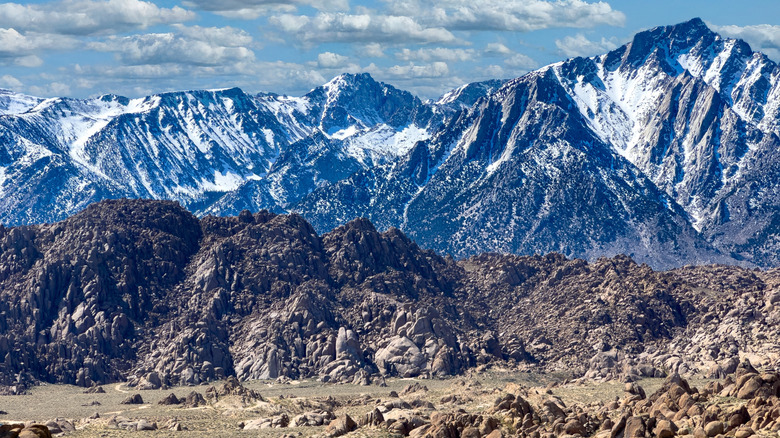
Fourteeners do have a lot in common. They're all located in the western half of the U.S., and each of these ranges is younger than its eastern siblings, as the Appalachians may be as ancient as 500 million years, while the Rockies are no more than 75 million years old. The Cascades date back 40 million years — eons after the death of the last dinosaur — and the Sierra Nevadas were also formed about 40 million years ago. Compared to the Smokies or Berkshires, all these ranges are basically juveniles.
For intermediate mountain climbers, the fourteeners may be just the right size. The thin air and exposed slopes make them challenging to climb, but many have non-technical routes, which means you can just hike a path to the top. Temperatures drop significantly at 14,000 feet, but fourteeners are rarely covered in snow past July. You don't need special equipment to bag Mt. Whitney, and the tough hike to Southern California's tallest mountain is beyond worth it for unmatched views.
For this reason, very few fourteeners need special permission to climb. Hiking Mt. Whitney requires a wilderness permit. A lottery system determines who can hike between May 1 and November 1. Similarly, you need to pay $150 for the permit to ascend Culebra Peak in Colorado, which sits at 14,047 feet. Most others are open to visitors, as long as they're prepared and respectful. Among mountaineers, an often overlooked state is New Mexico, which has 10 fourteeners, including Mount Wheeler, New Mexico's highest peak, and an incredible hiking haven with gorgeous alpine lakes.