
Hawaii's Once-Bustling Sugar Plantation Town Is Now An Eerie Abandoned Ghost Town Reclaimed By Coastal Foliage
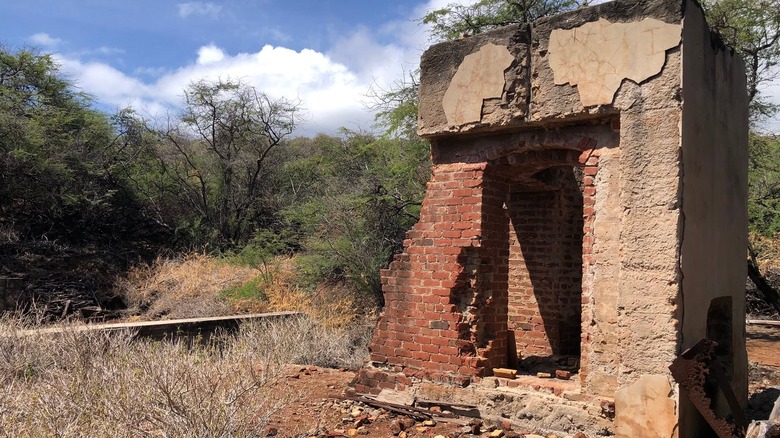
Growing up in Hawaii, the term "ghost town" wasn't something I readily associated with my home state. Hiking in the hills behind my house on Oahu, I'd sometimes come across old shacks or rusted vehicles that hinted at the communities that might have once thrived there, but ghost towns were something I assumed mostly existed on the mainland, in the tumbleweed-filled deserts of California or Arizona. Hawaii's statehood was too recent, the islands were too small, and the land too valuable to be sheltering abandoned century-old villages like Keōmoku, a former sugar plantation on the island of Lanai. Or so I thought.
Hawaii may not have as many ghost towns as Texas, which has as many as 511, or California, which has an estimated 346, but it likely has more than many people realize. By some estimates, Hawaii has 21 ghost towns, one of which is in the Guinness Book of World Records as the "largest medical ghost town" because of patients with Hansen's disease (leprosy) who were once quarantined there. Six of the ghost towns are within 50 miles of Honolulu, while others are scattered across the outer islands. Once bustling hubs for sugar mills and plantation villages, many are now abandoned ruins, rusting in the salty sea air and reclaimed by coastal vegetation.
Keōmoku was once home to about 2,000 residents at the height of Hawaii's sugar plantation era. Today, it's an eerie, overgrown ghost town where the crumbling remains of a boat, train, and sugar mill sit alongside a beautifully restored church. Though Keōmoku's remote location on the east coast of Lanai makes it a journey to reach, the site offers adventurous visitors a fascinating glimpse into plantation-era life in one of the world's most isolated island chains.
Visit a 120-year-old church and the eerie remains of a sugar plantation
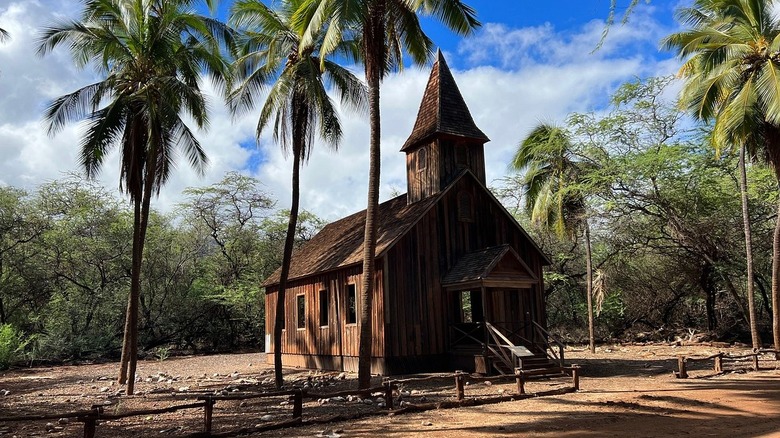
Keōmoku was formed in 1899 with the opening of the Maunalei Sugar Company. Though you wouldn't be able to tell from what little remains of the plantation today, it once was large enough to employ as many as 800 workers. At its peak, the town included houses, stores, an inn, a hospital, a wharf, and a railroad.
While many had high hopes for the mill, it struggled for several reasons, including drought, difficult growing conditions, and its remote location, which presented transportation challenges. In 1901, after just two years of operation, the mill closed. While some Hawaiian families stayed on in the town to eke out an existence through fishing and farming, many mill workers relocated to other islands. By the 1950s, the town's last residents had left, and Keōmoku officially became a ghost town.
Today, all that remains of the once-bustling sugar mill are the remnants of a bread oven, sections of the railroad, and the mill's brick foundations. The village's best-preserved structure is the Ka Lanakila Church, built in 1903 by Hawaiian families and restored in 2010. The rest of the settlement has largely been reclaimed by coastal foliage, overgrown by weeds and shrubs, and nearly swallowed by a thick web of twisted, spindly trees. Fortunately, the ruins are easy to explore thanks to the signs, clearly defined trails, and informational placards.
Explore a train and boat reclaimed by nature
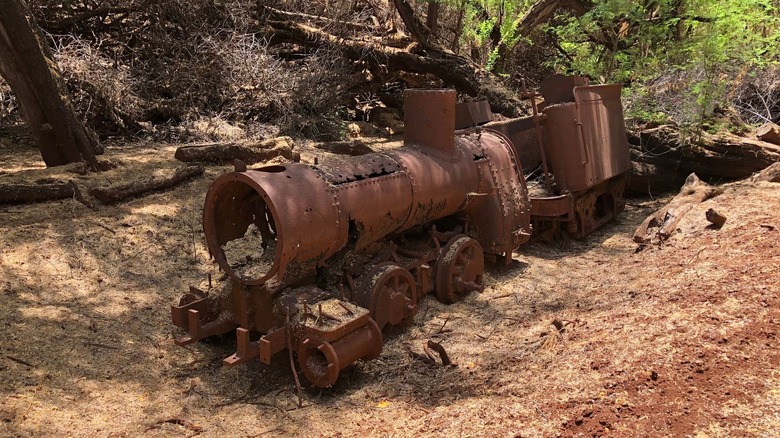
One of the settlement's most striking relics is the 24-inch-gauge Baldwin locomotive. Built in 1882, it was brought to Lanai in 1899 to help with the mill's transportation efforts. The locomotive traveled the railroad linking Keōmoku with Kahalepalaoa Wharf. Today it sits abandoned, rusted, and clogged with sand, though remarkably still in one piece. The same can't be said for the village boat. It once ferried passengers, food, supplies, and fresh water between Lahaina and Lanai, but it has remained beached since the 1920s. More than a century of exposure to the elements has whittled the roughly 38-foot vessel to little more than its engine and outer hull framing.
While a beach is about a one-minute walk from the town, those looking to spend more time by the water may prefer Shipwreck Beach, about a 26-minute drive away. As its name suggests, the shoreline is known for vessels that have either wrecked or have been intentionally grounded. The drive also offers sweeping views of Maui and the famous "whale soup" in the ʻAuʻau Channel. Nearby, you can also visit the historic Kaunolu Village Site, a once-thriving fishing village and former home of King Kamehameha I that's about an hour's drive from Keōmoku.
Getting to Lanai can be a challenge if you're flying in from the continental U.S. You'll need to either take an interisland flight to Lanai or, if you're on Maui, a 70-minute ferry ride from Lahaina. Once on Lanai, take Keōmoku Road for about 8 miles until you reach the shoreline and then turn right and take a sandy coastal road for about another 6 miles. If you're looking to spend the night on Lanai, the island has just three hotels, one of which is Four Seasons Resort Lanai, one of Hawaii's most exclusive resorts, which offers guests complimentary charter flights to and from the Daniel K. Inouye International Airport (HNL) in Honolulu.