
Canada's Underrated Stretch Of Coast Boasts The World's Highest Tides, Ocean Floor Walks, And Immaculate Trails
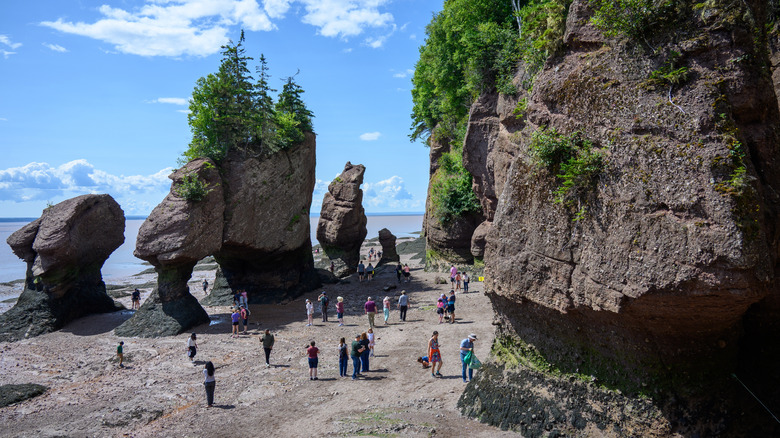
At Hopewell Rocks Provincial Park, one visit just really isn't enough to get a complete picture of its remarkable nature. Located on the shores of New Brunswick's Bay of Fundy, the park is home to towering rock formations called sea stacks that lend themselves to different perspectives as the tide rises and falls.
At low tide, you can walk right up between the sea stacks and follow trails tracing the ocean floor. Just a few hours later, the beach is underwater, with kayakers paddling around the tops of the rock formations instead. The tidal transformation is dramatic, owing partly to the fact that the Bay of Fundy has the highest tides in the world.
Hopewell Rocks may be a signature attraction of New Brunswick, but it doesn't usually appear on travel best-of lists. Nevertheless, Hopewell Rocks holds a 2026 Tripadvisor Traveler's Choice award, indicating that it's the kind of place travelers are glad they didn't skip. "Hopewell Rocks Provincial Park was one of the highlights of our trip ... watching the tide come in to cover the very ground where we had been standing only about an hour earlier was both fascinating and humbling," one past visitor on Google Reviews shared. It may not have the international fame of Banff National Park or Niagara Falls, but Hopewell Rocks offers something few places in the world can: ocean floor access with two distinct views at different times of day.
See how time and tides shape the Hopewell Rocks
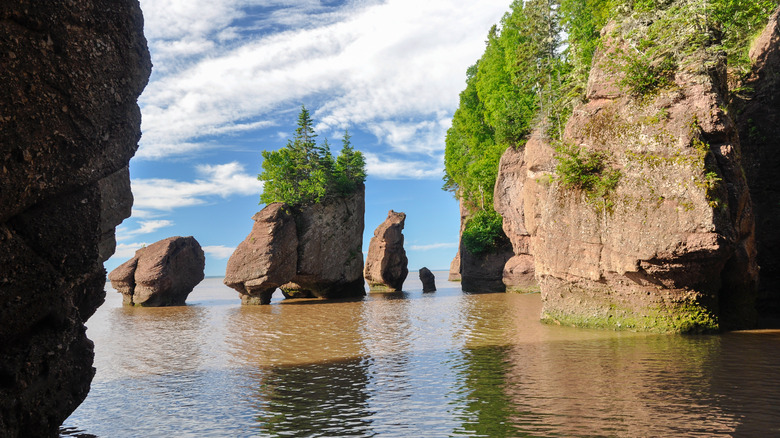
Standing beneath Hopewell Rocks' imposing sea stacks at low tide, it's hard not to wonder how such improbable formations came to exist. More than 20 of these sea stacks (sometimes called flowerpots, due to their shape and the trees sprouting on top of some) speckle just over a mile of shoreline, according to the official New Brunswick Parks website. The rock towers began forming millions of years ago as sediment from nearby mountains compressed into the Hopewell Conglomerate, a geological phenomenon that's also responsible for much of the scenic Atlantic views of coastal New Brunswick.
At low tide, visitors can walk along the ocean floor between the sea stacks — some forming arches, others more reminiscent of columns. About 6 hours after the tide's lowest ebb, it reaches peak high tide, and the area becomes fully submerged. The Bay of Fundy's extreme tidal changes are up to 53 feet at their peak, because of the Bay's funnel shape and natural oscillations.
Over thousands of years, those tides have also helped shape the park's sea stacks. One of the perks of visiting Hopewell Rocks is that admission is valid for two days, giving you ample time to see the park at both high and low tide. The New Brunswick Parks website provides a helpful tide table, so you can track when the ocean floor will be accessible.
Explore Hopewell Rocks' trails and ocean floor
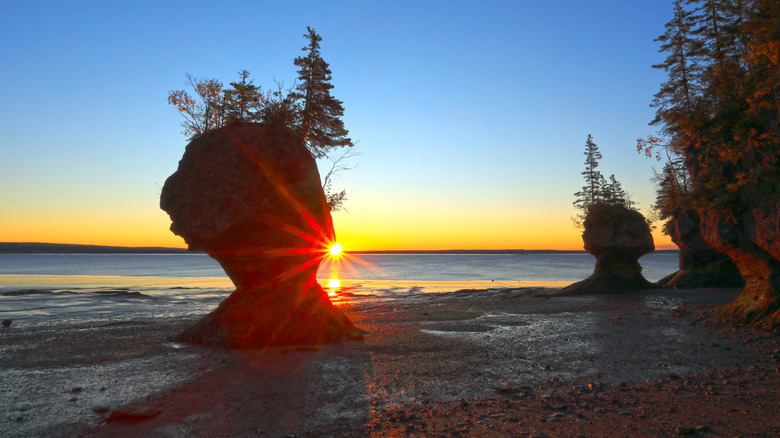
Along the shoreline stretch that makes up Hopewell Rocks Provincial Park, visitors can follow trails bordered by a string of sea stacks. Some of the sea stacks have nearby lookout platforms, but there are three primary spots where you can directly access the ocean floor and walk up to the stacks (tide permitting). The trails, made up of gravel and dirt, are classified as easy by the park, meandering through coastal forest and past viewpoints over the bay. Benches and interpretive signs along the way give hikers a chance to pause and take in some of the scenery. Online reviewers frequently mention that the trails are well-maintained, so you won't come across any warning signs that a hike isn't beginner friendly.
The Main Deck access point sits at the end of a roughly 0.5-mile trail from the park's entrance and interpretive building. Here, you climb down about 100 steps to reach the ocean floor and some incredible sea stacks, including the fairly iconic, arch-shaped formation known as the Lovers Arch. A bit further beyond the Main Deck, there's a wheelchair-friendly ramp to the ocean floor (though the sandy floor itself, as New Brunswick Parks notes, may be difficult for wheelchairs to traverse). Visitors can also walk a 1.5-mile route that traces the shoreline entirely along the ocean floor, letting you get up close to hidden coves and cliffs. Just beware that there's one tricky section called the Ledges on the path that involves some rocky scrambling.
For long-haul travelers, the most practical gateway to Hopewell Rocks is Moncton, a charming Canadian college city on the river with the Greater Moncton Roméo LeBlanc International Airport. From Moncton, you drive about 40 minutes to reach Hopewell Rocks.