
Canada's Spectacular, Lesser-Known Park Filled With Close To 100 Lakes Is An Outdoor Lover's Dream
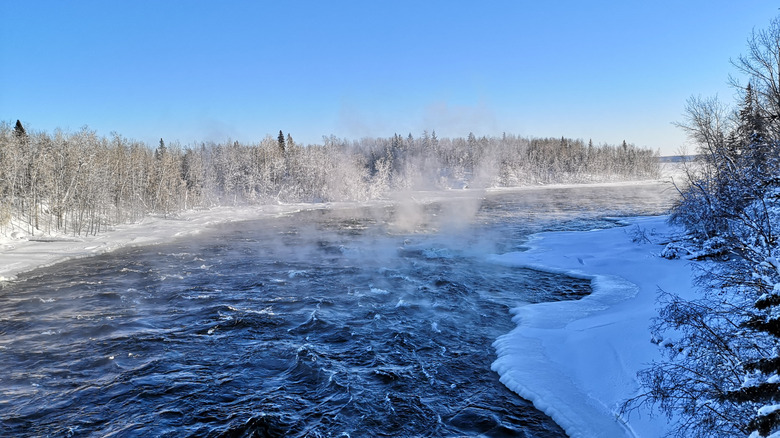
Running up through the spine of Canada from the U.S. border to the Northwest Territories, Saskatchewan is the country's prairie heartland, long sought out for its fertile plains and abundant sunshine. In the north of the province, where the prairies give way to boreal forest, sits a sprawling park whose spectacular scenery belies the fact that it's not well known beyond Saskatchewan. Called Lac La Ronge Provincial Park, it has almost 100 lakes, backcountry camping and fishing opportunities, and miles of hiking and cross-country skiing trails slicing through the forest. It also hosts Saskatchewan's oldest building, the mid-19th century Holy Trinity Anglican Church, and Nistowiak Falls, one of the largest waterfalls in the province.
Lac La Ronge takes its name from the large glacial lake in the heart of the park. Coming from a French term meaning "the chewed," it was likely named by Francophone fur traders who observed beavers chewing trees around the water's edge. The eponymous lake is by far the largest, beset with islands and peninsulas and points and bays, but there are dozens more within the park.
Though encompassing more than 336,000 hectares — making it larger than Yosemite — more than half of Lac La Ronge Provincial Park is submerged under water. And the water is where visitors are likely to end up, whether it's canoeing, fishing, or kayaking on the rapids; watching the thundering falls; hiking between the lakes; or sitting by the lakeshore admiring the towering conifers or aurora borealis enlivening the night sky. Other scenic lakeside provincial parks in Saskatchewan, like Blackstrap, are closer to civilization. But serious outdoor lovers should consider traveling deeper into the province to discover Lac La Ronge.
Outdoor adventures in Lac La Ronge Provincial Park
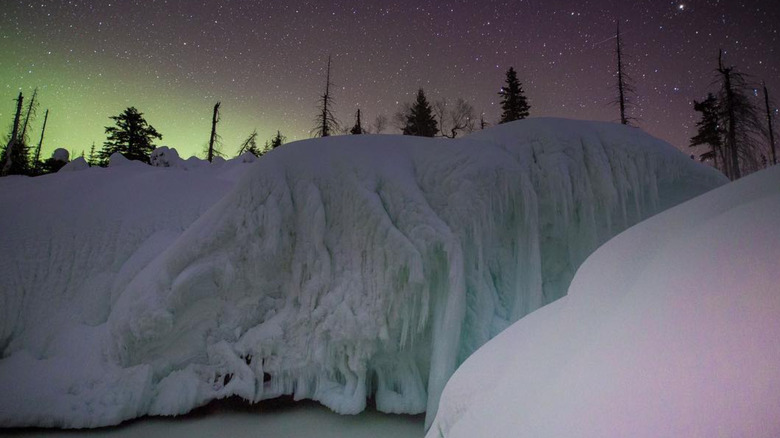
What you do on and around the lakes of Lac La Ronge will be dictated by the season. Over 30 miles of hiking, biking, and skiing trails weave through thickets of jack pine, spruce, and larch trees, occasionally drifting back to the edge of the lakes. The longest of these routes, the Nut Point Trail, is a challenging, 19-mile hike with more than 2,000 feet of elevation gain. Hikers on AllTrails note that the trail could be better maintained, but give top marks to the scenery, especially when the leaves change in fall. The park's trails are then groomed in the winter for cross-country skiers.
Paddle sports are popular in the park, both on the lakes and the river rapids. You can rent canoes, kayaks, and tubes from Churchill River Canoe Outfitters (4.8 stars on Google), north of the main lake. The outfitters also take visitors on guided expeditions, from a multi-day excursion along the Churchill River to an introduction to solo white-water canoeing, and offer accommodation in rustic log cabins. If you're going to traverse the water solo, GoTrekkers sells detailed maps of the park, or you can download free maps and route instructions from Canadian Canoe Routes.
It's worth seeing Nistowiak Falls while you're here. A 32-foot drop on the Fisher Rapids, the falls are a 12-mile paddle east from Stanley Mission, a town on the banks of Mountain Lake. They're also accessible by boatplane, bike, snowmobile, or skis, depending on the season. Even in the winter, when the park is covered in ice and snow, the falls emit a tremendous roar. If you're fortunate enough to be here on a day with bright blue skies, you're likely to see rainbows thanks to the spray mist rising towards the sky.
Staying in and getting to Lac La Ronge Provincial Park
Keen outdoorsfolk often prefer to sleep in the wild, and Lac La Ronge Provincial Park has campgrounds to accommodate that, including a couple of large grounds on the western shores of Lac La Ronge. Further north you'll find Little Deer Campground, enclosed by trees and offering a boat launch and firewood (but not electricity). There are only a couple of sites here, and because it's hidden away from the main lake, it feels like a proper escape from the world.
Devil Lake Campground is another small, secluded space to spend the night under the stars. You'll get access to the namesake lake with a boat ramp and fish filleting shack, along with the short but scenic Devil Lake Trail. Always check in advance if campgrounds and other areas of the park are open, as wildfires are unfortunately common during the Canadian summer — making it one of the many destinations worldwide being damaged by climate change.
Lac La Ronge is in Northern Saskatchewan, but geographically speaking, it's bang in the middle of the province. It's about a four-hour drive from the hip and artsy prairie city of Saskatoon. There's also a small airport in the nearby town of La Ronge, fielding flights from Saskatoon and a handful of other regional airports.