
Canada's Stunning Coastal Park Is A Pristine Getaway For Beach Beauty And Shoreline Hikes
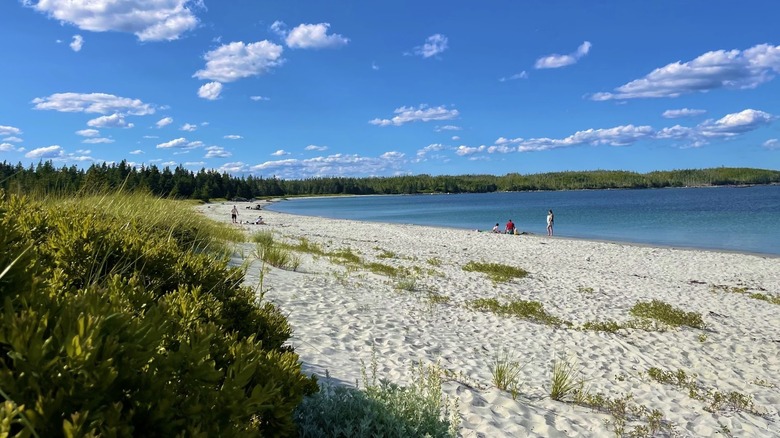
While Nova Scotia has plenty of storied maritime towns and buzzing cities big and small, its coastal regions are often the main event for travelers visiting the province. Indeed, the peninsula's famed access to some of the most stunning beaches and rocky stretches earned it the title of Canada's "ocean playground." Despite its contained size (it is Canada's second-smallest province), Nova Scotia looks after more than 140 provincial parks (an even more impressive figure when you consider that the much larger Manitoba has only 93). Located on the province's pristine Eastern Shore, southwest of Sheet Harbour, Taylor Head Provincial Park particularly stands out for its shoreline hiking trails and untouched beaches stretching for miles along its unique shape.
Taylor Head Provincial Park's peculiar shape, consisting of a 4-mile stretch of sand snaking into the ocean, is one of its unique features, contributing to secluded rocky coves, smooth white beaches, and crystal-clear waters. While the park's sandy beaches make for tranquil boardwalk strolls and chilly swims, keen hikers also have access to almost 9 miles of trails, crossing some of the park's most scenic spots. Accompanying beautiful beaches are a plethora of wildlife and bird life and open, wind-swept vistas over the Atlantic Ocean reflecting the park's more rugged nature.
Despite its secluded location, Taylor Head is still easy to reach from the province's main hubs. Nova Scotia's capital, Halifax, is located about 65 miles west, via a panoramic, 90-minute drive along Marine Drive (Route 7), and the park is just 57 miles from the popular tourist attraction of Sherbrooke Village.
Taylor Head Provincial Park has beach beauty in spades
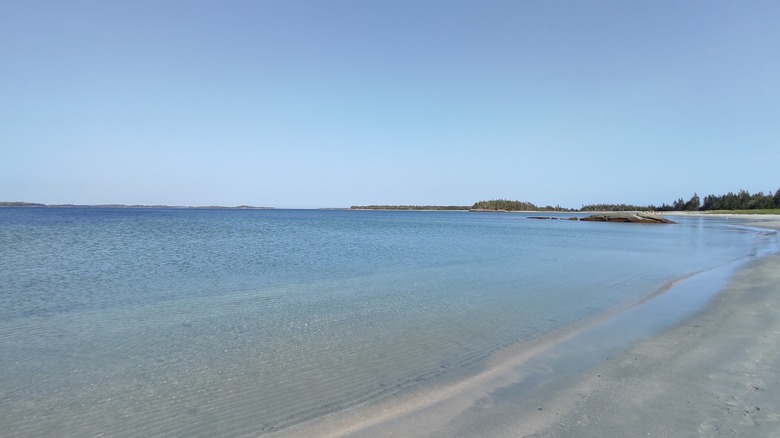
Compared to Nova Scotia's popular South Shore, this stretch of elongated shore, jutting out from Spry Bay and into Taylors Head Bay, offers travelers a quieter and less crowded getaway. While places like UNESCO Heritage-listed Lunenburg, with its quirky charm and fresh seafood, or Canada's "most picturesque village," Peggy's Cove, are likely to be on visitors' bucket lists, the Eastern Shore is less traveled –- and more rugged.
With 10 miles of mesmerizing, pristine shores, Taylor Head Provincial Park is ideal for scenic seascapes and lookout points dotting the perimeter. A particularly photogenic spot is Psyche Cove, a sandy beach in the shape of a crescent moon, sporting turquoise, see-through waters. Visitors can reach the spot on foot by following the 1.2-mile Beach Walk, which is the park's shortest trail. Aside from its wind-swept sand dunes — a geological result of glacial till and bedrock eroding over time – the soft, sandy terrain and peaceful, pristine surroundings make it a popular spot for a swim on a sunny day. It is worth noting that beaches in the park are unsupervised. For a change of scenery, venture along the Bull Beach Trail, which swaps sandy, flat beaches for more rugged landscapes — including boulders, pebbled stretches, and upland forested areas.
Embark on epic shoreline hikes in Taylor Head Provincial Park

Beyond its pristine beaches, Taylor Head has a network of linked hiking trails visitors can use to explore the park's natural habitats, as well as to enjoy oceanic views. There are five main trails, including the aforementioned Beach Walk and Bull Beach Trail. The Spry Bay and Headland trail loops converge into one long walk almost circumnavigating the tip of the peninsula and measuring 4.7 miles. The combined trail crosses some of Taylor Head's wildest points, giving hikers unparalleled access to shaded woodland paths, magnificent boulders, and almost 360-degree views of Spry Bay. However, one of Taylor Head's most remarkable views can be observed from the slightly elevated Bob Bluff Trail. On this 1.8-mile hike, visitors can spot the islands orbiting off the coast of Mushaboom Harbour and descend close to the rocky shore.
Due to the park's positioning, projecting directly into the turbulent Atlantic waters, hikers should prepare for windy conditions regardless of the season and wear waterproof footwear for muddy paths and occasional ocean sprays. Visitors should also be cautious of fast-moving tides to avoid getting marooned.
While Nova Scotia may not be the Canadian province where you can spot all of Canada's "Big Five" wildlife (that would be Manitoba), it still has a rich and diverse ecosystem encompassing more than 11,000 endemic species. Some of its residents include otters, porcupines, white-tailed deer, and seals, as well as about 100 recorded bird species. Along with native and migrating waterfowl, visitors can spot plenty of seabirds, including Arctic terns, guillemots, eiders, ospreys, and bald eagles, as they hike.