
This Once-Thriving City In The Roman Empire Is Now Scenic Abandoned Ruins That Are Still Worth A Visit
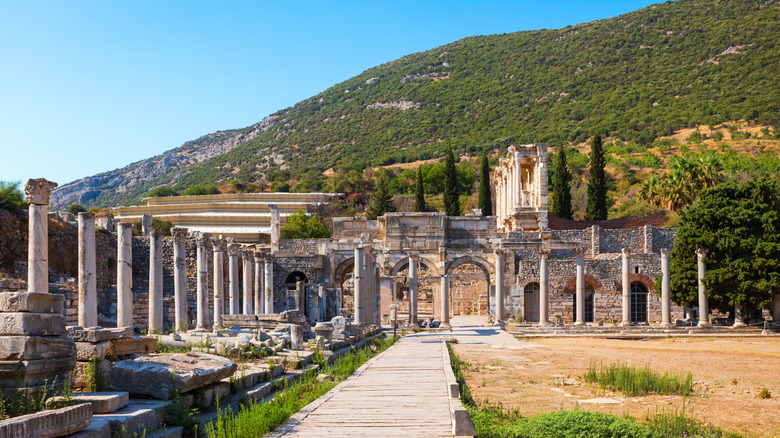
Two thousand years ago, Ephesus was a city of crowded streets and grand monuments to power and prosperity. Today, travelers can walk around the historic city and see where its former residents shopped, worshipped, watched performances, and even used the community latrines, a row of marble toilets that reveal a more human side of ancient Roman life. This sprawling archaeological marvel near Turkey's Aegean coast is a UNESCO World Heritage Site and covers about 2.6 square miles. It includes some remarkably preserved ruins from the Roman Empire, including the impressive Domitian Square, where you'll find a graceful relief of the goddess Nike. Just beyond the city center, visitors can see the remnants of one of the Seven Wonders of the Ancient World, the Temple of Artemis. Look out for smaller details as well, like the centuries-old mosaic sidewalks in front of the Terrace Houses. Meanwhile, the surrounding hills frame the site with lush Mediterranean greenery.
Although located in present-day Turkey, Ephesus had its beginnings in the Greek and Roman Empires. Under the Greeks, it was an important commercial port city, sought after and captured by Alexander the Great around the fourth century B.C. It passed into Roman rule in 133 B.C. and became the capital of their Asia province. At its height, over 250,000 lived in Ephesus, the fourth-biggest city in the empire. However, the port slowly became harder to access, as its harbor naturally silted up, and it declined in the early Middle Ages until being deserted altogether. But that abandonment meant that many of its structures remained untouched. Travelers can walk through the original street plan where homes, baths, shops, temples, and public squares have been preserved, getting a glimpse into how this notable metropolis once functioned.
How to visit Ephesus
Many visitors to Ephesus are surprised at just how big it is. "I had no idea the extent of the ruins, you get the feeling of a sprawling, ancient city ... everything that you could imagine a city would have is preserved in some degree," one Tripadvisor reviewer described. It isn't a compact cluster of ruins you can check off in half an hour — most guides suggest planning around two to four hours for a visit. The site has two entrances, the Upper Gate and Lower Gate — the latter is the most popular, since it has more facilities and parking. Three broad, marble streets link the city's biggest landmarks, which you can easily follow with or without a guide.
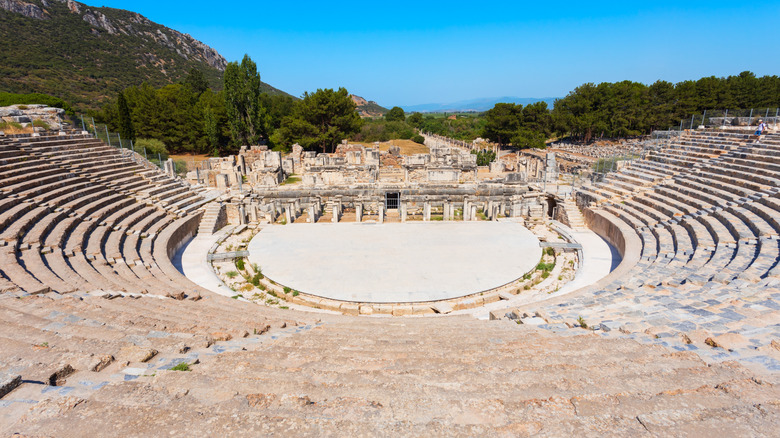
There are some obvious stars along the route: The towering Library of Celsus is one of the city's most photographed ruins, built around A.D. 135. Though its interior collapsed long ago, the elegant, two-story facade has been restored. And the semi-circular Great Theater of Ephesus that once seated tens of thousands of spectators and dates back to 250 B.C. is another must-see. Built into a mountain slope, the giant venue offers sweeping views across the ruins and of the surrounding hills. On clear days, you can see out toward the Aegean coastline when you climb to the top.
Ephesus can be found around six hours southwest of Istanbul, the country's dazzling capital and unlikely beach destination. Travelers can use Izmir, a tourist-friendly but underrated city on Turkey's coast, as a launch point. It's just over an hour by car from Ephesus and has the international Izmir Adnan Menderes Airport. If you're looking for more unique historical sites to visit, the underwater cities of Halfeti and Kekova are an enchanting snorkeling destination.