
Under An Hour From Boston Is New England's Former Battlefield That's Now A Historic, Scenic Nature Park
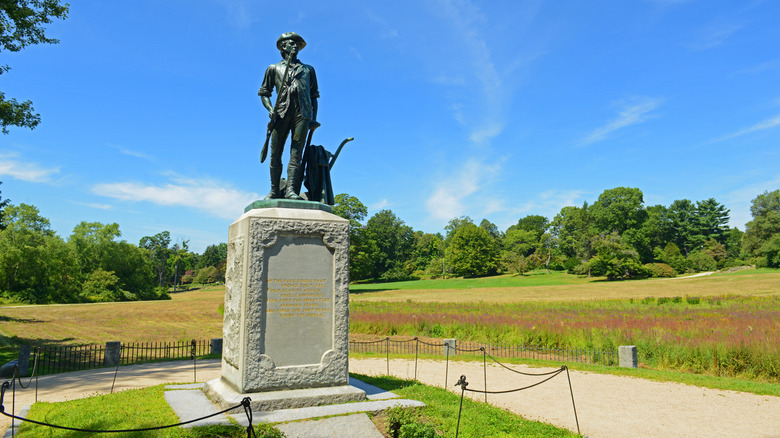
The battlefield that occupies Minute Man National Historical Park in Massachusetts doesn't look much like a battlefield anymore. Once the site of battle lines and bloody skirmishes, the park now preserves woods, wetlands, meadows, and farm fields. Yet there are traces from the period of the what's now called "the Birthplace of the American Revolution."
The park includes segments of the original Battle Road on which fighting took place (and which now serves a hiking route). A few 18th-century structures still stand, too, including the house from which Major John Buttrick led the Minute Men to meet British forces. Located on a corridor spanning parts of Lexington, Lincoln, and Concord, a Massachusetts town famed for local charm and unique landmarks, the park is an easy day trip if you live near or are visiting Boston — about a 30-minute drive from Boston's center, depending on frequently heavy traffic.
Minute Man National Historical Park gets its name from the Minute Men, local militia volunteers during the colonial period who trained to be ready "at a minute's warning," per the National Park Service. On April 19, 1775, they mobilized against British troops sent from Boston to Concord, igniting the first armed battle of the American Revolution.
At the park site's North Bridge, the militia and British soldiers fired shots at each other, cementing it as the spot where the war began. Fighting then followed along what is now the Battle Road Trail, with numerous sites that mark where ambushes and exchanges of fire took place: Meriam's Corner, Elm Brook Hill, the "Bloody" Bluff, and Fiske Hill. Visitors can still see the North Bridge and walk preserved sections of the five-mile trail, visit the restored 1733 Hartwell Tavern, and see the bluff and fields where soldiers fought.
Walk the Battle Road at Minute Man National Historical Park
For all the battle-strewn weight Minute Man National Historical Park carries, its character today is that of a peaceful nature park. "One of the main trails we walked on was such a beautiful place, including passing on a straight route full of trees, walk[ing] around a big magnificent pond full of ducks," a Google Maps reviewer wrote. Around half of the park is forested, the park service says, with a distinctly New England mix of maples, birches, oaks, and ashes — trees that turn fiery colors come autumn, making it a good stop for travelers looking for New England's best fall foliage tours.
Elsewhere in the park, you'll find everything from vernal pools (small, seasonal pools rife with amphibians) to ancient boulders, including one that allegedly shielded a young Minute Man from British fire. Wildlife is abundant, too: Bring binoculars to look for white-tailed deer, foxes, and coyotes in the woods, while countless birds (herons, cardinals, and woodpeckers among them) flutter between them.
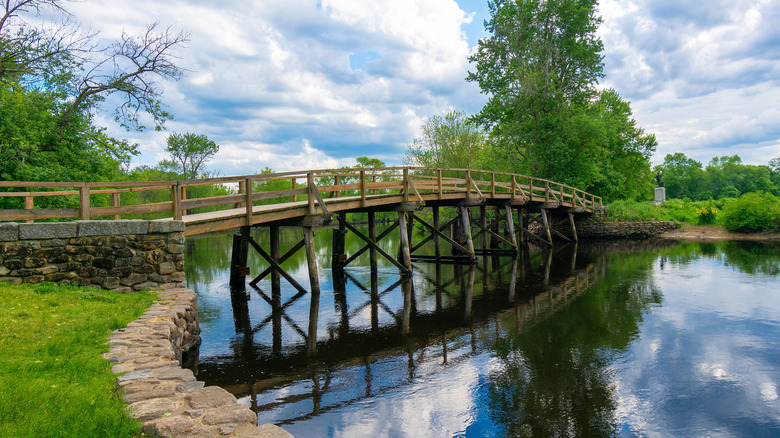
The Battle Road Trail is the park's main hiking route, bridging most of the important battle sites but also moving through fields and woods. Walking three-tenths of a mile instead, from the North Bridge's visitor center, takes you to Concord's North Bridge, a simple wooden bridge built in 1956 to look like the bridge that stood during the battle. You can walk these routes independently and use the park-service app's self-guided tours, covering historic details, or plan a visit between Memorial Day and the end of October for ranger-led programs and walks. If you visit around the battle's anniversary in April, you can attend one of the park's free reenactments or demonstrations with costumed interpreters. Regardless of when you come, the park charges no fee to visit.