
These Are The 10 Most Gorgeous Japanese Gardens In America
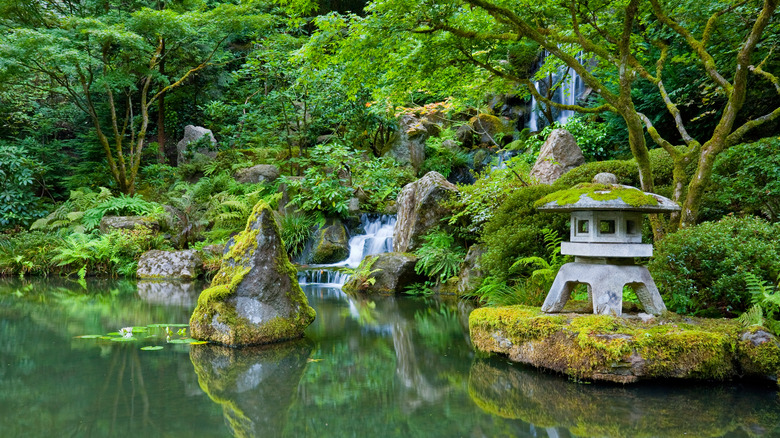
The great Japanologist, Lafcadio Hearn, once wrote that a Japanese garden's artistic purpose is to "convey the real impression that a real landscape communicates. It is therefore at once a picture and a poem; perhaps even more a poem than a picture." More than 100 years later, his words still ring true. What has changed is that you don't have to go to Japan to see one. Because of America's lengthy history of Japanese immigration and the Western fascination with Japanese design during the Meiji era (1868-1912), Japanese gardens have been constructed all across the U.S., many designed by legendary Japanese garden architects.
You may have some sense of what a Japanese garden should look like. Perhaps there are pine trees, clipped and pruned with precision, their boughs looking like thick green clouds. Maybe you see stones raked in concentric circles, rolling carpets of moss, ponds filled with carp, and scenery "borrowed" from nearby landscapes. You may hear the gentle glug of a "shishi-odoshi" (rocking bamboo fountain) and detect the earthy scent of a "hinoki" (cypress tree). Flowers are often absent — as though regarded as glorified weeds — and spiritual iconography is everywhere, even if you can't immediately see it.
A Japanese garden can mean many things, but irrespective of its style, it's both an aesthetic exercise and an act of communication. The "karesansui," or "dry landscape garden," is not a simple assemblage of stones and pebbles, but a lesson in the virtues of restraint. Strolling gardens use the principle of "hide and reveal," thereby rewarding movement. They convey landscapes in miniature form and depict scenes from ancient paintings and poetry. The 10 Japanese gardens below are among the most beautiful you'll find in America, and represent Japan's different garden styles. These gardens are often popular with tourists, have received rave reviews from users and garden experts, and are scattered across the country.
Portland Japanese Garden, Portland, Oregon
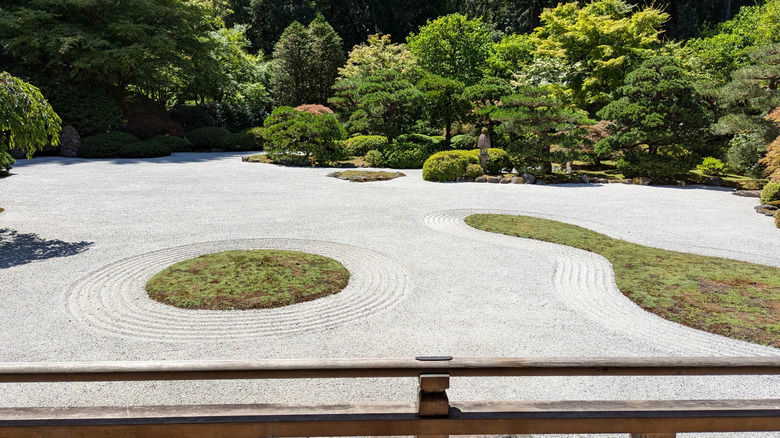
It's often said that Japanese gardens look their best in drizzling rain. It makes sense, then, that Portland, famous for overcast skies and frequent rainy days, has one of America's finest Japanese gardens. Designed in 1963 and covering 12.5 acres, Portland Japanese Garden comprises eight garden spaces, including a dry landscape garden, a tea garden (with a gorgeous wooden tea house), and a courtyard-style "tsubo-niwa" garden. Country Living argued that this garden is worth planning a trip around, and a former Ambassador of Japan proclaimed it to be "the most beautiful and authentic" Japanese garden on foreign shores.
Seattle Japanese Garden, Seattle, Washington
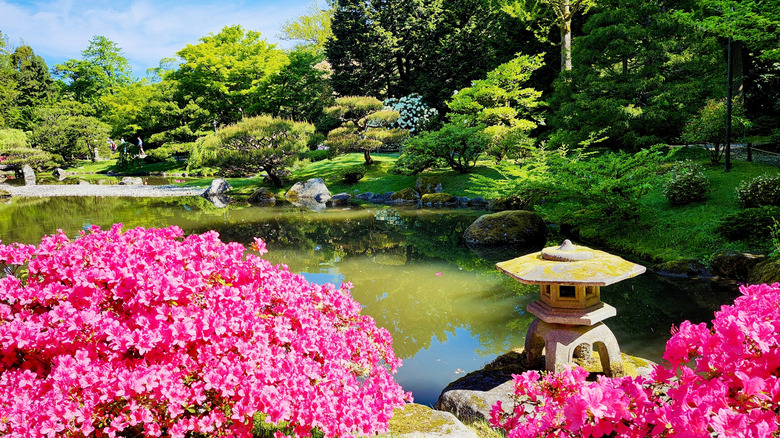
Another drizzly city, another beautiful Japanese garden. Every year, 100,000 people visit Seattle Japanese Garden, a neatly manicured space set within a vast arboretum, a little east of Capitol Hill. It's defined as a strolling garden and carries all the hallmarks of one: a central pond, a network of paths, artificial hills, "hide and reveal" scenery, and symbolism at every turn. The Kubota Garden in Rainer Beach might be one of Seattle's most underrated parks, but Seattle Japanese Garden is the most accomplished of the city's surprisingly plentiful Japanese-style outdoor spaces.
Japanese Tea Garden, San Francisco, California
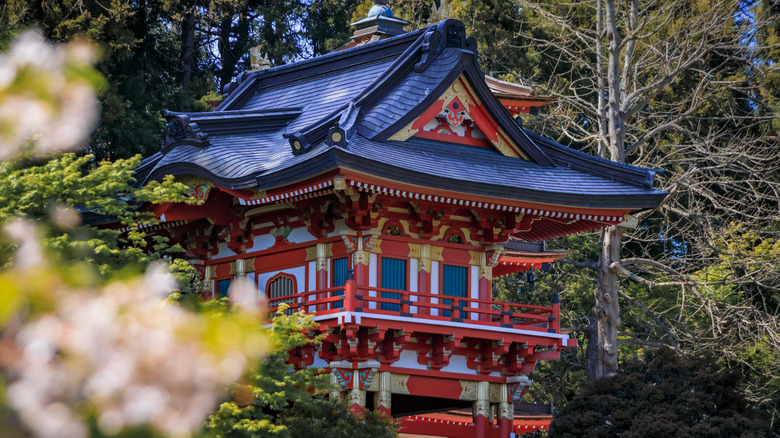
As matcha and romantic ideas of the Japanese tea ceremony boom in lockstep with Japanese culture abroad, San Francisco's Japanese Tea Garden has become an increasingly in-demand tourist attraction. It's older than its peers, built as a Japanese-style village for the 1894 California Mid-Winter International Exposition, and perfectly located, right in the middle of San Francisco's most beloved attraction, Golden Gate Park. Stroll among the cherry trees, flowering shrubs, Japanese architecture, and Buddhist iconography, then stop in the tea house for tea brewed on a sunken "irori" hearth.
Tenshin-en, Boston, Massachusetts
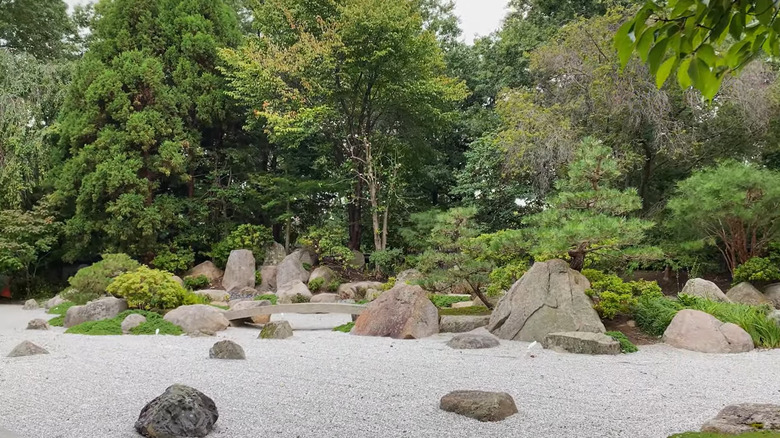
In the West, gardens are experienced actively; you wander among the flower beds and fountains as a participant in a three-dimensional space. In Japan, however, some gardens are only meant to be viewed. Famous garden designer Adachi Zenko once described these, quite beautifully, as "living paintings." Tenshin-en, "Garden of the Heart of Heaven," in the Museum of Fine Arts Boston is one such example. Designed by Kinsaku Nakane, the dry landscape garden is admired from the edge, as though it were a painting in a white-box gallery. Look for rock formations resembling a turtle and crane (symbolizing life's polarities) and landscapes depicted in miniature.
Shofuso, Philadelphia, Pennsylvania
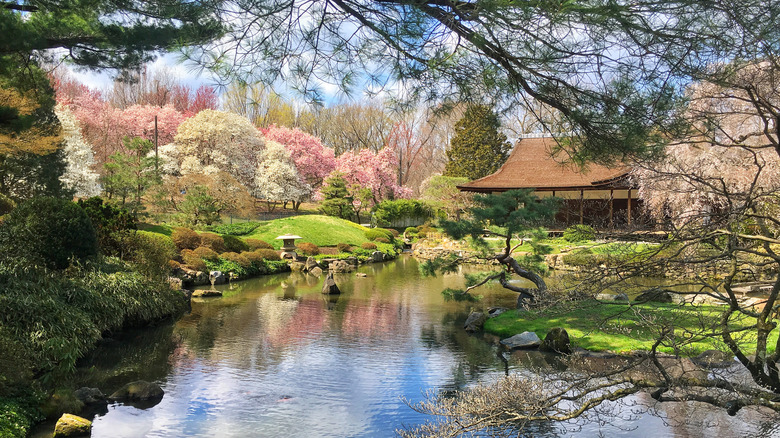
Though it's now located in Philadelphia's Fairmount Park, Shofuso has been unusually itinerant. The Shofuso house was built in Japan in 1953, shipped to New York, and exhibited in MoMA before arriving in Philly in 1958, after which a new garden was added. Almost 70 years later, Shofuso Japanese House and Garden is still one of Philadelphia's best hidden tourist attractions.
Surrounding the sparsely decorated wooden building are maple trees, a carp-filled pond, a teahouse, and towering pines. It's particularly beautiful during the spring cherry blossom season, when sakura petals drift across the grounds.
The Huntington Japanese Garden, San Marino, California
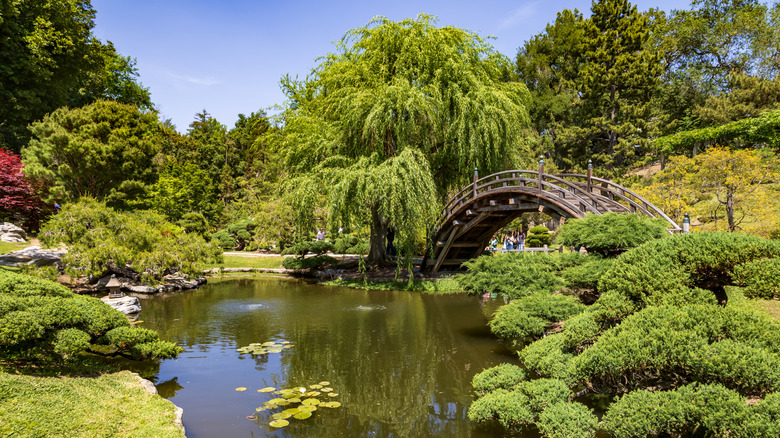
The Huntington Japanese Garden almost feels like a fanciful recreation of a feudal-era Japanese town, with its temple gate-like entrance, half-moon bridges, a bamboo forest, and paths connecting the garden to a tea house and a pair of manors. One of these dates back to the 18th century, when it functioned as an opulent home and agricultural compound in Marugame, a small city in Japan's Kagawa Prefecture. Popular gardening YouTuber Rooted Theory reckons The Huntington Japanese Garden is the "best Japanese garden in California," a title for which there is healthy competition.
Japanese Hill-and-Pond Garden, Brooklyn, New York
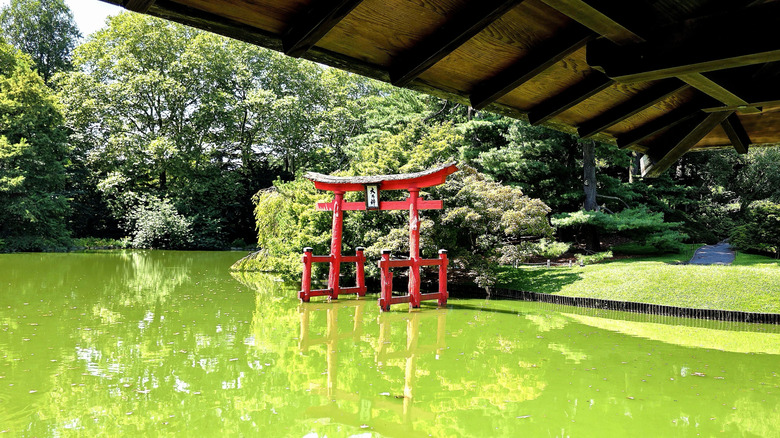
There's no prize for guessing what you'll find at Brooklyn's Japanese Hill-and-Pond Garden, one of the most-visited Japanese gardens in America — and one of the oldest, constructed in 1915. A vermilion "torii" gate rises from the middle of the pond, in the style of the gate at Japan's famous Itsukushima Shrine near Hiroshima. The shrine looks particularly resplendent when doused with snow in winter. Elements from different garden styles are combined here; you'll find viewing areas, paths winding around the pond, and scenery borrowed from the backdrop and worked into the overall composition.
Roji-en, Delray Beach, Florida
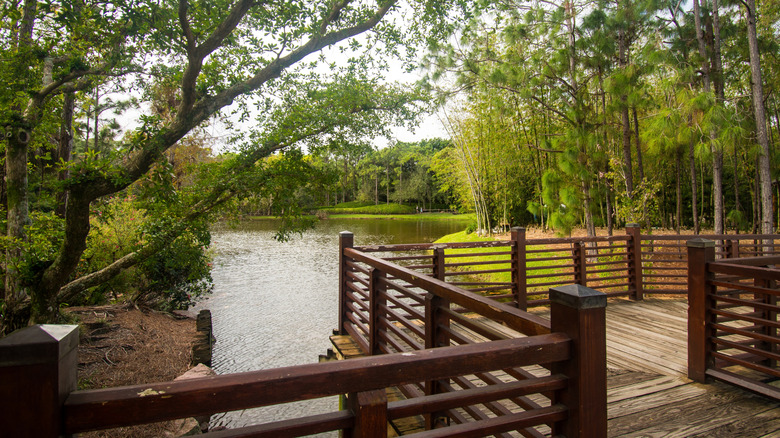
Roji-en, whose poetic English translation is "Garden of the Drops of Dew," is a collection of six gardens at the Morikami Museum in Delray Beach, Florida. Designed by eminent garden designer Hoichi Kurisu, the gardens not only represent different aesthetic styles — rock garden, paradise garden, flat garden — but also the different eras when such gardens became fashionable. The Shinden Garden, with its zigzag bridges, is emblematic of the Heian period (794-1185), the so-called Golden Age of Japan, while the Modern Romantic Garden is a Western interpretation of traditional Japanese garden aesthetics.
Rohoen, Phoenix, Arizona
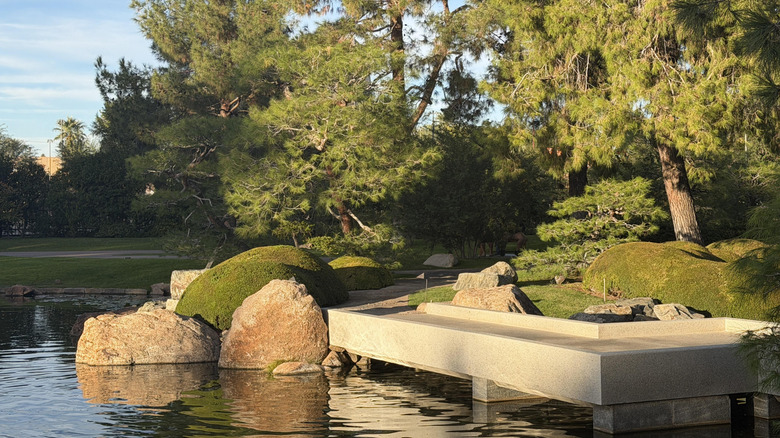
Rohoen, or the Japanese Friendship Garden of Phoenix, resulted from Phoenix's relationship with its sister city, Himeji, the site of Japan's most magnificent castle and one of its prettiest strolling gardens. Despite the arid conditions of the Valley of the Sun, Rohoen is a little oasis. To ensure Rohoen was authentic, more than 50 Himeji-based garden experts were invited to contribute to its creation. Ornamentation was shipped from Japan and placed around the central pond, including fishlike "shachihoko" statuary, which adorns Himeji Castle.
Anderson Japanese Gardens, Rockford, Illinois
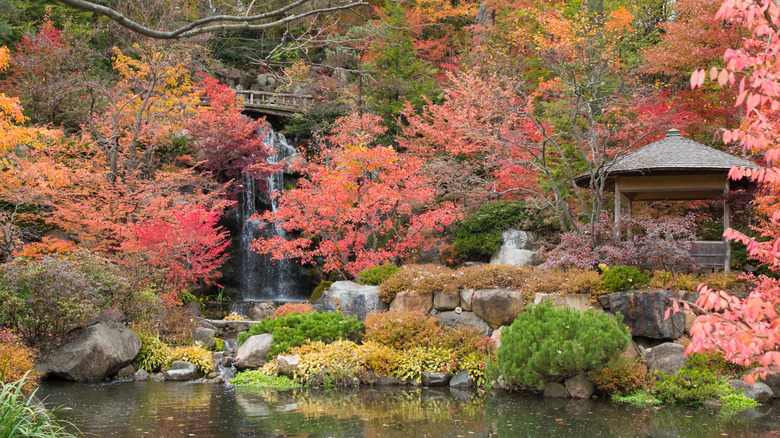
The Anderson Japanese Gardens in Rockford, Illinois, were once ranked the second most beautiful Japanese gardens in America by Sukiya Living; only Portland's gardens were deemed prettier. And it's easy to see why. Designed by Hoichi Kurisu, whose fingerprints are all over America's best-known Japanese gardens, it's a serene strolling garden, beset with wooden arbors and bridges, cherry blossoms, maple trees, tumbling falls, and immense stones shaped by nature. The Anderson gardens exemplify the Japanese gardening technique of "controlled nature" — or as one writer for the Asian Art Newspaper deftly phrased it, "nature with manners."
Honorable Mention: National Bonsai and Penjing Museum, Washington D.C.
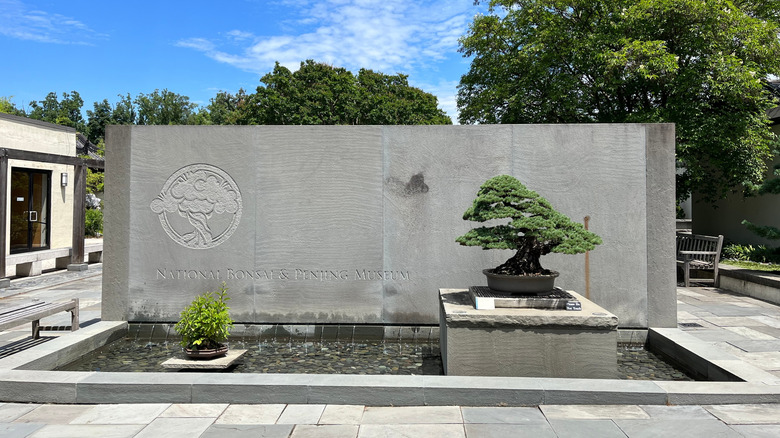
This one isn't technically a garden, but for years, bonsai, the Japanese art of creating miniature trees, has found a captive audience abroad. You could also argue that bonsai are miniature gardens; they're potted in beds of soil, topped with decorative moss, and sometimes paired with stones and "kusamono" (companion plants). The National Bonsai and Penjing Museum in Washington, D.C., has a fine collection. Works of bonsai and penjing, the Chinese equivalent, are placed around the museum's gallery and pavilions, where a Japanese garden serves as a pretty backdrop.