
The Hands-Down Best Wine Region In Italy That Isn't Tuscany
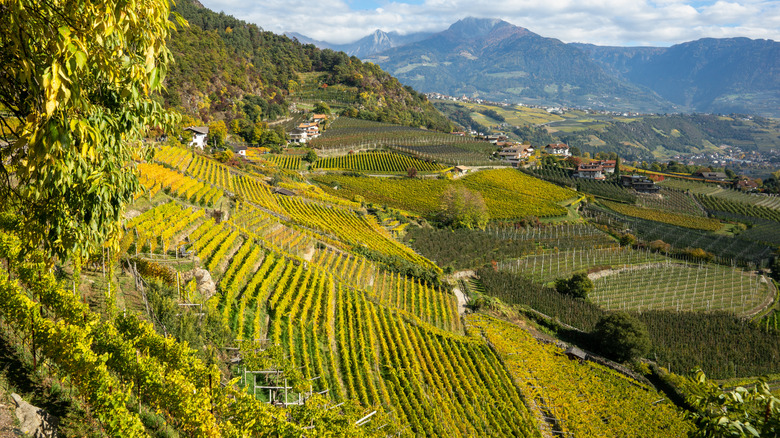
Italy is defined by landscapes, colors, and flavors that are known and appreciated around the world, and wine is at the forefront of that. The country's 20 wine regions make for a wine lover's paradise, and no one can blame oenophiles for conjuring up the dreamy Tuscan hills with their staple Sangiovese grapes that are used to make world-famous wines like Chianti. Tuscany might get the majority of the attention, but another wine region happens to stand in a league of its own: the tranquil Alpine valleys of Alto Adige.
Alto Adige's wines stand out for their diversity and character. Sitting at a crossroads of cultures and climates, Alto Adige's mountainous landscape, caressed by warm Mediterranean winds, and complemented by a rich terroir, has helped shape a distinctive character for this northernmost Italian wine region. Alto Adige has produced a wide range of soil types, giving wines from different valleys their own distinctive characteristics and flavor profiles.
With some parts of the region enjoying around 300 days of sunshine a year, this idyllic corner of Italy offers a distinctive combination of mountain scenery, Mediterranean influences, and exceptional wine. With many major hubs nearby, including Verona on the Italian side and Innsbruck in neighboring Austria, arriving in Bolzano, Alto Adige's capital, is the best starting point. Renting a car is especially recommended to get the most out of the region's incredible beauty and access to local mountain wineries.
What makes Alto Adige stand out
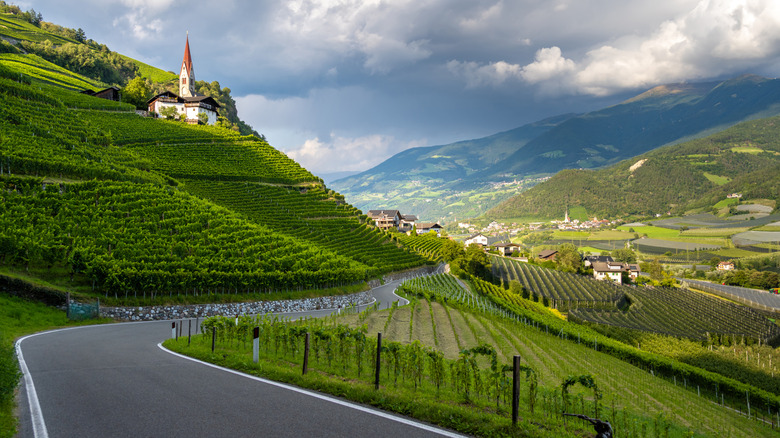
While Italy's northwestern Langhe wine region is celebrated for its complex reds and serene hills, Alto Adige counters with its dramatic mountain views and a particular strength in white wine, with white varieties accounting for at least 65% of its production, according to Wine Folly. There are around 20 grape varieties grown in Alto Adige, with vineyards ranging from around 650 to 3,300 feet in elevation. Large diurnal shifts, the difference between daytime and nighttime temperatures, contribute to the diversity, with around 270 wineries in the region. And although diminutive in size compared to other wine regions in Italy (producing less than 1% of the country's output, according to Eataly), the flavor spectrum is vast.
Also commonly known as Südtirol, Alto Adige is a bilingual cultural crossroads of Italian and German identities, with around 70% of the population being German speakers. The region combines Italian and German winemaking, and has one of the highest concentrations of Michelin Stars per capita in Italy. In a region with limited space, quality is more important than quantity, a philosophy embraced by the local cooperatives. More than 70% of the region's wine is produced by multi-generational family communes that take into account everything ranging from geology to the ideal grape variety for the area, according to Grape Collective.
The gold standard, known by the acronym DOC (Denominazione di Origine Controllata), which roughly translates to "Controlled Designation of Origin", designates a defined geographical area and adheres to rigorous controls over quality, variety, and production. Around 98% of Alto Adige's wine production is DOC-certified, placing it first in Italy, according to Alto Adige Wines. Local grape varieties such as Schiava and Lagrein, along with the globally known Pinot Grigio, can be found in Südtirol.
Wines to drink in Alto Adige
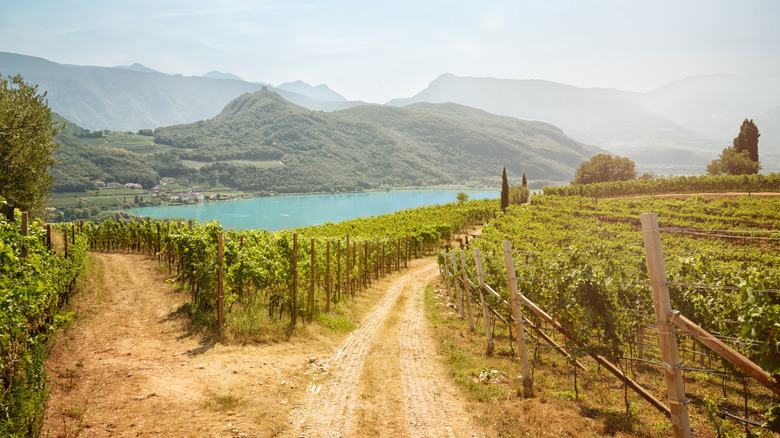
Getting to Alto Adige is fairly straightforward, especially if you're in nearby Treviso enjoying fairytale views and gorgeous canals. You can reach Bolzano, a gateway to the Dolomites where Austria meets Italy, in under three hours by car or train from Venice, and half that time if traveling from nearby Verona. Once you find your feet in Waltherplatz, Bolzano's main square, you'll see just how distinctive Alto Adige is. This is a region where hiking, alpine skiing, and mountaineering can be paired with gorgeous wine and stunning scenery.
To sample some of the best whites in the region, head over to Weingut Falkenstein. Located 30 minutes north of Bolzano (traffic dependent), this winery specializes in varieties such as Riesling, Gewürztraminer, and Pinot Blanc, grown in its high-altitude vineyards. For a local Bolzano gem steeped in tradition, head to Weingut Nusserhof, family-owned since 1788 and praised for its mastery of native grapes such as Schiava and the rare Blatterle, which the family helped bring back from the brink of extinction.
You will encounter Alto Adige's impressive wine portfolio wherever you stop, but if you wish to enjoy a bottle with spectacular views, Rifugio Col Alt is an iconic hiker's refuge and a memorable spot for a tipple. Italy's first ski lift was tested here in 1947, and the refuge offers both sweeping views and an impressive 42-page wine list.