
This Charming Car-Free Escape In The English Countryside Is A Scenic Idyll Only An Hour From Manchester
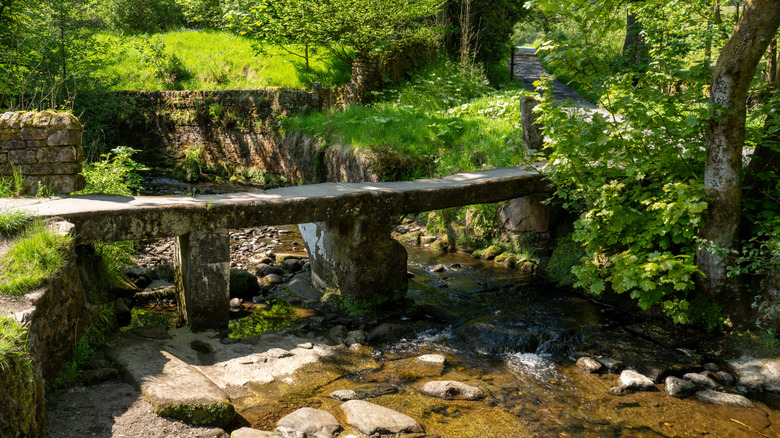
To say that Wycoller, a bucolic village in England's Lancashire hills, was a boom town would be a relative statement. Even at its height in 1820, when textile weavers were the village's primary source of income, the population never exceeded 350, and soon after that, most moved to nearby towns to work in more lucrative mills. But because Wycoller never fully industrialized, it retained its beautiful setting, surrounded by rolling countryside and hedgerowed farms and thickets of native trees. The village still carries a pastoral air, as evidenced by its Anglo-Saxon name — Wic-Alr, meaning "dairy farm among the alders."
Following the mass exodus of the weavers, Wycoller had become a ghost town by the turn of the 20th century. Had it not been for the establishment of a local volunteer organization in 1948, the Friends of Wycoller, it would likely have fallen into further ruin. The organization spearheaded the restoration of the village and its famed Wycoller Hall, clearing rubble and replacing some of the original features. Then, a few decades later, Lancashire County acquired the land and turned it into a country park.
Visitors can still explore the old village, which now has a handful of modern cottages joining the ruins of the old manor. A trickling stream, known as a "beck," winds through Wycoller, passed over by seven mossy stone bridges. You can also head into the surrounding countryside park, 350 acres of pretty hills, farms, and woodland. The scenery might bring Tolkien's Shire to mind, but the area is more associated with the Brontë sisters, serving as inspiration for both "Jane Eyre" (Charlotte) and "Wuthering Heights" (Emily). Car access isn't permitted anywhere in the village (unless you hold a resident's permit).
Exploring Wycoller Hall
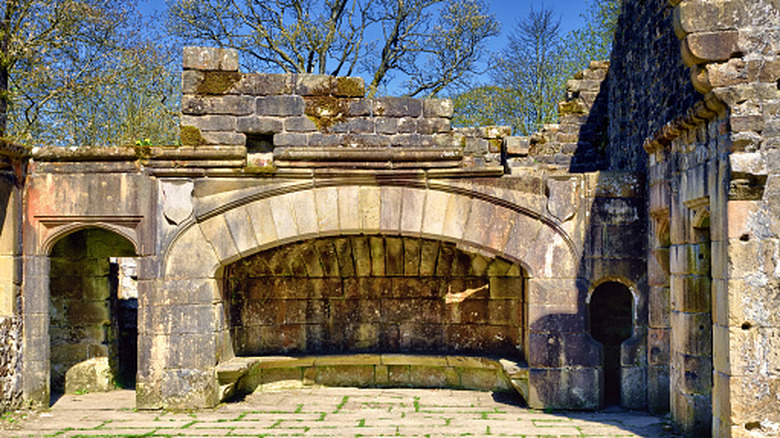
Despite being only an hour's drive from Manchester, one of England's largest and most underrated cities, Wycoller's relic structures give it the feeling of a world away. The first building erected on the site of Wycoller Hall was a stone structure that appeared in the middle 1500s. It was modest compared to the great manor that would follow, built in a bungalow style and featuring two large rooms, the shells of which still stand on either side of the entrance. Under the Cunliffes, an aristocratic family who inherited the manor, it grew with profusion, comprising three stories, a large kitchen, and a south tower by 1660. When a young relative, Henry Owen Cunliffe, took over the house in the late 18th century, he added features we can still see today. These include the fireplace and mullioned windows that look a little like prison bars, which portended its downfall. Upon Henry Owen's death, parts of the house, including the doors, timbers, and building stone, were sold off to cover his debts.
The manor is a partially restored ruin, so visitors can wander in and poke around in what was once one of Lancashire's great aristocratic halls. Charlotte Brontë supposedly based Ferndean Manor from "Jane Eyre" on Wycoller Hall, a supposition gleaned from her description of the manor and its absentee owner, who shared some parallels with Henry Owen Cunliffe. Inspect the great fireplace, restored by the Friends of Wycoller, or recline on a bench in the hall's front gardens. Look for the mullioned windows and walk up a vertiginous staircase to nowhere. Though the structural features of the building are intact, it's a symbol of faded glory, with weeds, mosses, and the occasional wildflower growing among the stones.
For more information, head to the barn at Wycoller Hall, which, with its handsome vaulted ceiling and curving timber uprights, doubles as a visitor center. Exhibits detail the history of the manor and the village. You can also grab a walking map here.
Exploring Wycoller Country Park
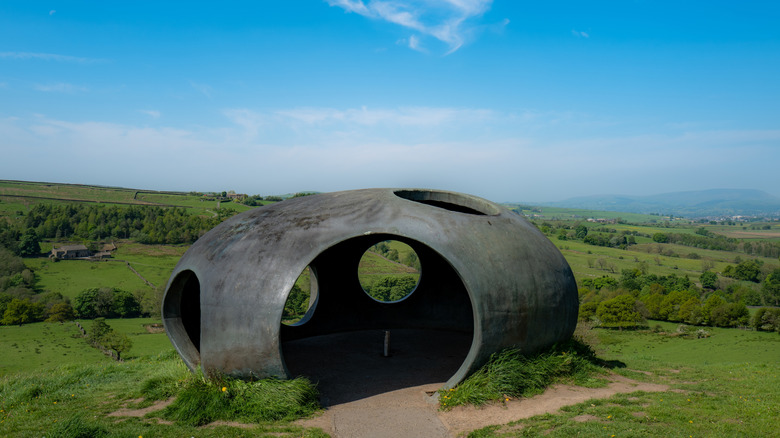
You should also spend some time exploring Wycoller Country Park. Three main trails cut through the park, running from 1.7 to 3.1 miles in length. The Wycoller Panopticon Trail is the gentlest of the three, a loop of the park taking in some of its key sites: the beck and its bridges; Wycoller Hall; the farmlands; and the "Atom," one of four structures scattered around the Lancashire Hills as part of the Panopticon series of artworks (designed to lure more people into nature). Completed in 2006, the "Atom" is a smooth, hollow ovoid with holes in its ferro-cement exterior, à la a block of Swiss cheese. These serve as apertures through which you can view the countryside from inside the structure.
Wycoller Country Park Circular is the longest of the trails, adding more than 400 feet of elevation gain to its 3-mile length. Circumnavigating the park, hikers will benefit from the same scenery and landmarks as those on the Panopticon Trail, albeit with more sweeping views of the pastoral hills. Note that the trails around here can turn into quagmires after heavy rainfall. You can find trail maps and recent reviews on AllTrails.
Manchester is the closest hub city to Wycoller, though you can also get here easily from Leeds, just over an hour's drive away. If you want to bundle other country towns into your trip, consider Chorley, with its rolling hills and walkable canal, only 50 minutes away. Also consider what time of year you're visiting. Wycoller can look fetching in all seasons, but people often complain that Britain has one of the worst climates in Europe. While you can never guarantee dry days, May through September tends to be the best window for traveling to the northwest of England.