
North Carolina's Former Military Fort Is Now A Scenic State Historic Site With An Eerie But Beautiful Ghost Town

You hear "ghost town" and think of, maybe, ramshackle buildings silhouetted against a desert. Some fascinating ghost towns have a very different kind of scenery, though. Along North Carolina's lower Cape Fear River, an unassuming stretch of mossy woods is where a colonial town burned down more than two centuries ago. A few eerie remains of this town — shelled brick church walls, the crumbling foundations of a former mansion — are still visible and now form part of the Brunswick Town-Fort Anderson State Historic Site. If walking among the remnants of Brunswick's colonial foundations isn't enough, there's a second layer to the site: the earthworks of the Civil War fort later built on the same ground, which you can also see surviving traces of. For anyone interested in some North Carolina historic ruins set against riverside scenery, the site is an easy day-trip option from Wilmington or even Myrtle Beach.
Before Brunswick Town transformed into one of North Carolina's abandoned beauties beneath trees covered in hanging moss, it was a fairly significant little port. Founded in 1726, it became a major center for the export of raw materials such as tar and turpentine, and it even served as the de facto seat of North Carolina's colonial government, when royal governors lived there. The town started to wane as Wilmington grew, and British troops reportedly burned it down in 1776. Low-lying colonial foundations and the towering brick walls of St. Philips Church still stand roofless among the trees. Later, in 1861, the Confederate Army saw the site's high river bluffs as an advantage for defense. Thus, it built Fort Anderson here, consisting of sand earthworks and batteries, which share their grounds with the colonial ruins and river banks.
What to see at Brunswick Town-Fort Anderson
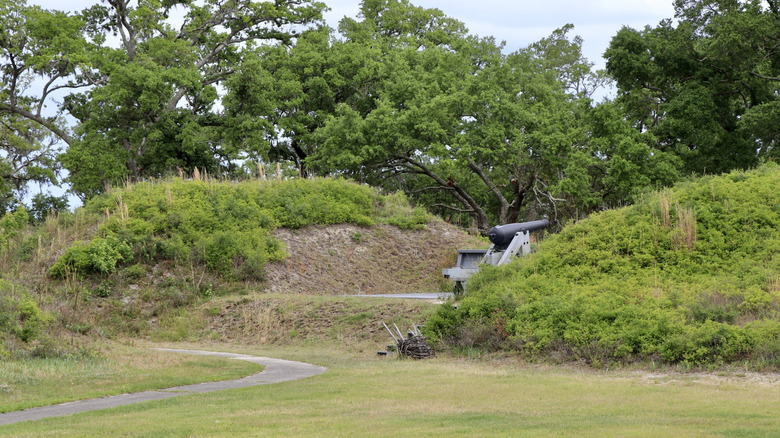
The historic ruins and earthworks of Brunswick Town-Fort Anderson sit among the woods in a deteriorated, but largely unaltered, state. Entry is free, and visitors can pick up a self-guided tour map to follow the trail through the ruins at their own pace. There are outdoor exhibits along the route identifying archaeological remains (though guided tours are available, for a small fee, if you want the complete story). The grounds are an active archaeological site, and one Google Maps reviewer noted, "We saw students out there actively working on excavations at the site which added to the idea that history of sites like this is never ending."
The most imposing remnant is St. Philips Church, whose surviving brick walls rise up with arched windows framing surrounding trees. Elsewhere, the trail passes foundations of colonial kitchens, homes, and outbuildings, as well as Russellborough, the former royal governors' residence. Stop in the visitor center to see some artifacts from the old town and fort, including the Confederate flag that once flew over Fort Anderson.
Visiting the Brunswick Town-Fort Anderson State Historic Site is as much a nature walk as it is a history lesson. The river flows past the old town site and earthen walls, and some nature trails wind through the wooded riverside setting. Keep an ear and eye out for birds — the North Carolina Department of Natural & Cultural Resources specifically notes that the painted bunting adds flashes of color to the site from April through October. If you're after more birding spots along Cape Fear River, check out Carolina Beach State Park, a coastal escape with boating and trails. Otherwise, Brunswick Town-Fort Anderson is around a 30-minute drive from Wilmington (with its own beloved historic attractions) or 1.5 hours from Myrtle Beach.