
St. Louis' 3rd-Largest Park Has A Sinkhole-Turned-Lagoon With Fishing And Pleasant Trails
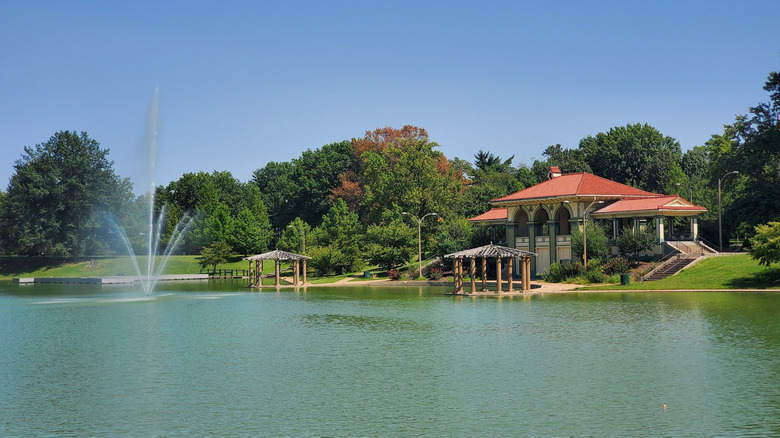
Anyone well acquainted with St. Louis might know that the city harbors some grand urban parks, but one of its more novel examples began with something that doesn't sound so grand: sinkholes. In the early 20th century, the city joined several sinkholes to form one of the lakes that anchor the scenery of Carondelet Park, per The Cultural Landscape Foundation (TCLF). The park covers roughly 180 acres in southern St. Louis and is the city's third-largest. In its midst, hills rise and dip, paths wind along stone walls, mature stands of oaks and hickories break up the lawns, and lakes stocked with fish fill hollows. Meanwhile, an elegant boathouse and rec center offer visitors facilities for a waterside detour just beyond the city's downtown.
For travelers exploring one of Missouri's colorful cities filled with scenic parks, Carondelet offers a landscape that sets it apart. The park's rolling terrain was shaped by the underground limestone caves and sinkholes characteristic of the area. Rather than smoothing them away, park planners put some of those depressions to work. In 1913, nine of the holes were connected to make Horseshoe Lake, turning a potential nuisance into one of the park's scenic features. Its other lagoon, Boathouse Lake (listed as "Lake Eridan" on Google Maps), was also formed from enlarged sinkholes, according to the Kirkwood Historical Society. Elsewhere in the park, a number of sinkholes remain, appearing as shallow depressions and hollows in the land. Today, paths will take you along the contours of the park's geological oddities, with a sprinkling of historic structures and picnic pavilions in between.
What to do at Carondelet Park
Together, Carondelet Park's two lakes provide fishing spots aplenty. Boathouse Lake has more logged catches on the fishing app Fishbrain, with a 4-star rating from 27 user reviews, as of this writing. It's stocked seasonally with channel catfish, hybrid sunfish, and rainbow trout, per the Missouri Department of Conservation (MDC). For a convenient post, there's a T-shaped dock to fish from. Horseshoe Lake is a good bet for largemouth bass, with the MDC noting bass of up to 20 inches. Fishing is permitted year-round, but most anglers need a Missouri fishing license — you can buy a daily permit online. (If you're not satisfied with fishing at Carondelet, you could head about 30 miles outside of St. Louis to Young Conservation Area, a free-entry escape with fishing and trails.)
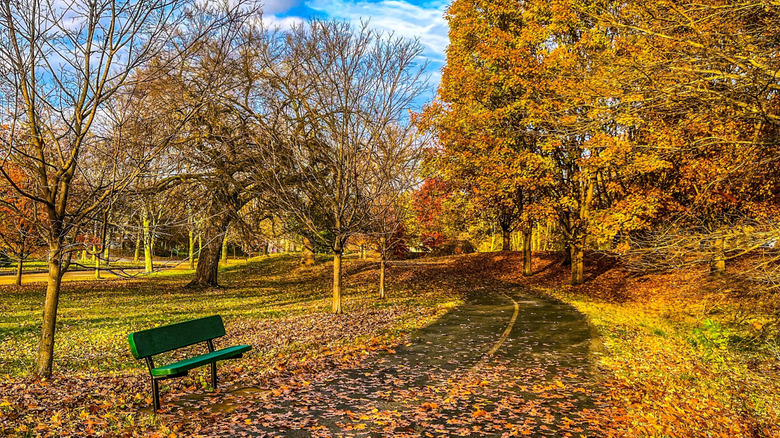
For hikers and joggers, the park's main 2-mile trail is an all-in-one option, skirting past the park's lakes and making a loop through its lawns and woods. On AllTrails, the loop's difficulty rating is listed as easy, with some undulating terrain totaling about 100 feet of elevation gain. One reviewer suggested, though, to "go off the trail to the other marked paths to see some of the features more in the park." St. Louis's first mountain biking trail is also in Carondelet, called Federer's Folly. It's a mile-long, lightly bumpy trail designed to accommodate kids and more experienced riders alike.
You can reach Carondelet Park in about a 15-minute drive from downtown, or you can take the MetroBus, which connects from Midtown for a 30-minute ride. You could make a mini tour of St. Louis's green spaces by pairing it with Tower Grove Park, minutes from downtown, which has its own easy trail.