
This French Cheese Etiquette Faux Pas Is Nowhere Near As Bad As People Make It Seem
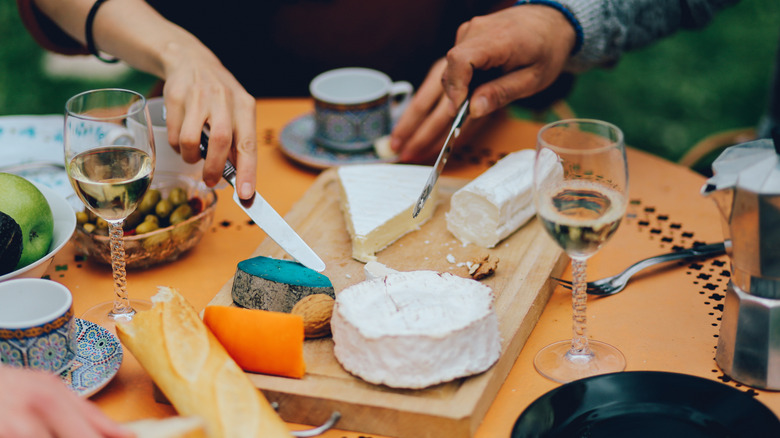
I still remember a first date at a French restaurant when the man across from me stabbed his fork into an extra-large slab of Brie, smooshed it onto a baguette, and ripped off a bite with his teeth. I had spent a year studying abroad in France, living with four different French families, so I knew exactly what I was witnessing: a cheese faux pas.
The proper à table (at the table) approach to French dining is considerably more delicate, and yes, there are rules. Camille Chevalier-Karfis, a Paris native who has taught French language and culture to English speakers for 25 years, walked through the rules for eating politely at a French table for French Today. At a traditional French meal, the plateau de fromages, or cheese board, makes its way onto the table after the main course and before dessert. The idea is, essentially, to tear off a bite-sized piece of bread, place the cheese on top, and eat them together in one graceful bite, rather than turning an entire piece of bread into a cheese sandwich. Traditionally, you don't spear the cheese with a fork or pick it directly off the communal plate with your fingers.
Emily Monaco, a Paris-based cheese expert, laid out some additional rules for France Today: cut off a portion of the cheeses you want to eat, move each morsel to your own plate, then dig in. Monaco recommends that you start with a milder cheese and work your way up to your boldest choice, so you can taste the full flavor of each one. However, while the ritual may be worth knowing, breaking it isn't exactly going to incite an international crisis.
The French aren't keeping score about cheese
It's true that the French take bread seriously, but like so many myths about visiting France, it's not something you really need to worry about. Unless you find yourself at a three-star Michelin restaurant, relax! These are traditional conventions, particularly relevant in formal dining situations, rather than rules that every French person polices at every meal.
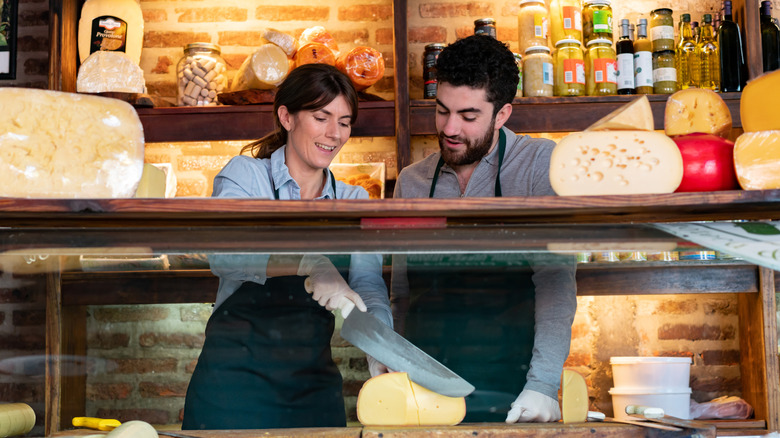
Eating cheese informally isn't going to ruin your trip or get you deported. Chevalier-Karfis says as much herself in French Today, framing the whole code as something that governs a fairly formal household, and admitting she mops up sauce with her baguette "all the time." Nathalie Quatrehomme, whose family has run Fromagerie Quatrehomme in Paris for four generations, told Euronews that the traditional cheese course is evolving. Cheese now turns up in appetizers, on all-cheese-and-charcuterie courses, and at breakfast. "We really changed the way of eating cheese," she said, "and that's nice." That's good news for those of us who would happily eat cheese at le goûter, the beloved 4 p.m. snack also called the quatre-heures, which bridges the gap between lunch and a late French dinner.
If you get excited and accidentally put a giant slab of Brie on a chunk of baguette and take a bite, don't panic. The French people around you will likely delight in the fact that you're enjoying one of their incredible cheeses. If you're still nervous, study up on Taste of France's do's and don'ts of a French cheese board and learn a few basic French phrases tourists should know before you go. Then, follow the lead of the people at or near your table. Otherwise, consider this one of those French etiquette rules that is useful to know, but definitely not one worth losing your appetite over. After all, as Rick Steves has pointed out, food is one of the highlights of a French adventure, and part of that experience is savoring it.