
Be Cautious Taking A Fall Vacation To This Popular State Where Bear Attacks Are On The Rise

In June 2026, a woman hiking in Apex Park near Golden, Colorado, reported a bear attack with unusual behavior. The bear reportedly followed her and "circled" her for close to 30 minutes, despite her attempts to intimidate it and drive it away (via Denver 7). The woman sustained a leg scratch before the bear wandered away, in what would become the first of ten bear attacks in Colorado in 2026 — a year with a marked increase in bear encounters. Colorado Parks and Wildlife attributes the rise to the scarcity of a bear's natural forage caused by extreme drought, wildfires, and untimely frosts.
Every fall, bears enter what is known as the hyperphagia phase, in which they eat up to 20,000 calories per day to prepare fat deposits for the long winter hibernation. However, as a result of food scarcity, 2026 is shaping up to be a year of unusually high numbers of bear encounters, given that bears have come to associate humans with food sources. Colorado Parks and Wildlife (CPW) 2026 Preliminary Bear Reporting Data (document) puts the number of bear encounters this year at over 6,000 – more than double the numbers reported last year. Still, Rachael Gonzales, public information officer for CPW, was quoted in the Aspen Times saying "Bear attacks in Colorado are very rare. Between 1960 and today, Colorado has only had 105 bear attacks." For perspective, Colorado welcomed over 96 million visitors in 2025 alone.
Colorado is one of the country's most famous fall destinations due to its vibrant autumn colors and early season onset, but it coincides with a bear's hyperphagia phase. CPW points out that a lack of adherence to bear safety protocols can increase dangerous encounters with black bears that are not naturally aggressive, and is reminding people to be vigilant and bear-proof all food and trash. "Bears that repeatedly get food around homes can lose their natural wariness of people and learn to return to human areas," says the CPW's notice on August 13, 2026.
A Colorado fall vacation requires proper bear safety precautions
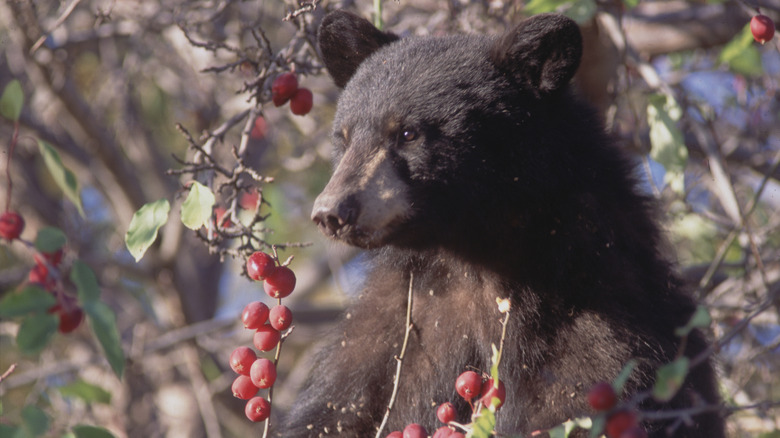
Although bear encounters are on the rise in Colorado, that doesn't mean you have to abandon your fall vacation plans. According to the CPW Living With Bears resource, black bears — the only bear species found in Colorado — are not an aggressive species. However, they can become so if you stand between them and food, especially in a time of scarcity when the bear may be starving.
The chances of encountering black bears increase substantially if you're vacationing anywhere west of the I-25 divide. For example, the village of Snowmass is one of Colorado's top fall destinations for its stunning views of yellow and orange foliage mixed with dark evergreens. However, it also lies west of I-25 in Pitkin County, which, per the CPW's Preliminary Bear Reporting Data, is one of four counties with the highest number of bear encounters. Two of the other counties, Routt and La Plata, also lie west of I-25, while the third — El Paso — straddles the interstate.
However, you can still enjoy your vacation in any part of Colorado as long as you follow proper bear safety protocols. If you're hiking the Interlaken Trail, famous for its fall beauty, or camping in Colorado, keep your food in bear-proof canisters, use bear-proof lockers at campgrounds (if available), and keep all scented items, such as toiletries and the clothes you cook in, away from where you sleep. Avoid camping near streams or areas with berries, acorns, or other food sources for bears. If you're traveling in a car or RV, lock your doors tightly and keep your food and coolers inside — these enterprising bears often recognize coolers as a source of food now. Alternatively, you can admire Colorado's stunning fall beauty in comfort and safety onboard the scenic Durango & Silverton Train through mountains and fall foliage.