
Everyone Thinks About London When Visiting England, But They Often Miss This Charming City For A Day Trip
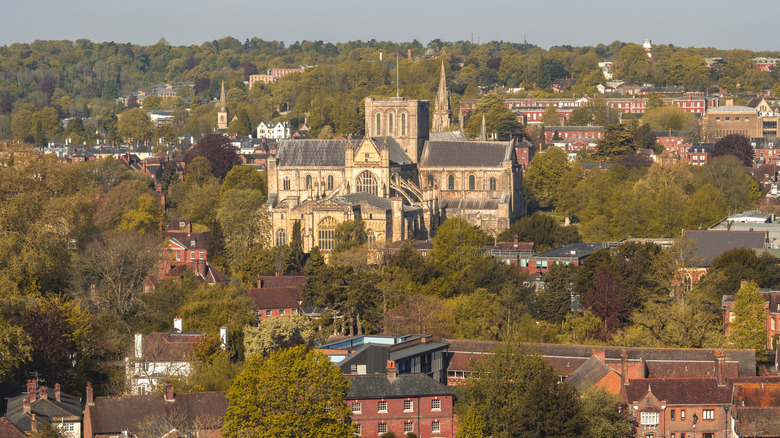
It makes sense that first-time travelers to England pencil London atop their itineraries. The U.K.'s sprawling capital city hosts some of the world's best theater productions and high-end fashion and luxury boutiques. It's awash in lovely old buildings from the Georgian, Victorian, and postmodern eras and has fine-dining restaurants and comely pubs in neighborhoods around the city. It also gave rise to many quintessentially English things — iconic red buses, Paddington Bear, Sherlock Holmes, Buckingham Palace guards, and cozy cobbled lanes — that tourists seem to love. But if you commit yourself to London, you might miss out on some great day trips. One of those is Winchester, a cathedral city just under an hour from London's Waterloo Station on the South Western Railway.
Sitting on the western edge of South Downs National Park, known as the "Gateway to England," Winchester was once one of the largest market towns in Roman-era Britain. In the ninth century, it became the capital of the Anglo-Saxon kingdom under King Alfred the Great. Following the Battle of Hastings in 1066, it continued as a major power center during the centuries of Anglo-Norman rule. Despite Winchester's historical importance and its proximity to London, comparatively few London tourists think to visit it. Winchester's district receives around 8 million annual visitors — by no means an inconsequential figure — whereas London can field four or five times as many.
If you decide to include a day trip to Winchester on your next London sojourn, you'll be well rewarded. Explore the town's ancient roots through the City Museum, Winchester Cathedral, a still-active medieval almshouse, and the venerable Winchester College. You can also walk a portion of the South Downs Way, a 100-mile trail that starts in Winchester, and finish your day in one of the town's charming old pubs.
What to do on a Winchester day trip
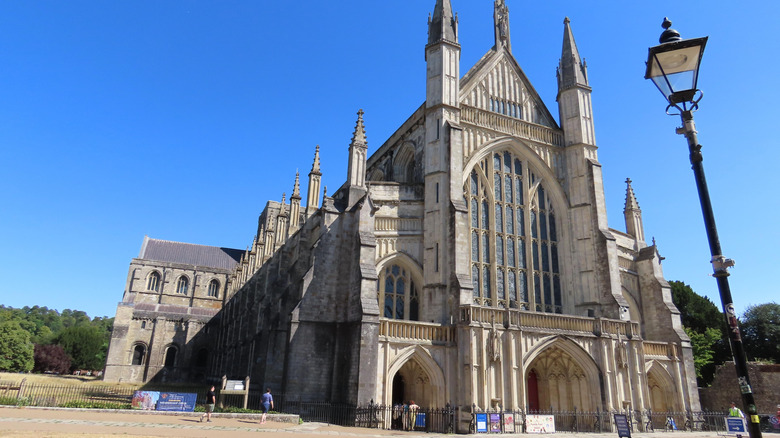
Catch an early train from Waterloo Station. Leaving at 8 a.m. gets you to Winchester around a hour later, when businesses start to open. Head straight for Winchester Cathedral, a 15-minute walk from the railway station. The cathedral has been a place of worship for more than 900 years and has many significant features within its walls, including the Kings and Scribes mini-museum, the longest nave (central hall) of any Gothic cathedral in Europe, and a retrochoir (the area behind the altar) with tiles dating to the 13th century. Moreover, the grave of legendary novelist Jane Austen — who's often associated with Bath, a UNESCO World Heritage site and Roman spa town — is found in Winchester Cathedral's north nave. Before visiting, check the website for closures due to special services.
For more history, visit the City Museum in the center of town. The museum explores Winchester's history, from its origins as an Iron Age trading center, through the Roman, Saxon, Norman, and medieval years, and on to the 19th and 20th centuries. Among its artifacts are a well-preserved Roman mosaic, medieval jewelry and ornaments, and some of Jane Austen's personal effects.
Next, make a stop at the Great Hall, one of the last remaining structures of William the Conqueror's Winchester Castle. Fixed to a wall in the Great Hall is a 13th-century recreation of the Round Table of Arthurian legend, which the fabled King Arthur had constructed, as the tale goes, so he and his men could sit as equals. Other historical sites include Winchester College, one of the oldest still-running schools in England, and the Porter's Lodge at the Hospital of St. Cross, where travelers can request a Wayfarer's Dole, a free portion of beer and bread, which the lodge has been serving for centuries.
More activities in Winchester
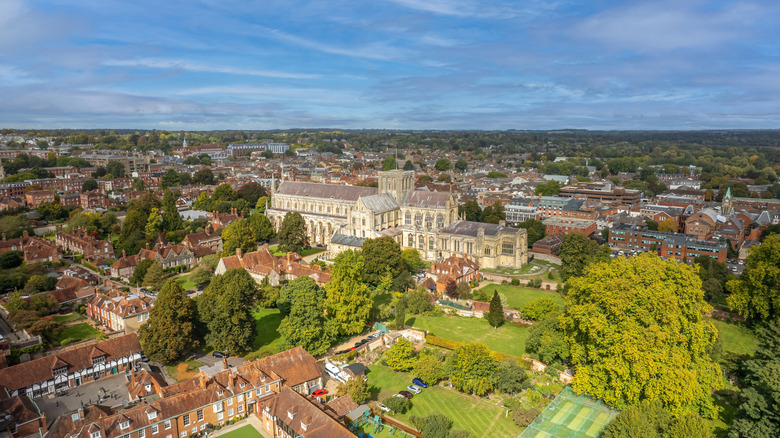
If time permits, take a stroll along the South Downs Way. You'll get long hours of light during the British summertime, when the sun can set after 9 p.m., making for a lovely late-afternoon or early-evening walk. You can join the Way near Winchester Cathedral. Some walkers follow it on to the village of Exton, 12 miles away, though this might be ambitious during a day trip. Instead you could walk along the River Itchen and out to Chilcomb Wood and back. The round trip should take a couple of hours.
Finish your evening with an ale in one of Winchester's pubs. The Wykeham Arms, which has been serving thirsty patrons since 1755, is among the most famous — it was named one of the Daily Telegraph's top 500 pubs in the country, which equates to the top 1%. The Black Boy pub is a place of zero pretension, all brickwork and cracked walls and beer-stained carpets. Don't be fooled by the humdrum interior. It has a great selection of ciders and ales, serves pizza in its garden shed on weekends, and hosts a quiz night on the first Tuesday of every month. The Old Vine, an 18th-century inn, is another charming spot for a tipple. Sit in the timber-framed pub and dining room and order a steak, pie, or Mediterranean-style dish from the supper menu.
Don't miss the last train back to Waterloo Station, usually between 10 and 11 p.m. If you don't want to return to London, there are some lovely boutique hotels in Winchester, paying homage to the city's storied past. If you're looking to travel onward, Southampton is also nearby. This underrated city, known for its vibrant seaside culture, is either 25 minutes away from Winchester by train or 35 minutes by car.