
Between Bath And Bournemouth Sits England's Picturesque Medieval Town With Shops, Trails, And History
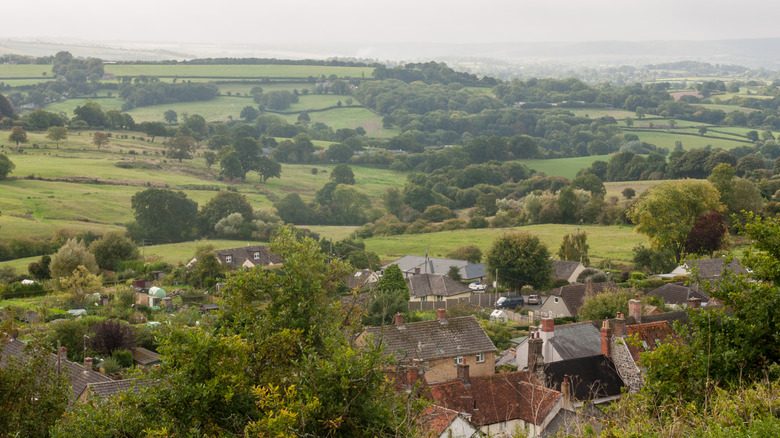
Thomas Hardy, one of the great novelists of the Victorian Age, wrote of a pretty hilltop town called Shaston that overlooked a vale, most notably in "Tess of the D'Urbervilles." Though it was a fictional place, Hardy had plucked it from the real world. We know it as Shaftesbury, a small English town whose history stretches back to the Saxon era (between the fifth and 11th centuries). With its overgrown, cobbled lanes and weather-beaten cottages, it's easy to see why Hardy was so enamored by it.
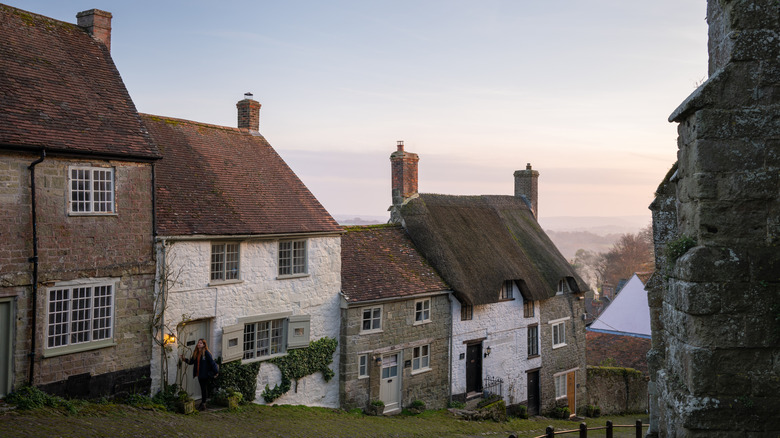
Shaftesbury's elevation, 700 feet above the river-webbed Blackmore Vale, is perhaps its most defining feature, the symbol of which is Gold Hill. This street descends precipitously toward the center of town, with cottages rising like steps on one side and a brooding, fortress-like wall on the other. This is Shaftesbury's most iconic area, featuring in nigh-on every promotional material and a 1973 TV advert for Hovis bread that's fondly remembered. There's also a free-to-enter Gold Hill Museum atop the hill, alongside the 14th-century St. Peter's Church, one of Shaftesbury's oldest buildings.
Aside from being easy on the eye, Shaftesbury is a great place for shoppers, who attend its weekly markets and browse the artisan boutiques around High Street. There are some great countryside walks, too, taking in the surrounding vale. Shaftesbury is in North Dorset, about halfway between Bournemouth on the south coast and the regal city of Bath, a UNESCO World Heritage Site and one of the best-preserved ancient Roman bath complexes in Europe. Only an hour's drive from either city, you could treat it as a day trip. There's also a handful of charming inns and guesthouses.
Medieval history in Shaftesbury
By the 14th century, Shaftesbury was Dorset's most densely populated town, with a grand abbey housing Benedictine nuns, a thriving economy that benefitted from a constant stream of traveling pilgrims, and industrious tradespeople including tanners, tailors, leatherworkers, masons, and cobblers. As pilgrimages fell out of favor and trade shifted to coastal hubs, Shaftesbury had begun to decline by the 1500s, epitomized by the dissolution of Shaftesbury Abbey in 1539. The abbey may not dominate the town's skies anymore, but relics of it remain at Shaftesbury Abbey Museum & Gardens near Gold Hill.
The museum displays artifacts excavated during archaeological digs, such as floor tiles from the Middle Ages and Saxon carvings. It also charts the abbey's history, from its founding by Alfred the Great in A.D. 888 to its eventual demise at the hands of King Henry VIII. The abbey's stone foundations in the museum garden show the layout of the building, including remains of the crypt and nun's chapter house, all surrounded by flowers and herbs once vaunted for their curative, spiritual, or utilitarian properties.
A visit to Shaftesbury wouldn't be complete without a stroll (or hike) up and down Gold Hill. According to Dorset Council, the name was first recorded in 1352, when it was probably a market street running along the eastern side of the abbey. As you walk up the cobbled lane, admire the quintessential English cottages that line the 540-foot hill, which has a maximum gradient of 22% near the top. Once you reach the summit, check out the museum, church, and Hovis loaf sculpture — a commemoration of the ad that (re)put the town on the map. Don't forget to turn around and take in the view which has been described as "one of the most romantic sights in England."
Shopping and walking in Shaftesbury
If you're in Shaftesbury on a Thursday, stroll through its weekly market, a nod to the settlement's centuries-old history of mercantilism. Stalls proffer locally grown produce, freshly baked bread, dairy products, and ground coffee, as well as keepsakes, artisanal crafts, and used books. Markets also take place on Saturdays and Sundays in the town center. They're likely to run rain or shine (some stalls are indoors in the town hall), but you may wish to check the best time to visit England for optimal weather before booking your trip.
Also visit the boutiques on High Street. Nature's Treasures is part mineral emporium, part quirky dreamscape, selling crystals, incense, oils, and other curios derived from the earth. It also stocks fossils, which is apt given the beautiful, fossil-lover's coastline around Lyme Regis is just 90 minutes away, in the southwest corner of Dorset. You'll find stylish gifts and women's apparel at Mine and Willow Natural, while bookworms will want to peruse the aisles of Folde, a value-driven bookshop specializing in works that celebrate nature.
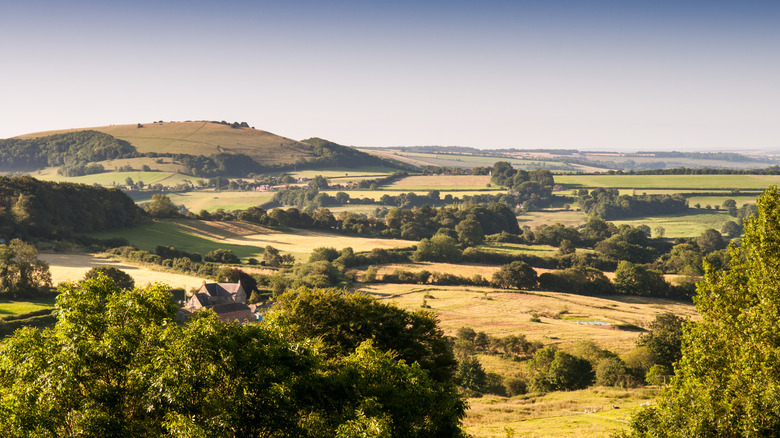
To appreciate nature in a more tangible way, meander around Shaftesbury and into Blackmore Vale. The 3.7-mile Shaftesbury and Gold Hill Circular is a great way to take in the historic town and its hilly environs on foot. Alternatively, you could add Shaftesbury into a larger walking itinerary. Opt to hike the 216.5-mile Hardy Way, which follows the author's footsteps through the woodlands and valleys of Dorset and Wiltshire; the ancient St. Edward's Way Pilgrimage, a 30-mile hike between Wareham and Shaftesbury Abbey; or the White Hart Link, a 50-mile trail linking Shaftesbury with Stalbridge, Gillingham, Sturminster Newton, and Blandford Forum towns.