
Forget Florida, Retire To Thailand's Vibrant City With Festivals, Gorgeous Mountains, And Affordable Living

If the familiarity of retiring to Florida doesn't feel like the golden-years adventure you have in mind, let us pitch you this: an ancient city, packed full of art galleries and live music bars, that's home to countless Buddhist temples and is surrounded by mountains to the north, east, and west. But despite all this cultural richness, it somehow doesn't feel hectic at all. Can such a place exist? Enter Chiang Mai, Thailand's vibrant second city and "Rose of the North."
Founded in 1296, Chiang Mai was built on the banks of the River Ping, fortified with terracotta brick walls, and protected from invasion by the mountains that surround it. Today, it's home to around 1.2 million people, including a lively student population (Chiang Mai's universities attract Thais from across the country), a large expat community of digital nomads, teachers, and retirees from across the globe. The appeal is the slower lifestyle — particularly compared to Bangkok, a 12-hour drive or train ride to the south — matched with natural wonder and, perhaps most interestingly for retirees, affordability.
Retirees in Chiang Mai can participate in Loy Krathong, the lantern festival that celebrates the Thai water goddess, by giving thanks and making wishes as lanterns are released down the river and into the sky. Chiang Mai is one of the most popular places in Thailand to celebrate this three-day event, which takes place every November, depending on the cycle of the moon. There's also Songkran, aka Thai New Year, which takes place in April and sees Chiang Mai turn into one big water fight. (Many locals prefer to watch from indoors, as things get slippery outside.) The other highlight of the festival calendar is the vibrant annual flower festival in February – parades go through the city and culminate in a display in the park.
Accessible natural wonder surrounds Chiang Mai
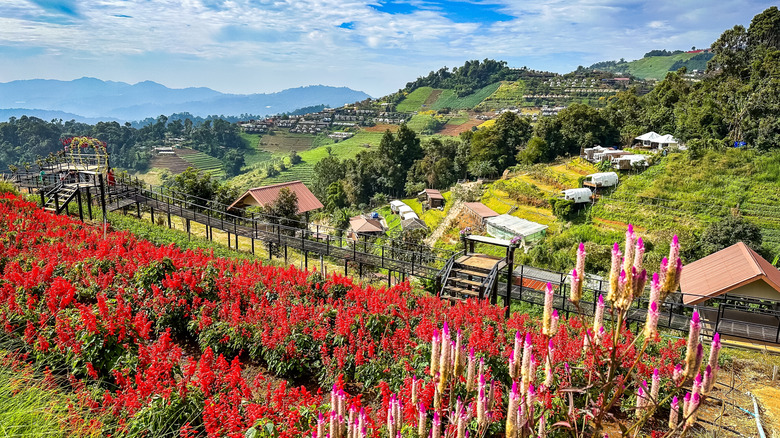
Chiang Mai is awash with natural wonder that feels a million miles away from Florida's wetland parks or white-sand beaches. A mountainous region, Chiang Mai province — of which Chiang Mai city is the capital — is a stunning backdrop for hikes, with local Facebook groups filled with people of all ages and nationalities heading out into nature with trekking poles in hand. Doi Suthep ("doi" meaning "mountain") is the closest hiking spot, flanking the western side of the city center. Active retirees can take the Monk's Trail, a 45-minute walk that's uphill but gentle and manageable in the early morning, before temperatures rise in the afternoon. The trail concludes at Wat Pha Lat, a beautiful temple in a forest. And if the moss-coated stupas and devotional statues don't wow you, the view over Chiang Mai down below surely will.
Climate can be a challenge (or part of the excitement) for senior residents in Chiang Mai. Between March and June, temperatures can routinely rise up to nearly 100 degrees Fahrenheit, so many retirees head to the hills. Mon Jam is a village 45 minutes northwest of the city center that's full of flower farms — and given its higher elevation, it's much cooler on average. Similarly, nearby Doi Inthanon National Park is home to the highest mountain peak in Thailand, and temperatures are considerably cooler up there, too. Other natural wonders in the foothills of Inthanon include Mae Wang National Park's impressive Pha Chor Canyon.
Nature in Chiang Mai doesn't have to be as adventurous as Florida's gator-filled waters — the outskirts of the city are dotted with relaxing natural hot springs. San Kamphaeng Hot Springs, for example, is roughly $3 to enter (as of this writing), and the sulphur-infused, naturally heated waters are thought to boost blood circulation and ease joint pain.
Affordable living in Chiang Mai

Given the increasing costs for living expenses in the U.S., it almost goes without saying that life in Thailand is much more affordable. Forget retiring in Florida; Chiang Mai is roughly 71% cheaper than Miami at the time of this writing, for example, and that's factoring in monthly rent. Dinner at a casual Thai food restaurant will set you back $2 in Chiang Mai while a similar equivalent in Miami averages $30. If you're frugal, it's easy for a retired couple to live in Chiang Mai on $1,500 a month, according to Live and Invest Overseas – renting a studio-sized condo can cost as little as $150 if you live outside the old city center, or a two-bedroom house in a neighborhood next to the old city comes in at around $500 a month. Healthcare is also comparatively affordable. Local private health insurance can cost as little as $2,600 a year for a retired couple, per International Living.
Self-care is easy in Chiang Mai, where it often costs about $20 to see a chiropractor; $10 for a gentle yoga class; and $8 to visit a spa with a swimming pool, a gym, and hot springs. Getting around is low cost, too. The old city is easy to bicycle and stroll around if you avoid mid-afternoons, which can get sweaty. There are also local taxi apps like Grab and Bolt, which you can book rides with — a 15-minute ride in a car taxi is usually around $5, while it can be as little as $1.50 if you are comfortable riding a moped taxi.