
Be Cautious Driving Through This State With The Most Documented Flock Cameras In America
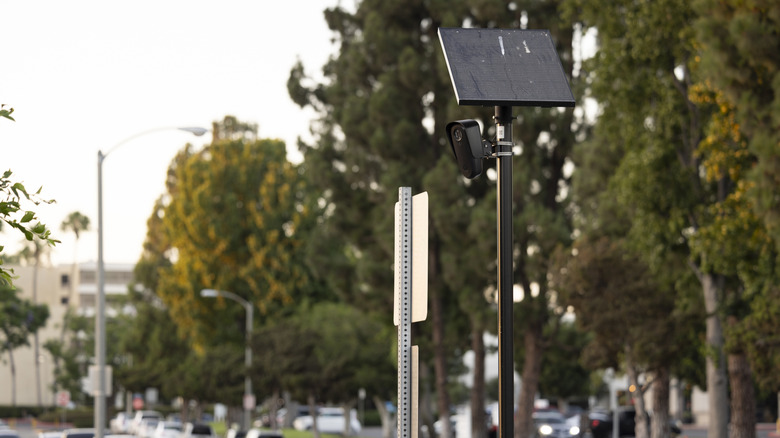
You may have noticed an increase in subtly placed (or blatantly placed) cameras while driving as of late. They've been around since the late 1950s, at least in prototype form, but these cameras have evolved immensely since the originals were first implemented for safety purposes. Today, automatic license plate readers, or ALPRs, are the latest version of the first models. Cameras made by Flock Safety, a proprietary brand of camera that features deeper layers of image- and data-capturing, have become a ferociously debated and controversial topic across the U.S.
The first speed detection camera was invented by professional race car driver Maurice Gatsonides to accurately gauge his MPHs while racing. Gatsonides' company, Sensys Gatso, followed up with the invention of the first red-light enforcement camera in 1966, a device able to capture drivers running red lights. That infraction alone causes thousands of injuries and over 1,000 fatalities annually in the U.S.
Currently, California has the most ALPR cameras in the country, with nearly 21,000 cameras documented statewide. They also have the most cameras specifically from Flock, with over 14,000 from the brand. Of course, California also has 39 million residents and a lot of land mass. There are many dangerous roads in California, according to the National Highway Traffic Safety Administration, so many believe that these cameras can be beneficial. Studies by the nonprofit Insurance Institute for Highway Safety (IIHS) found that a driver was 62% less likely to exceed the speed limit by 10 mph or more on roads with cameras. The IIHS also found that, in big cities, cameras lowered the number of fatal accidents caused by running red lights by 21%. The rate of fatal crashes at signalized intersections in general was lessened by 14%. So, why are cameras that are proven to help keep drivers and pedestrians safer so hotly contested currently?
What's the debate over ALPR cameras?
Let's begin with the fact that Flock cameras capture far more data than many other ALPRs. Flock cameras record not only license plates, but the make, model, and color of your car, along with any exterior damage and stickers. It's not just speeders or red-light runners, either. Flock cameras capture every single car on the road that passes by and upload the data into the Amazon Web Services' GovCloud. Flock claims the information can only be accessed by authorized users, such as the businesses, communities, and schools who employ the cameras. That data, the company maintains, can then be shared with law enforcement.
However, many people are feeling their privacy is being violated by these cameras, and in at least 36 states, they're taking aggressive action against the cameras, according to NPR. While Flock maintains they don't implement facial recognition, YouTuber Benn Jordan reported to his 1.4 million followers and PC Magazine that this isn't true. He claimed he was able to hack into Flock cameras in under 30 seconds and review captured data. Jordan was surprised at how he could easily see faces, including his own.
A major point of contention for the public is that little oversight and regulation currently exists for the data captured and stored by the cameras. While Flock Safety states it can only be accessed from the cloud in specific, case-based investigations, many instances have proven otherwise. Because of a multitude of documented issues, several California cities such as Mountain View, Santa Barbara, and the West Coast hub of Los Angeles — America's most traffic-congested city — are discontinuing use of the cameras. Despite residents' outrage and concerns, California state legislators shot down a 2026 bill regulating the cameras. The American Civil Liberties Union has launched a campaign to fight the presence and further installation of cameras they state have created a "nationwide mass surveillance system" by "tracking, logging, and sharing your movements without a warrant."
A balancing act of positives versus negatives
While many law enforcement officers believe ALPRs have helped them, there's definitely cause for concern. At least 50 law enforcement officers nationwide have been accused of using the cameras' data to stalk and harass women. In Colorado, a family, including a six-year-old girl, was made to lay down on the pavement at gunpoint when their car was misidentified by an ALPR as being stolen. This was caught on camera and resulted in a nearly $2 million settlement.
In Texas, a deputy accessed recordings from 83,000 Flock cameras to hunt down a woman he suspected of having an abortion. A San Jose police officer was fired after sharing information he had garnered from Flock data with a relative who was suspected of domestic violence. Neither he nor the relative was arrested. Despite not having an official contract allowing them to, ICE has also accessed Flock data.
However, police departments across California claim ALPRs have also helped catch an arsonist, a kidnapper in less than five minutes, and identify — but not catch — a suspected murderer. San Diego has the most cameras in the state, with 732, with San Jose, Oakland, and San Francisco close behind, averaging one camera per 3-to-10 square miles. Most states have exponentially less than California, including the road-rage heavy Louisiana, which only has about 2,100 cameras within its borders. Sites such as Have I Been Flocked and Flockhopper help enlighten drivers as to nationwide camera locations while also intensifying public volatility. These sites prove helpful when seeking to avoid being caught on camera, as the masses hope for increased regulation in the near future.