
5 Ski Resort Rules Tourists Break Within The First 10 Minutes
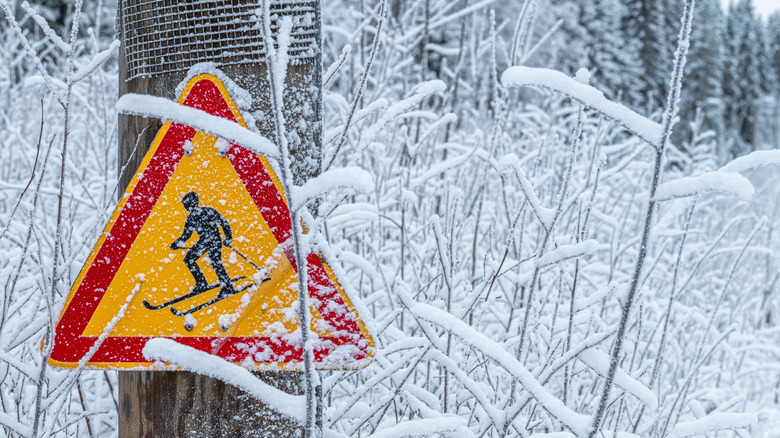
If you're strapping on skis or a snowboard for the first time, you don't want to be called a gaper (mountain slang for a clueless yet overconfident skier who barges around with no sense of spatial awareness, unwittingly breaking all the etiquette rules). Failing to follow proper etiquette on the ski slopes and in the ski lodge is rude, but also can be downright dangerous. Make a blunder that's the equivalent of blocking the soup aisle in the supermarket with your cart, and instead of a polite tap and an "excuse me" you could end up tumbling down the mountain in a tangle of skis and poles. This is called having a yard sale – that's more ski slang for what happens when you crash so badly that your skis, poles, and other gear ends up scattered all over the slope like yard sale items on a front lawn.
Instead, you can prepare yourself by memorizing a few simple, common-sense rules before hitting the slopes. In 2022, the National Ski Areas Association published a 10-point Responsibility Code, expanding on its original 7-point code from 1961. The code includes many of the rules listed here, as well as helpful advice on what to do if you're in a collision with another skier as well as more advice that every new skier should soak up before hitting the slopes. We also scoured social media for examples of the kinds of behaviors that drive veteran skiers crazy, in addition to the official rule book. Some offenses, like talking politics to the stranger on the ski lift next to you or playing loud music through a Bluetooth speaker, are so broadly offensive they would apply in any setting, not just a ski resort, so we left those off the list.
Don't speed
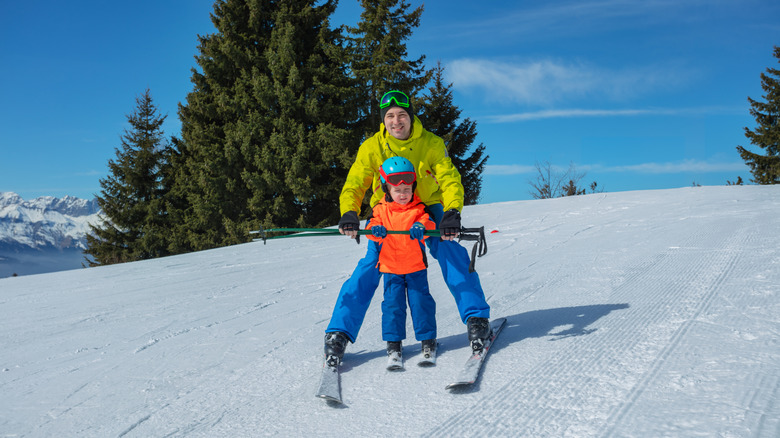
Sometimes newbies get so carried away with the thrill of speed, they move on to bombing down routes before mastering an essential skill: learning how to stop. If you're a newer skier who straps your skis on and hits those exhilarating double diamond slopes ten minutes after you arrive instead of working on your fundamentals, you're probably a menace to everyone around you. A 2023 study published in the Journal of Science and Medicine in Sport found the average speed on all ski slopes to be around 21 miles per hour. Experienced skiers, the same study found, routinely reached average speeds of 27 miles per hour. According to the Coloradoan, "Most on-mountain fatal trauma is caused by head impact with stationary objects at speeds of 27 miles per hour." So the saying is true on the slopes: speed kills.
Ski slopes do not generally have posted speed limits the way roads do. However, Ski Patrol has broad discretion to pull your lift ticket should you endanger others with reckless skiing, and that absolutely does include going so much faster than a particular slope's flow of traffic that you create a hazard. So look around and match your speed to the scenario. As one Redditor put it in a debate over how slow to go, "Slow enough that if a beginner cuts you off or falls over in front of you then you can stop or go around them in complete control."
Speeding through designated slow zones where children and beginners congregate is particularly bad behavior. Ski Safety U.S.'s #RideAnotherDay campaign is aimed at decreasing collisions and began after a 5-year-old girl, Elise Johnson, was struck and killed by a speeding, out-of-control skier, prompting her grieving parents to fund the program. The simple formula to remember is: speed, space, and self. That is, keep your speed under control, give other skiers plenty of space, and practice self-awareness.
Don't stop where you can't be seen
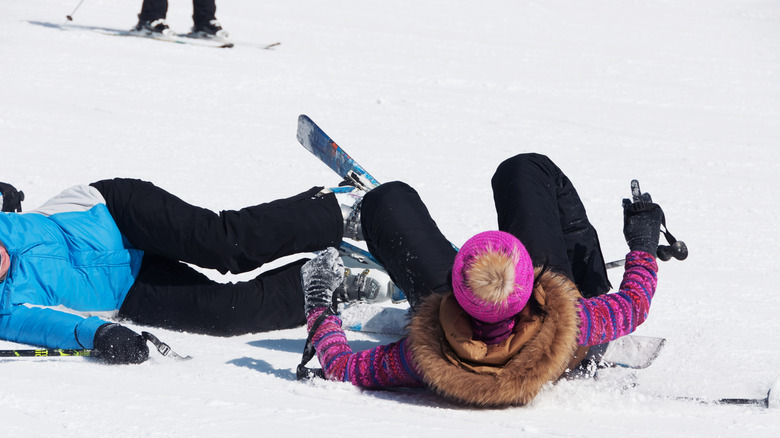
Stopping in the middle of your downhill run isn't just rude, it's one of the most dangerous things you can do — and new skiers and snowboarders do it all the time. It unfolds like this: you've had a lesson or two, and now it's time to ski down your first blue diamond slope solo. You will probably stop within the first ten minutes, maybe to take a breather or a selfie. Regardless, you should be aware that stopping makes you an obstacle to skiers behind you, and you're responsible for doing it in a way that keeps you and those around you safe.
The NSAA Responsibility Code rule states: "Stop only where you are visible from above and do not restrict traffic." Sounds easy, right? One unfortunate Redditor described what happened when he flouted this rule. In order to wait for family, he stopped where he was visible but accidentally restricted traffic by coming to an unexpected halt on a busy slope. Another snowboarder traveling behind him couldn't react quickly enough, and the two collided. "My board hit his ribs and I got turned upside down landing on my head concussed. He just took a mean shot to the ribs and got wind knocked out of him." The two walked away, fortunately, but situations like this should be avoided.
Don't be a litter bug
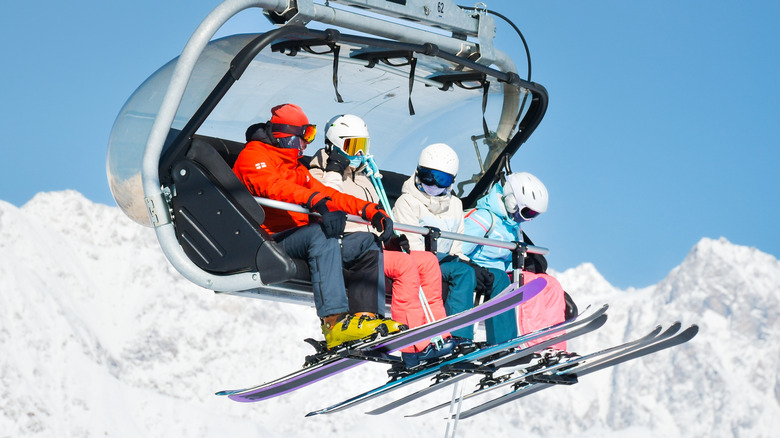
Ski Patrol at Boyne Mountain, one of the Midwest's best ski resorts, posted an Instagram reel depicting a heap of discarded beer cans they had gathered, with the caption, "We spend mornings picking up garbage after adults. It's ridiculous." Indeed it is. Believe it or not, littering on the slopes is a problem at many ski resorts. People seem to think that littering on the slopes isn't as bad as in another environment, or they may believe that someone comes along every night to clean their discarded beer cans and food wrappers. But that's not the case.
Another common item that litters the slopes? Miniature Fireball whiskey bottles. Powder Magazine declared the popularity of downing the cinnamon-flavored whisky shots on the chair lift "the worst trend in skiing." Others agree, largely due to the avalanche of littering. "I had to explain to my 7 year old what they were after he skied down carrying his poles in one hand and a handful of them he'd picked up along the way to bring down and throw away in the other," lamented one skier on Reddit.
It's also easy to litter by accident on the ski slopes. Every year when the snow melts, clean-up crews at ski resorts scour the mountain raking up heaps of accidentally lost items, from AirPods to ID cards. In Breckenridge, Colorado, spring clean-up crews swept up 780 pounds of trash from under the ski lifts, including a whole pineapple and an empty gallon jug of barbecue sauce. No wonder Breckenridge is urging skiers to zip up their pockets.
Be spatially aware around the lift
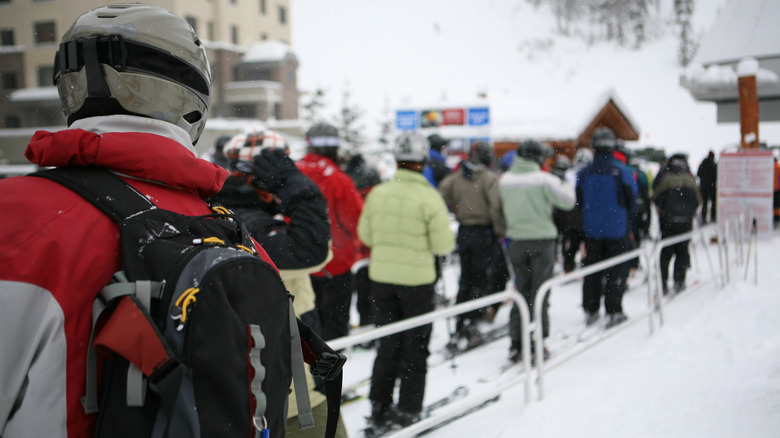
Spatial awareness is important when you're standing in any kind of line but even more so when you're armed with potentially dangerous implements like poles and skis. One of skiing's major rules is to practice spatial awareness, and nowhere is this more relevant than standing in line waiting for the chair lift well before you've even hit the slopes. One Redditor reported standing in a lift line at Seven Springs Resort in Pennsylvania when "a guy just fell over and kicked his ski off in a way that sent it flying. Then when he stood up he whacked me in the head with his other ski."
Another breach of spatial awareness and etiquette that's surprisingly common once you exit the line and climb onto the lift? Slamming the safety bar down before everyone is ready for it. Many North American skiers prefer not to use the safety bar at all, and the pro-bar and anti-bar groups can be quite at odds. According to Ski magazine, "asking to lower the bar seems to carry with it an unfortunate stigma where the asker can be side-eyed by fellow riders." Whether you use the safety bar or not may even provide a clue as to which part of the country you're from. It's an aspect of ski culture so nuanced it's actually been the subject of a study, which found that safety bar use was lowest in the Midwest (9%), and highest in the Northeast (80%). So if you're a Midwesterner traveling to one of the East Coast's incredible ski resorts, your fellow skiers aren't being rude when they lower the bar on you unexpectedly, it's just habit.
Know your right of way
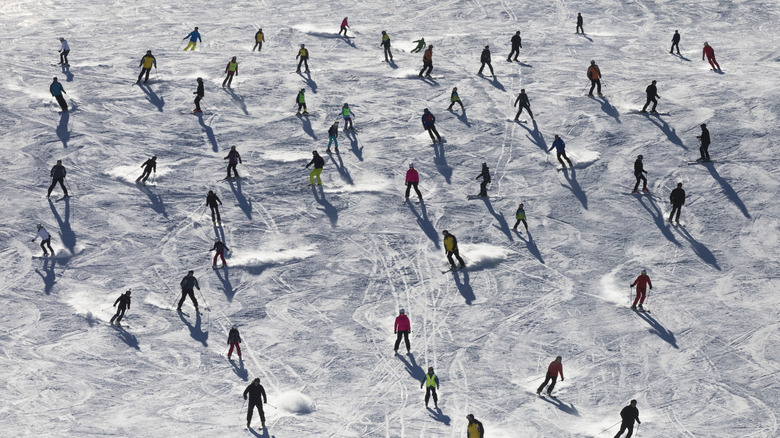
Another serious gaffe you can make on the slopes within minutes of strapping on skis is failing to follow right-of-way (ROW) rules. In 2016, actress Gwyneth Paltrow had a dramatic collision with another skier during a family vacation at Deer Valley, one of Utah's best ski resorts. The man she collided with, an elderly optometrist, claimed broken ribs and a brain injury and sued the actress, leading to a protracted he-said/she-said legal battle — all of which hinged on the question of which skier had the ROW. Both parties claimed they had been the victim. In downhill skiing rules, the skier or snowboarder lower on the mountain has the right of way, which usually means that the one who skis into the other from above is presumed to be at fault, much the way a driver who rear-ends another driver is presumed to be at fault. Failing to observe this ROW rule, whether you're a first-time skier or a celebrity, can leave you injured or facing a time-consuming lawsuit.
According to Ski magazine, "The skier in front of you may be slow, unpredictable, or making wide turns. It doesn't change the most important rule on the mountain: You are responsible for avoiding people downhill of you." To help drill the message in, the Snow Angel Foundation has created the R.A.D. Initiative, putting up signage encouraging skiers to always be ready to stop, maintain distance between them and other skiers, and be alert and watchful on the slopes.