
Tucked On The Czech Border Is A German National Park With Rustic Forests, Mountain Trails, And Rare Wildlife
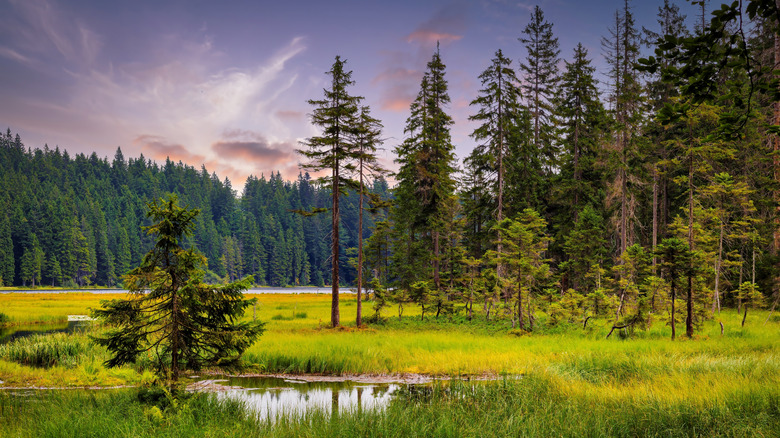
In many ways, Bavaria ("Bayern" to locals) is the archetypal German state. The home of Oktoberfest and lederhosen, of herbaceous meat sausages and F.C. Bayern Munich, it's beset with thick green forests, imposing mountains, Disney-like castles, and alpine lakes. Such scenic beauty was a source of inspiration for 19th-century King Ludwig II, who wrote of Bavaria's "holy silence" and "blissful stars," how "the mountains surround me so seriously, and sublimely." Arguably the most prepossessing stretch of Germany's largest state is Bavarian Forest National Park, which remains as sumptuously beautiful as it was in Ludwig's heyday.
The national park, also known by its Deutsch name, Bayerischer Wald, lies in Germany's southeast, hugging the Czech border. Along with the forest of Czechia's Šumava National Park, it's the largest protected contiguous forest in Central Europe, with thickets of beech, spruce, sycamore maples, silver fir, and dwarf pines scattered throughout. There are also 57 named peaks — several rising to more than 4,000 feet — and more than 200 miles of trails, making the national park a prime destination for hikers and trail runners.
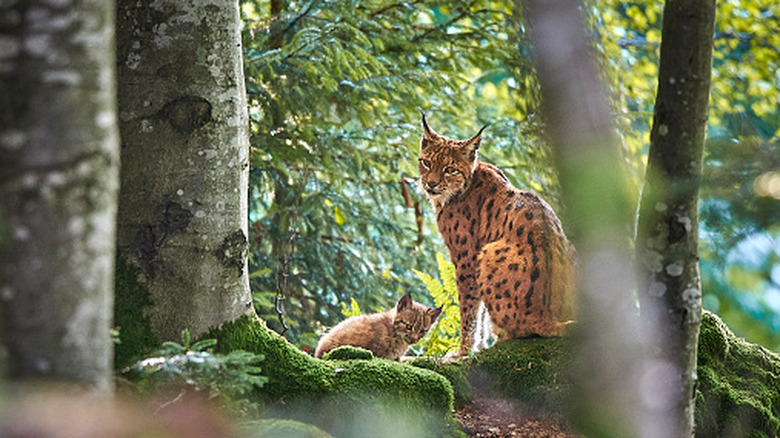
The park was offered government protection, in part, because it harbors some of Germany's rarest wildlife. The lynx, the largest wild cat native to Europe, was hunted to extinction here in the 19th century. Reintroduction of lynxes began in the 1970s, and though the population grew over the next few decades, the number has plateaued and the lynx is still considered highly endangered. Other beautiful mammalian species have been spotted in the Bavarian Forest, including wolves and brown bears, while rare birds like capercaillies, peregrine falcons (the fastest raptors in the skies), three-toed woodpeckers, and Eurasian pygmy owls (squat birds about the same size as starlings) have also made their habitats here. As wild as this region is, it's quite accessible from Bavaria's capital. Munich, ranked the most walkable city in the world in 2024, is only two hours away by car.
Hiking the trails of the Bavarian Forest
Hiking allows you to appreciate Bavarian Forest National Park's scale and the different landscapes existing within its borders. Because of elevation changes and the network of waterways webbing the region, the national park hosts a variety of habitats, from highland spruce forests and lichen-smothered boulder fields to flower meadows and raised bogs where mosses thrive. 217 miles of marked trails guide you through these different habitats — those indicated with an animal on a yellow background are loop trails, those indicated with a plant on a white background are out-and-back trails. The hikes of Bavaria Forest National Park can be quite demanding. The northern section of the Goldsteig Trail — the longest certified hiking trail in Germany at 410 miles — carves through the forest, featuring testing inclines and rugged terrain.
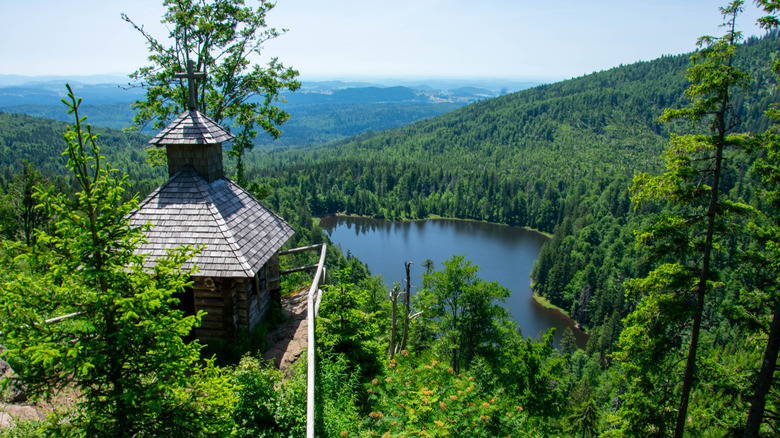
Mountaineers will likely head for one of the more vertiginous trails, like the Rachel Circular Route, which summits Großer Rachel (meaning "Great Rachel"), the highest mountain in the park at 4,767 feet. The hike could take half a day, entailing more than 1,800 feet of elevation gain, but your exertions will be justly rewarded with panoramic views of the forest, a visit to a secluded wooden chapel, and a stop at the glacial Rachelsee Lake. The Falkenstein Circular, in the northwestern corner of the park, is an even sterner challenge, running for 9.3 miles and covering almost 2,500 feet of elevation, with sections traversing rich, primeval forest.
In winter, when the snows blanket rural Bavaria, you can instead experience the forest on cross-country skis, with 50 miles of well-maintained ski trails. The park's 217 miles of hiking trails can also be traversed on snowshoes in the winter, though not all are of them are cleared and compacted. Visit the Bavarian Forest National Park website to download a map of its many hiking and biking trails; a map of winter hiking, ski, and toboggan trails is also available. Most trails are accessible from parking areas dotted around the national park.
Spotting Bavaria's wildlife
Europe's most stunning national parks are often admired for their diverse wildlife, and in that respect, Bavarian Forest National Park is up there with the best. The Hirschgeweih Trail is great for spotting red deer — the trail's English name is "Deer Antler Circuit." Accessible from mid-May through November, the two-mile loop starts and ends at a research station and passes through forests and meadows. Consider coming in autumn, when the rut begins, meaning the young males are active and lively (especially at dusk and dawn), which contrasts the reflective atmosphere of tumbling leaves.
Spotting rarer animals, such as the lynx, will be more challenging — a recent analysis found fewer than 30 living in the forest in the wild. That said, you can see lynxes, and other creatures that have since been eradicated from the forest, in the open-air animal enclosures at the Lusen National Park Center. The 200-hectare site houses more than 40 native species, including lynxes, European bison, Ural owls, brown bears, grey wolves, martens, and moose. A 4.5-mile loop hike takes you around the expansive natural habitat enclosures for wildlife viewing. You can also partake in a treetop walk here: The spiral walkway rises through an open-air, ovoid tower, offering views across the forest and its mountains — on a blue-sky day, you can see as far as the Alps.
At the Lackenhauser campground, you'll see birds, including European honey buzzards and yellow-feathered Eurasian siskin, whirling in the skies or flitting between trees in the nearby woodlands. Additionally, hikers on the gentle, two-mile Waldhäuser Habicht circular trail can listen to the forest come alive with melodic birdsong in spring. To catch sight of peregrine falcons, pygmy owls, capercaillies, and more rare avian species, the Aberseewand nature reserve, just outside the national park, is your best bet. It's one of the most important bird habitats in the Bavarian Forest. To continue your adventuring upon leaving the forest, another of Europe's best hiking destinations isn't too far: The Karwendel Mountains of Austria, which merge with the Bavarian Alps, are just a four-hour drive away.