
'The Last Port Of The Titanic' Is Now A Scenic Coastal Town With Colorful Houses And A Majestic Cathedral
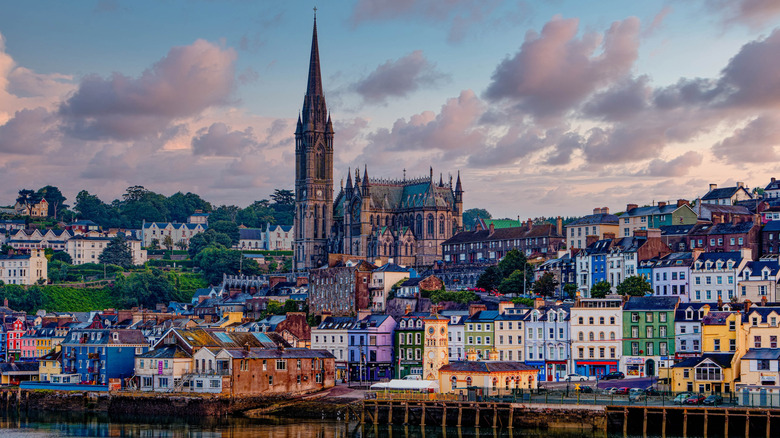
When the RMS Titanic set sail on its ill-fated maiden voyage across the Atlantic in April 1912, the last port of call was Queenstown in County Cork, a harbor town today known as Cobh (pronounced "cove") on the south coast of Ireland. The Titanic, at the time the largest seafaring vessel ever built, picked up 123 predominantly third-class passengers in Cobh, many seeking fresh beginnings on the other side of the pond. A few days later, it struck the iceberg, and the ship gradually flooded, then nose-dived for the ocean floor, killing 79 of those emigrants, a tragic event commemorated in Cobh through The Titanic Experience museum. There is, however, more to this charming seaside town than the ghosts of maritime past.
Though Cobh is small (its population is around 15,000), it's situated on one of the world's largest natural harbors, and many of its attractions — the Cobh Heritage Center, the Titanic Trail monument, the Five Foot Way coastal path — are along the waterfront, overlooking a bay that feeds boat traffic into the Celtic Sea and on to the Atlantic Ocean. Even the majestic St. Colman's Cathedral, with its marbled shrines and soaring Gothic arches, is just a short stroll from the coast.
Many small towns in Ireland are known for their colorful townscapes. Cobh is no different. A vertiginous street called West View, dubbed the "Deck of Cards," is a kaleidoscope of brightly painted terraced houses. Rising up the hill like a series of steps, or perhaps a precariously balanced house built of cards, it's a favorite spot of shutterbugs, who clamber to the top to take photos. With the turrets, bell tower, and central spire of the cathedral serving as the backdrop, it's admittedly one of the finest scenes in Cobh.
Finding the best coastal views in Cobh
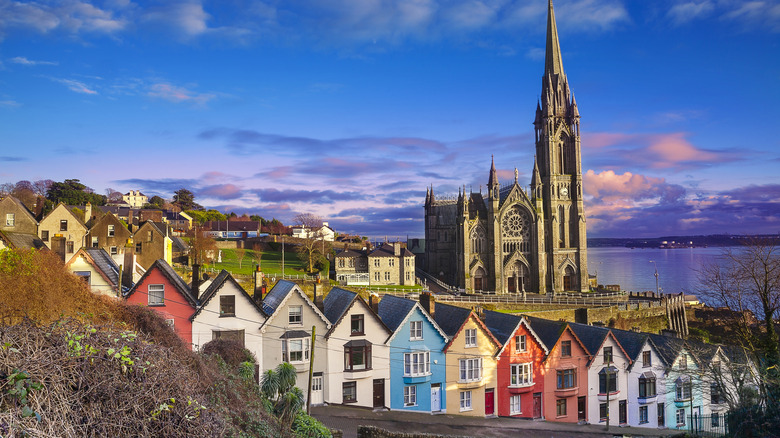
To get the best view of Cobh, march past the Deck of Cards to the top of West View, where a panorama opens up before you, bringing the polychromatic street, the ornate cathedral, the harbor and estuary, and Haulbowline and Spike islands into view. It's best appreciated on a bright day, when the sun illuminates the sea and enhances even the houses painted in dull shades of grey and brown.
The harbor offers its own panoply of seascape views, from the American Pier at one end of Cobh to the Titanic Memorial Garden at the other. The number of passengers boarding ships from Cobh peaked in the 19th century, when famine and deprivation caused many Irish to flee to America with dreams of finding a more prosperous life on the other side of the Atlantic. In the years since, many piers lining the harbor have fallen into states of disrepair. The American Pier, built over an old slipway in 1918, has also crumbled, despite a local campaign to restore it to its former glory. Nevertheless, you can still appreciate the view from here, looking across the bay to Haulbowline Island, used as a military base for more than 400 years. As they did in generations past, swimmers still take to the waters from the stone remnants of the pier.
To see Spike Island, with its ancient forts and dark prison cells, head eastwards along the coast and board the Spike Island ferry. This ship brings visitors to the island for a guided tour, covering the monks, imperialists, rebels, and prison riots that shaped the island's past. Alternatively, learn about Spike Island, the maritime history of Cobh, and the people who boarded history's most famous sunken vessel on the Titanic Trail walking tour.
Exploring St. Colman's Cathedral
There were more than 200 saints named Colman roaming through Ireland in the early centuries C.E., spreading the word of God to a previously pagan people. So it's easy for the story of one Colman, the size of his influence, the sheen of his legend, to become conflated with another's. That said, the cathedral in Cobh is said to honor Colman of Cloyne, a 6th-century bard in Aodh Caomh's court. Colman only became ordained at age 50 (some sources claim it was earlier), establishing the Church of Cloyne, becoming its first bishop and setting up more halls of worship across Ireland's deep south. The ruins of his namesake church, including a soaring stone round tower, are still visible in Cloyne, just a 25-minute drive from Cobh.
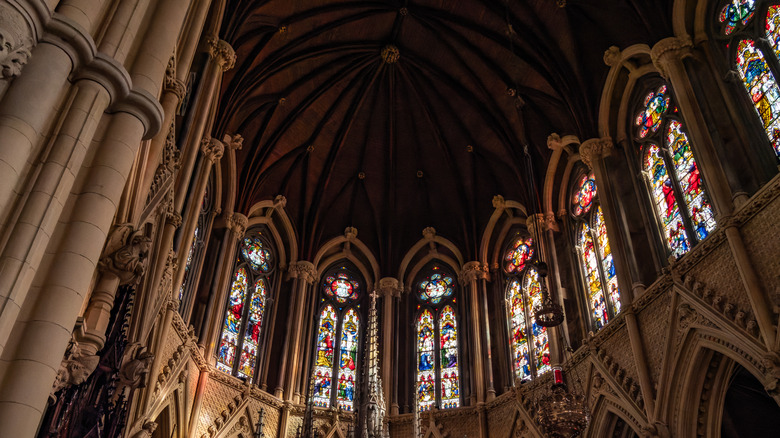
The Cobh church dedicated to Colman, St. Colman's Cathedral, is in much better condition. Construction began in 1868 and lasted nearly five decades. The cathedral is a wonderful example of neo-Gothic design, with its huge stained-glass windows, gargoyles and decorative exterior flourishes, a heavenly interior of pointed arches and red-marble columns, and a 320-foot spire housing a 49-bell carillon. The cathedral is open to visitors for daily Mass or private prayer — contact the St. Colman's parish office if you'd like to arrange a tour. On Sundays, the melodic clanging of the church bells can be heard throughout town.
Outside Ireland's major cities, you'd struggle to find a church with the gravitas of St. Colman's Cathedral. Cobh also makes a great bonus destination on Ireland's Wild Atlantic Way, one of the world's "longest defined coastal routes." The town is less than an hour from Kinsale, the terminal point on the southern section of the Way, and is handily located on the doorstep of Cork and its international airport. It's also about 90 minutes from the charming coastal surf destination of Clonakilty.