
Colorado's Only Active Volcano Is A 'Mysterious Anomaly In The Rockies' To Explore Under An Hour From Vail
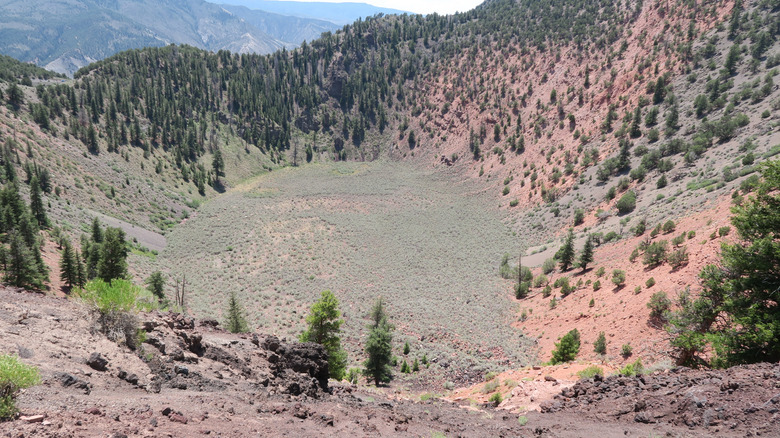
Millions of years ago, many parts of Colorado were a roiling, seething mass of ash clouds and lava rivers, straight out of an apocalyptic nightmare. Volcanic activity in places like the San Juan Mountains and the La Garita Caldera shaped much of Colorado's ski-friendly mountain peaks and river-carved valleys we see today. Since Colorado doesn't sit on a major, active fault line, the state's volcanic activity pretty much ended millions of years ago. However, there's one exception to that rule. The youngest of Colorado's volcanoes is still considered active and can be found just a 50-minute drive from Vail: Dotsero Crater.
Found near the small town of Dotsero near Glenwood Springs, Dotsero is the only active volcano in Colorado per the U.S. Geological Survey (USGS) Volcanic Threat Assessment. But "active" doesn't mean you can see lava flowing if you visit right this instant. Volcanoes are often classified into three categories, and they are considered "active" if they've erupted in the last 10,000 years and may erupt again in the future. "Dormant" is used if the volcano shows no signs of erupting now but could become active in the future, and "extinct" signifies there have been no eruptions for millions of years, with slim chances of the volcano becoming active again.
Most of Colorado's volcanoes are considered extinct, having ceased erupting hundreds of thousands or even millions of years ago. In contrast, Dotsero's last eruption was only 4,200 years ago, making it the youngest of Colorado's volcanoes by hundreds of thousands of years. Colorado Governor Jared Polis mentions in a Facebook post, "The rest of Colorado's volcanic activity ended over 20,000,000 years ago, and Dotsero remains a mysterious anomaly in the Rockies." Regardless of the mysteries surrounding its origins, the Dotsero Crater of today is a pretty, sagebrush-filled meadow with hiking and picnicking spots.
Exploring Dotsero Crater's volcanic past
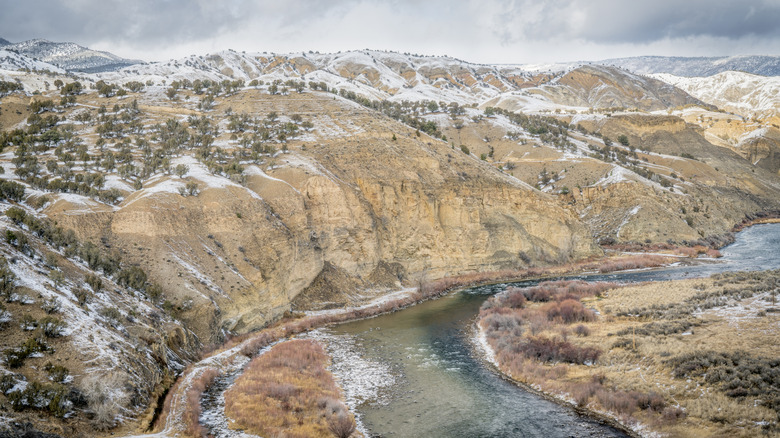
The Dotsero Crater may not be as massive as older Colorado calderas, but it's a peaceful spot for a bit of hiking or a family outing. The crater is almost 2,300 feet wide and just over 1,300 feet deep, making it much smaller than the massive La Garita caldera, which is miles long and large enough to hold entire towns — like the cliff-cradled town of Creede. Visitors can access the crater via a 2-mile out-and-back trail or enjoy a scenic picnic at the Bureau of Land Management Rec Site, which sits on the crater's rim and provides panoramic views of the mountains, as well as the Eagle and Colorado rivers. The Rec Site is accessible via a gravel road off Interstate 70, requiring a high-clearance, off-road vehicle.
The area around Dotsero Crater is mostly sparse mountainous territory dotted with pine trees — less exciting, perhaps, than volcanic crater sites at the otherworldly mountain spectacle of the Wheeler Geologic Area. However, exploring Dotsero is a great way to view relatively young geological formations, as remnants of the eruption 4,200 years ago are still visible nearby. According to geology and engineering professor Wendy Bohrson, Dotsero's eruption was a phreatomagmatic eruption, in which heated magma hits water before making its way out of the volcano, resulting in a massive explosion, where "the material just gets absolutely ripped apart" (via Colorado Public Radio News).
As a result, magma rocks, cinder cones, and fossilized lava flows are still visible around Dotsero. In fact, I-70 actually cuts through the lava bed from Dotsero's last eruption, and the magma under Dotsero is believed to provide the thermal energy for the nearby Iceland-like hot springs of Glenwood Springs.