
Quebec's Largest Artificial Lake Is A Secluded Paradise Filled With Endless Fishing Opportunities
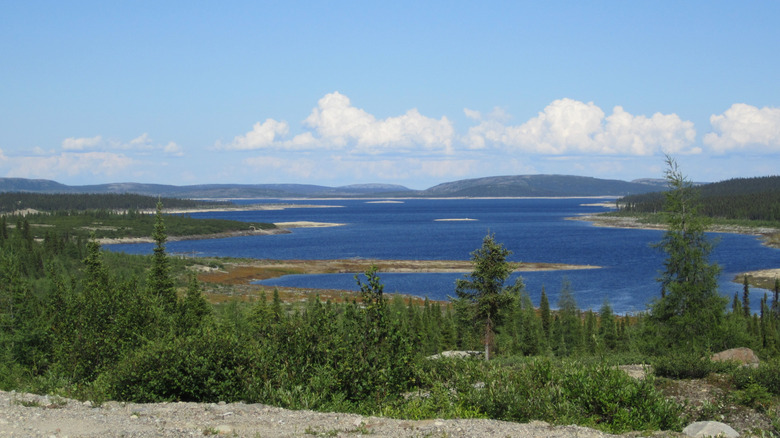
For travelers drawn to remote landscapes and big water fishing, there's a thrill in finding a lake far removed from vacation cottages and marinas. One of Canada's biggest, the Caniapiscau Reservoir, spreads so far that the opposite shore seems to dissolve into the distance. It sprawls across the boreal wilderness of northern Québec, where black spruce trees, muskeg, and rocky islands abound. A smattering of outfitters near the reservoir offer anglers opportunities to pursue trout, pike, and salmon, with seemingly endless space to cruise around and settle into a spot to cast a line in complete solitude.
Covering almost 1,700 square miles, it's the biggest body of water in Québec, according to Québec's Typonymy Commission — a serious title to have in the most lake-filled country in the world. For perspective, you could fit the city of Montréal nearly 12 times in Caniapiscau's surface area. It wasn't always this way, though. As part of the James Bay hydroelectric project, engineers built two dams and dozens of dikes to flood the land and create the reservoir. The water swallowed the rocky ground but left some higher hills poking above the surface, forming the reservoir's archipelago of around 300 islands.
It's worth noting that Caniapiscau Reservoir is very remote. It is reachable by car, but barely. The rugged Trans-Taiga Road that runs deep into northern Québec and connects to Caniapiscau has been called "the most remote road in North America" by the James Bay Road blog. Caniapiscau isn't a casual road trip. Driving the full Trans-Taiga Road from Radisson — the closest town, per James Bay Road — takes about eight hours, though some of the area's fishing camps require a seaplane or helicopter to reach. The effort will land you genuinely far from civilization, but that might be its allure.
Fish in the wild reaches of Caniapiscau Reservoir
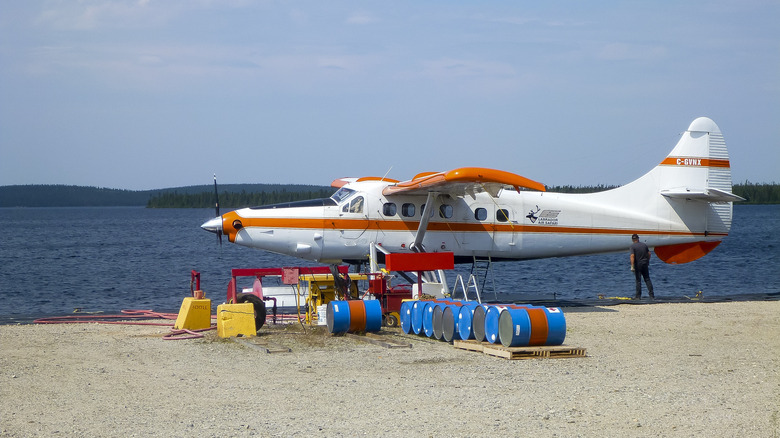
Caniapiscau Reservoir's maze of islands, bays, and forested shoreline make it an exciting destination for anglers willing to go the distance. The vast waterway supports lake trout, pike, speckled trout, and landlocked salmon, according to Bonjour Québec, the official tourism site of the Gouvernement du Québec. Caniapiscau is known for large, trophy catches — the outfitter Pourvoirie Ternay reports trout in the 15-to-25-pound range and northern pike reaching up to 20 pounds. Much of the fishing territory is accessed by boat, floatplane, or helicopter, and fishing camps provide cabins and boats. Note that Québec requires non-residents fishing north of the 52nd parallel — which includes Caniapiscau — to hire an outfitting service. In other words, making a fishing trip to Caniapiscau is much closer to an organized wilderness expedition than a casual afternoon of casting from the shore.
One outfitter is Les Aventures Jack Hume, which has base camps at the end of Trans-Taiga Road, just five minutes from the banks of the reservoir. The fishing package provides anglers with lodging at one of its three cabins, meals, and electricity. You can also take a floatplane from base camp to more remote spots for fly-out fishing. Another outfitter is Club Chambeaux, which has eight cabins by Caniapiscau. Its listed services also include charter seaplanes and helicopters, allowing anglers to reach its fishing territory by air.
There are many Québec lakes that are more accessible if you're not inclined to travel so far out. Closer to Montréal, for example, Lac-Simon is a serene lakeside destination with swimming and hiking. An alternative for anglers specifically is the Mastigouche Wildlife Reserve, a lush haven for fishing and boating.