
This Crucial Grand Canyon Warning From Park Rangers Is Way Too Often Ignored By Tourists
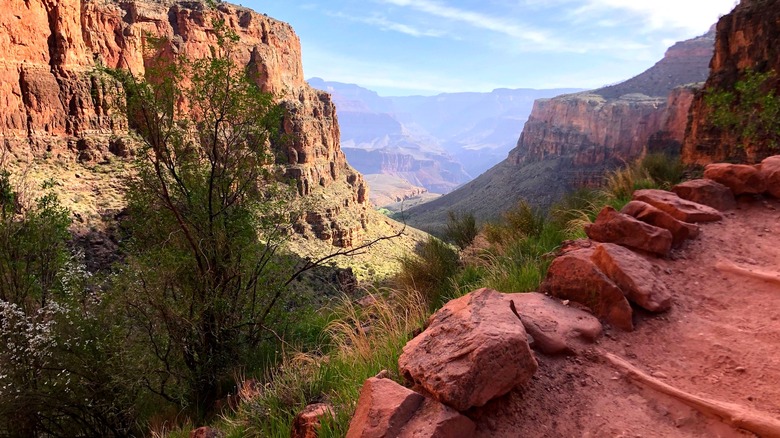
No one disputes that a hike from the rim to the river in the Grand Canyon's main corridor involves some truly daunting elevation gains. This is the exact reason why park rangers strongly recommend only doing it as an overnight. Climbing from the Colorado River to the South Rim along the park's most popular trail, Bright Angel, or the shorter and even steeper South Kaibab Trail, you'll gain about a vertical mile of elevation. That's the equivalent of four Empire State Buildings. Picture that effort, and you're likely imagining yourself bent over gasping at every turn on the lung-busting climb up.
Stop into the ranger station before a hike into the corridor, and park rangers will warn you of a surprising biomechanics fact: that hiking down a steep trail like those in the Grand Canyon corridor is actually a far greater physical challenge than hiking back up. While the uphill effort is where many hikers get into trouble due to heat exposure and dehydration, it's the downhill effort that punishes your joints and muscles — thus setting you up for an especially difficult climb out.
According to the Grand Canyon Visitor Center, "Sustained downhill walking loads the quadriceps eccentrically, meaning the muscle lengthens under tension rather than contracting. This type of loading produces delayed-onset muscle soreness more reliably than almost any other movement." This means that your muscles will already be blown before you begin your ascent back to the rim, right when you need them the most. By then it will be too late to modify your plan. As signs posted around the canyon trailheads warn, "Down is optional. Up is mandatory."
Hiking downhill in the Grand Canyon corridor
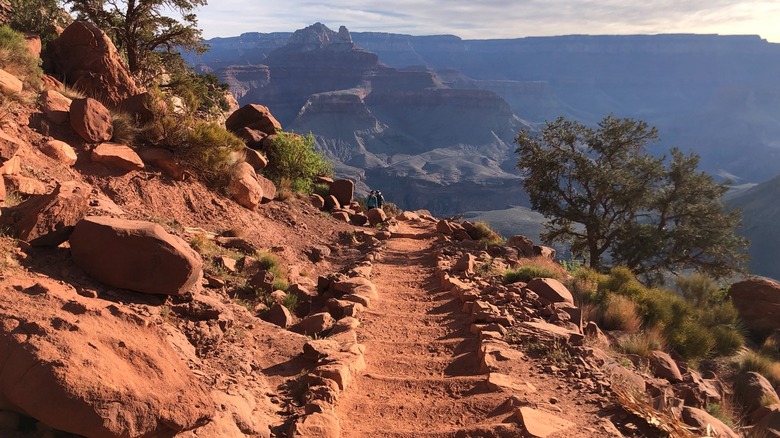
Many one-night backpacking trips into the Grand Canyon descend the stunning South Kaibab Trail to Phantom Ranch and return up Bright Angel Trail the next day. But much of the South Kaibab Trail, pitched at a 22% grade, is carved into steep, uneven stair steps, lined with rocks or logs.These are nothing like the stairmaster at the gym or the stairs in your house. The standard height of an architectural stair riser, according to most building codes, is 7 to 7.75 inches. South Kaibab Trail's steps can be more like 12 to 18 inches high, resulting in bruising, high-impact downward footfalls. One Redditor who has hiked the South Kaibab Trail "dozens" of times writes, "That downhill hike really beats people up, making the hike out particularly difficult. Be prepared to feel sore/exhausted the next two days. Plan on taking all day for the hike out."
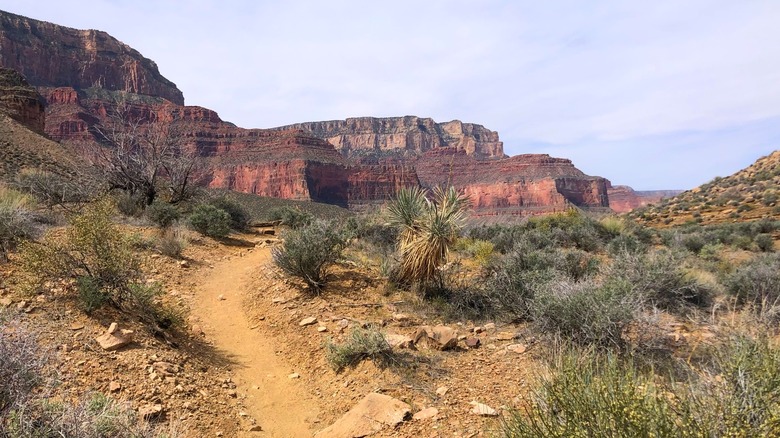
One clever way to experience all the awe and majesty of the Grand Canyon while limiting the total elevation gain and loss is to hike down South Kaibab to where it intersects with the cross-canyon Tonto Trail, then take that to Havasupai Gardens Campground. Spend the night there if you can snag a reservation, or have a long rest in the shade, then hike out in the late afternoon. This 13.8-mile route has an elevation change of just 3,400 feet — saving you 3.5 miles and 1,200 feet of elevation over a full rim-to-river-to-rim hike. Sure you'll miss the river, but there are other rewards. "The views from the Tonto Trail portion were so much more than I expected," writes one AllTrails reviewer who did it in a long day. "It wasn't just a connector between the two better known trails. It gave you a glimpse of the many different micro-environments within the canyon and also had amazing views of the sheer canyon walls." It's also important to take into consideration the best time to visit the Grand Canyon, as temperatures can reach up to 120 degrees Fahrenheit during the summer at the bottom of the canyon and snow often blankets the North Rim in winter, making hiking even more difficult.
Preparing to hike at the Grand Canyon
Wilderness Medicine Magazine recommends incorporating downhill hiking into your training routine beginning 4 to 6 weeks before your Grand Canyon hike to keep the delayed onset muscle soreness (DOMS) we all recognize from hard workouts at the gym from developing into the far more serious exercise-induced muscle damage (EIMD). Knee pain is common on these trails, but if you feel a searing pain on your outer thigh or on the outside of your knee, it is probably not the joint itself that is inflamed but your iliotibial (IT) band, the fascia that stretches from your hip to your knee. This is an especially common issue on steep downhills for people with sedentary day jobs. Healthline calls it "dead butt syndrome." If this sounds like you, start incorporating movement breaks into your workday. You can also prepare for your hike with some IT band strengthening exercises like those recommended by The Healthy Hiker.
Take a tip from veteran thru-hikers and stock up on "Vitamin I" before departing — that's "I" for ibuprofen, the NSAID of choice for relieving muscle pain on a hike. It does this by reducing inflammation. As a bonus, recent studies have shown that ibuprofen is also protective against altitude sickness, which can be an issue on the North Rim, especially if you're coming from sea-level. After your hike, if you happen to be heading west toward Las Vegas or California, you can hasten your healing and break up the long drive with a pit stop to take the 5-mile hike to ethereal Arizona Hot Springs on the Colorado River. Getting back on a short trail will keep your muscles from seizing up on the long car ride to come, and the hot mineral water will feel exquisite to your sore leg muscles.