
Baggage Handlers Aren't Always To Blame For Damaging Your Luggage
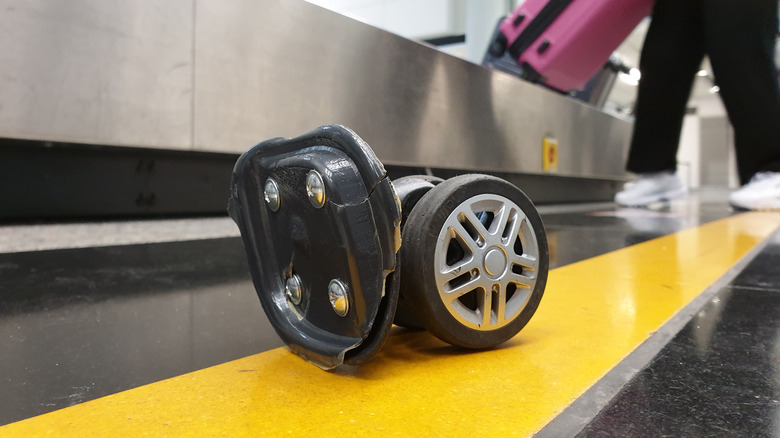
Virtually everyone who has traveled by air has either their own horror story or has heard of others being greeted by damaged luggage upon arrival at their destination. Most often, the blame for destroying luggage is placed on a single source — baggage handlers. However, rough as they may be (or appear to be), baggage handlers aren't always to blame for damaging your luggage. There are, in fact, a variety of reasons why your suitcase may get broken between the time you leave it at the check counter and when you see it again upon arrival. Unfortunately, some of these causes are unavoidable. However, others are completely within your control.
In general, the process of moving bags from the check counter to the plane, and ultimately to the luggage carousel, is rough. That's why you should never pack anything fragile in your checked bag; even with cautious baggage handlers, delicate objects, or your suitcase itself, can get damaged. Actually, much of the movement of checked bags, as well as the sorting, is handled not by humans, but by machines. These machines typically are not gentle — they move with speed and force. So, regardless of how gentle the human baggage handlers are with your luggage, it can still easily be damaged by the mechanical equipment.
Unfortunately, this part of the travel experience is unavoidable. Your checked bags will be handled by machinery at some point during the process. The only real option you have is to skip the bag check and pack everything into your carry-ons. But depending on your travels, this may not always be possible. Additionally, airline staff and even the equipment aren't always the reason your bags break. In fact, trying to stuff all of your items into a couple of carry-ons may actually exacerbate another common cause of damaged luggage.
Sometimes luggage damage is self-inflicted
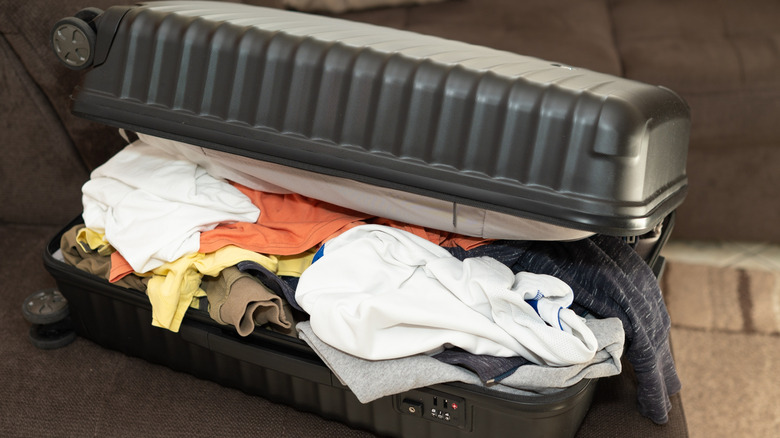
As much as travelers love to turn their ire towards baggage handlers and airport equipment when they discover their luggage has been damaged, sometimes the blame lies with the person who packed the bag. There are actually a couple of ways in which travelers can end up being responsible for the demise of their own luggage. One is simply trying to squeeze too much stuff into your suitcase. The other is not making a good choice when it comes to selecting your checked bag.
Overpacking is a common mistake you'll want to avoid with your luggage when getting your bag ready for checking. When the weight and bulk of the items stuffed inside your bag become excessive, the stress and strain on wheels, handles, and zippers may exceed their limits. Although the bag might make it to the check counter intact with your cautious guidance, once it gets bounced around by baggage handlers or machinery, or has additional bags stacked on top of it, your luggage could easily burst or break. Additionally, the heavier the bag, the more difficult it is for baggage handlers to manage, meaning the likelihood of it being dropped or banged around increases.
Sometimes, the bag itself is the problem. Poorly-made or old luggage is far more apt to break than newer, high-quality suitcases. This pertains to both hard- and soft-sided luggage. Inexpensive models typically don't utilize stout components, such as zippers, wheels, and handles, which leads to more breakage. Additionally, lower-quality shells on hard luggage and lighter fabric on soft bags can break or tear more easily. Additionally, regardless of the quality of the bag, if it's old or well-worn, it is more likely to be damaged and should be replaced.