
What Do Yellow And Black Striped Buoys Mean In Canadian Waters?
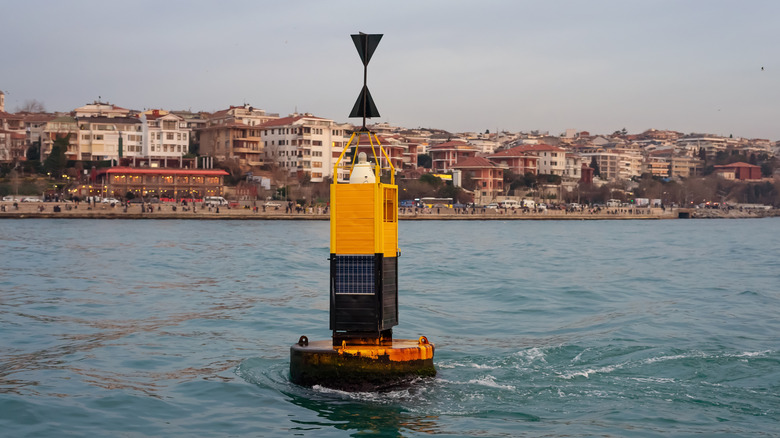
As is the case throughout the world, boaters in Canadian waters often encounter buoys of various shapes, sizes, colors, and patterns. Understanding what each buoy means and knowing which action should be taken is paramount to safe boating. To that end, the International Organization for Marine Aids to Navigation (IALA) has developed an international buoyage system with regional variations so that mariners from all countries around the globe can recognize the navigational aids. However, many American boaters may not be familiar with the yellow and black striped buoys seen in Canadian waters. So, what do these buoys mean? Their purpose is to point mariners to safe water.
Like all navigational aids, yellow and black striped buoys are giving directions. In fact, these buoys are referencing the cardinal directions – north, south, east, and west. However, yellow and black striped buoys are not a floating compass. Rather, they tell mariners which direction they should pass in order to reach or remain in safe water. It is important to note that unlike green and red channel marker buoys, which tell you which side of your boat to leave the buoy on, cardinal markers indicate which side of the buoy your boat should pass on. Therefore, if you see a cardinal buoy indicating south, that means your boat should pass to the south of the buoy in order to remain in safe water.
Colors and shapes indicate cardinal buoy directions
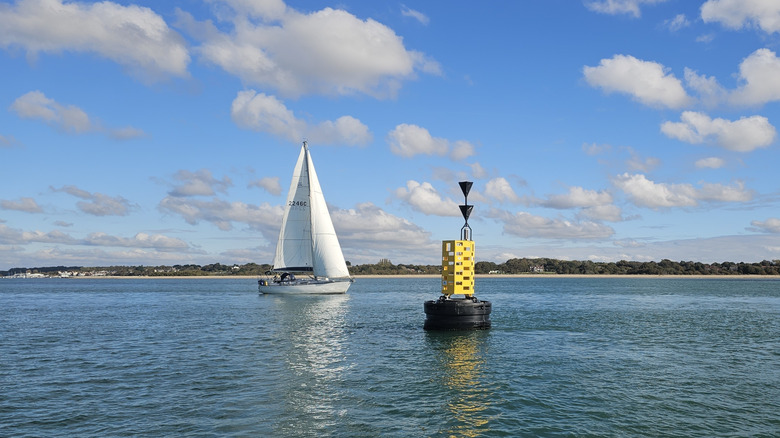
The next thing to know about cardinal buoys is that there is more than one type. That is because in order to show four different directions, it is necessary to have four different buoys. With that in mind, it is also important to note that four different combinations of color schemes, day shapes, and lights are utilized to differentiate between each cardinal direction.
Cardinal buoys indicating safe water to the north have a black top band and yellow lower band. When fitted, their topmarks are two black cones pointed up, and their lights flash white continuously at a quick or very quick rate. South cardinal buoys are opposite – yellow over black, with two black cones facing down when fitted. If lighted, they show six quick or very quick white flashes followed by one long flash. Buoys designating safe water to the east are black with a yellow band and, when fitted, two black cones with their bases facing each other. If lighted, they show groups of three quick or very quick white flashes. West cardinal buoys are yellow with a black band and, when fitted, two black cones with their points facing each other. If lighted, they show groups of nine quick or very quick white flashes.
Whether you're boating on Great Slave Lake, North America's deepest lake, or around the Discovery Islands, Canada's secret island archipelago, familiarize yourself with the local navigational aids before setting out. It should be pointed out that cardinal buoys aren't just a Canadian thing. They are part of the IALA's international buoyage system. However, if you're planning a bucket list-worthy American boating trip, note that yellow and black cardinal buoys are not used in the U.S. Coast Guard's aids-to-navigation system. You may encounter them if your route includes Canadian waters.